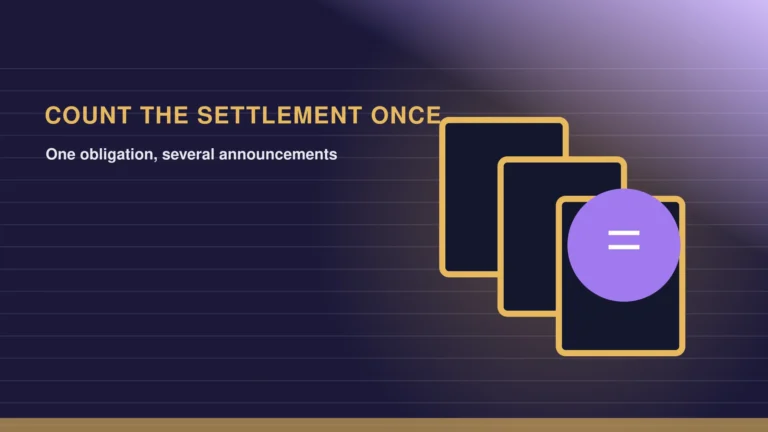
A stablecoin that appears on three chains can represent one issuer liability or several different promises. Adding all token balances without classifying issuer-native circulation, bridge escrow and destination claims risks presenting the same economic dollar multiple times. The market-share graph looks stronger than the reserve base has actually become.
Heath Muchena · Decentralised News · Reviewed 23 November 2026 · 2027 editorial edition · Crypto Trading
What Matters
Reconcile legal claims and backing first. Only then aggregate supply, and never confuse a bridged claim with a fresh issuer obligation.
The signal: Evidence, units and contractual scope decide whether an apparently precise result can be trusted. We separate documented facts, illustrative scenarios and unresolved questions.
The decision that conventional coverage misses
A stablecoin that appears on three chains can represent one issuer liability or several different promises. Adding all token balances without classifying issuer-native circulation, bridge escrow and destination claims risks presenting the same economic dollar multiple times. The market-share graph looks stronger than the reserve base has actually become.
For a reader building a company, using an AI agent or evaluating a financial platform, the useful question is not whether the marketing story sounds impressive. It is what decision changes after the hidden unit, party, right or obligation is identified. This is the reason Decentralised News publishes an inspectable instrument alongside the article, rather than relying on a product score that cannot be reproduced.
We do not claim to have independently audited every institution in this market. The factual boundary of each source is identified below. All examples can be changed by the reader; none is presented as an observed provider performance metric.
The accounting identity
Native issuance creates a liability of the issuer under the applicable terms. A lock-and-mint bridge can immobilize an existing token and mint a wrapped representation elsewhere. That second token is a claim on the locked source token, not necessarily another direct claim on the original stablecoin issuer. If you add source custody balances and bridged copies indiscriminately, the total can grow even when users have not acquired a single additional dollar of economic backing.
Native and bridged are different products
Circle’s published network announcements distinguish native USDC issued by Circle from third-party bridged versions with separate contracts and names. A label that resembles USDC is not sufficient evidence of issuer redemption rights. Examine the source-chain asset, bridge operator, lock/mint process, administrator, token contract and redemption route. Some bridging mechanisms burn on one chain and mint natively on another; their supply accounting differs from escrow-backed wrapper systems.
Define the population
Decide whether the metric is issuer liabilities, circulating claims, wallets holding dollar-denominated tokens, or the gross inventory of all token contracts bearing a stablecoin label. Each definition can be useful, but they are not interchangeable. An issuer-supply chart should not include independently issued synthetic dollars as if they were bank-reserve-backed tokens of the same issuer.
A three-stage register
Stage one records chain, contract, issuer, token type and direct redemption terms. Stage two records source escrow balance, wrapped representation and bridge proof, ideally at the same block timestamp or clearly reconciled observation windows. Stage three identifies whether a figure is a stock snapshot or a transfer flow. A bridge deposit is an event; a circulating supply measure is a stock. Summing the two is a dimensional error.
The bridge can break without the issuer failing
Even if a source stablecoin remains redeemable, a bridge can stop withdrawals, be exploited or issue more claims than escrowed tokens. That produces basis risk and additional counterparty or code risk. A double-counting adjustment is not a recommendation to disregard wrapped token holders. Their claims remain economically important, but should be presented separately from native issuer liabilities.
The dangerous dashboard shortcut
Data providers may label asset categories differently and revise supported-chain mappings. An analyst who merges feeds on ticker symbol alone can quietly put a wrapped product in the issuer’s category. Preserve provider identifiers, contract addresses, timestamps and a documented bridge mapping; stop the aggregation if the asset lineage cannot be resolved.
How to interpret the tool
The scenario compares a declared native issuer stock with one wrapped balance and escrowed backing. It assumes the supplied wrapped amount is backed by part of the already included native stock. It does not crawl chains or validate any live reserve balances; the output is an illustration of why an apparent supply increase may be duplicative.
DN decision instrument: One Dollar, Several Chains
Change the illustrative inputs, calculate the result, and export a local JSON record for your own working papers. The form runs in your browser without contacting an external service.
The export is an input record, not an official verification receipt. Recompute against authoritative evidence before relying on an actual decision.
DN methodology and limitations
Scope: this analysis addresses reconcile legal claims and backing first. only then aggregate supply, and never confuse a bridged claim with a fresh issuer obligation.
Evidence hierarchy: primary regulator, issuer, standard-setter or payment-provider documentation outranks promotional copy; the original contractual or technical record outranks a secondary interpretation. Where claims cannot be independently verified, they remain questions. The article is updated from information available on 23 November 2026. References to 2027 indicate forward-looking decision frameworks, not future observations.
Reproducibility: the calculator uses visible arithmetic or document-status logic, user-supplied values and explicit constraints. It neither connects to wallets nor sends transactions. Downloaded input records are not independently audited datasets. Legal, regulatory, accounting and investment decisions require the governing records and relevant professional judgment.
Editorial separation: there are no product rankings, disguised sponsored endorsements or invented real-world measurements in this piece. Any adjacent DN guide linked below is for methodological context; it is not evidence of the claims made in the external sources.
Primary sources and companion records
- Circle native and bridged USDC distinction
- DN dry powder index
- DN cross-chain market integrity companion
Source documents are linked for independent verification. Publication or website content may subsequently change; preserve the original edition date and consult updated official documentation when applying these rules to live transactions.
Frequently asked questions
Does this article describe a verified 2027 event?
No. The 2027 date identifies the planning edition. Facts are grounded in published sources available by 23 November 2026; user-entered examples are hypothetical.
Does the calculator use live financial, regulatory or market data?
No. It is a deterministic local illustrative model. Inputs are supplied by the reader and no external account or live platform is queried.
When should a reader stop and request additional evidence?
When identity, scope, contract terms, dates, source provenance or rights needed for the decision remain unresolved. A plausible numerical output never substitutes for that missing evidence.
DN Alpha Thesis
Reconcile legal claims and backing first. Only then aggregate supply, and never confuse a bridged claim with a fresh issuer obligation. The durable advantage is not a prediction about 2027. It is having enough source-linked evidence to understand which answer would change when a document, price, contract or input changes.
Disclosure: educational research. No financial product is being recommended. Calculators are deterministic illustrations, not investment, legal or tax opinions.
About the Author