What Matters
A fully automated crypto portfolio should not mean one agent can read every account, trade every asset, move every token and rewrite its own risk rules. The safer architecture divides observation, recommendation, execution, custody, tax and incident response into separate authority layers. Automation should make the portfolio easier to govern, not harder to reconstruct.
DN Evidence Block
Reviewed: 17 November 2026. Evidence base: current exchange API permission models, Safe policy controls, portfolio and tax API documentation, DN’s agent-permission, observability, DCA, staking and tax research.
Boundary: this is an operating blueprint, not a recommended asset allocation. Product support, tax treatment and exchange availability vary by country. A user should define the mandate before connecting execution tools.
The Portfolio Agent Is a System of Systems
The outline’s search intent is valuable: users want one workflow that can track balances, buy periodically, rebalance, interact with DeFi, handle records and move money to cold storage or a bank. The mistake is treating those tasks as one permission set.
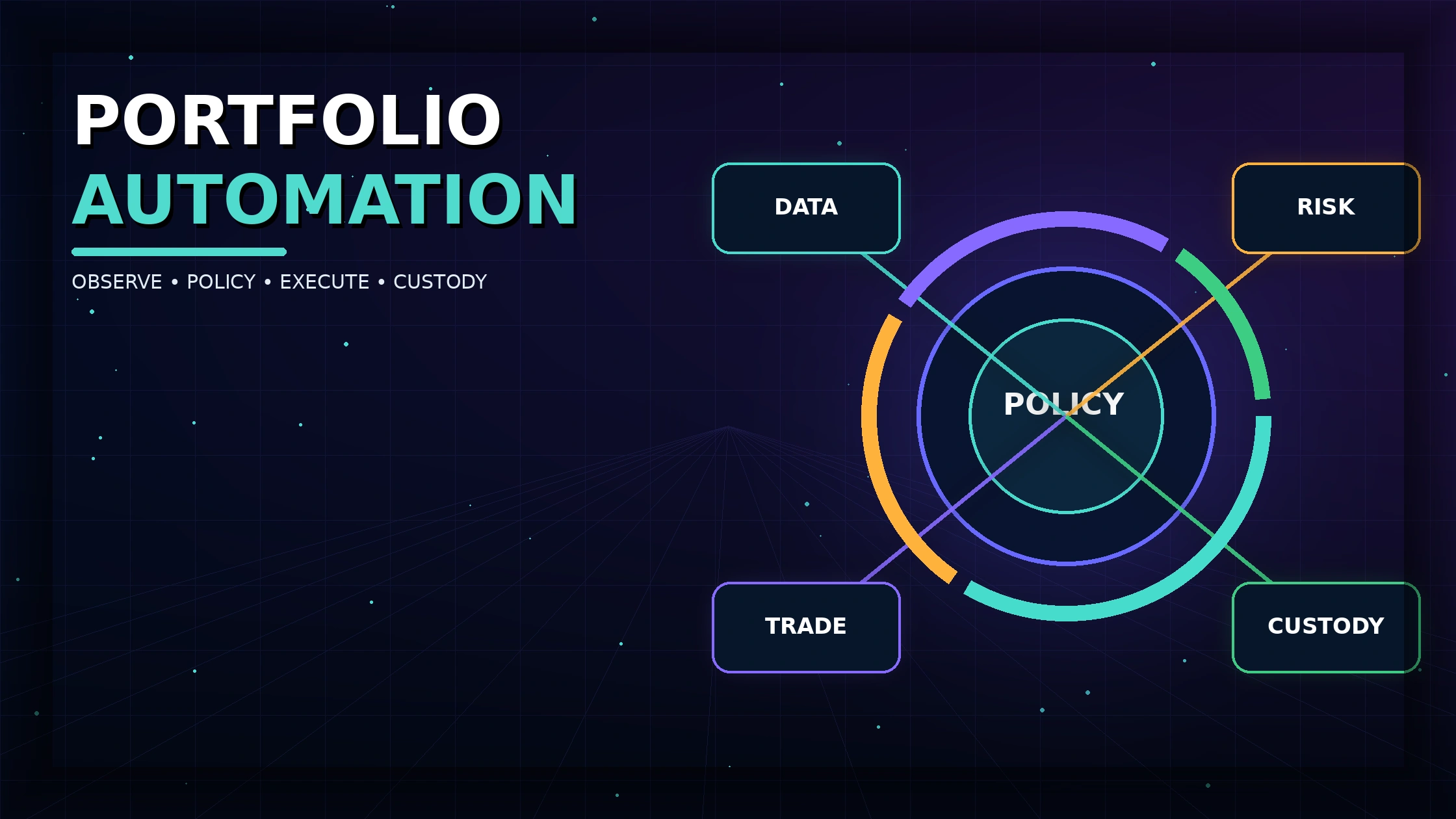
A robust portfolio architecture has at least four trust zones:
- Observation zone: read-only exchange, wallet, protocol and market data.
- Policy zone: target allocations, eligible assets, risk limits and tax rules owned by the user.
- Execution zone: narrow keys or smart-account permissions for specific actions.
- Custody zone: multisig or cold-storage authority that the agent cannot unilaterally override.
The Nine-Step Blueprint
| Step | Agent job | Required control | Evidence retained |
|---|---|---|---|
| 1. Inventory accounts | Read balances, positions, debts and pending transactions | Read-only credentials and address allowlist | Source, timestamp and account identifier |
| 2. Define the mandate | Compare state with target allocations and exclusions | User-owned policy version | Targets, ranges, caps and approver |
| 3. Automate contributions | Execute capped DCA or cash deployment | Periodic and total capital limits | Funding source, order and fee |
| 4. Rebalance selectively | Prepare trades when drift exceeds bands | Minimum economic size and turnover cap | Pre/post allocation and execution cost |
| 5. Manage yield exposure | Monitor staking, lending and vault positions | Protocol allowlist and no automatic APY chasing | Contract, chain, rate, liquidity and risk event |
| 6. Separate custody | Stage sweeps to approved wallets | Destination allowlist and human signing | Transfer ID and resulting balance |
| 7. Manage liquidity | Maintain cash and planned off-ramp buffer | Minimum liquid reserve | Available—not merely accounting—liquidity |
| 8. Reconcile tax records | Classify transfers and flag missing basis | No silent assumptions | Transaction lineage and exception queue |
| 9. Stop and recover | Pause after control, data or market failures | Independent kill switch and credential revocation | Incident timeline and final positions |
1. Build a Complete, Read-Only Inventory
Start with read access. The system should identify every exchange account, wallet, DeFi position, debt, staked asset and pending withdrawal. It should distinguish native assets from wrapped or bridged representations and keep source timestamps.
Portfolio APIs can simplify aggregation, but their output must reconcile to source accounts. DN’s Crypto Data API guide explains why entity identifiers, credit limits and stale data matter.
2. Write the Mandate Before the Rules
The mandate defines eligible assets, maximum exposure, minimum cash, prohibited leverage, permitted chains, custody destinations and review frequency. The agent may calculate drift, but it should not add a token because social sentiment changed or a yield dashboard ranked it highly.
Every policy change needs a version, date and owner. Otherwise, a post-trade review cannot tell whether the system violated the rule or the rule changed silently.
3. Automate Contributions With a Hard Capital Cap
DCA can be automated using a fixed amount and interval. An adaptive plan needs additional evidence and should never become unlimited martingale buying. Use the framework in DN’s AI DCA Automation in Falling Markets.
The contribution agent should only access the intended funding account and investment subaccount. It should not be able to borrow, transfer unrelated assets or raise the monthly cap.
4. Rebalance Only When the Benefit Exceeds the Cost
Rebalancing should use tolerance bands rather than constant trading. Before executing, calculate fee, spread, slippage, tax consequences, withdrawal cost and the effect on risk. A 1% allocation drift may not justify a taxable trade.
Set a minimum order size, maximum monthly turnover and cooldown period. The system should prepare a proposed trade list that a human can approve when the change is material.
5. Treat Yield as a Separate Risk Budget
Staking, lending and liquidity provision introduce smart-contract, slashing, oracle, queue and liquidity risks. The portfolio agent should monitor these positions without automatically moving to the highest rate. Link the rules to DN’s Staking Automation and Automated DeFi Lending frameworks.
6. Keep Custody Outside the Trading Brain
An exchange bot may trade inside a dedicated subaccount. It should not control long-term storage. Sweeps should go only to approved addresses and require a separate signer or multisig. A hardware wallet can reduce online-key exposure, but recovery and transaction verification remain human responsibilities.
DN has affiliate relationships with Ledger and OneKey. Choose based on signing clarity, recovery and supported assets rather than the link.
7. Maintain a Liquidity Floor
Portfolio value can be high while available cash is low. Staked assets may have exit queues; lending positions may lack withdrawal liquidity; bridges may be delayed. Define a minimum reserve in a custody and asset form appropriate to the user’s obligations.
Cash-out automation should prepare rather than blindly send large withdrawals. Bank details, destination addresses and tax records deserve separate confirmation.
8. Reconcile Every Transaction for Tax and Audit
Tax software can import exchange and wallet records, but bridges, internal transfers, DeFi receipts and bot activity often need classification. The agent should flag missing cost basis and unmatched transfers instead of inventing values.
DN has current affiliate relationships with Koinly and CoinLedger. See DN’s Crypto Tax Automation framework for record-level controls.
9. Design the Kill Switch Before Live Execution
The incident plan should revoke exchange keys, disable smart-account modules, cancel orders, pause strategies and preserve evidence. It must work without the model or third-party vendor. DN’s Agent Observability article defines the minimum trace and outcome data.
DN Rule
No single agent should be able to change the investment mandate, execute unrestricted trades and move funds to new destinations. Separate recommendation, trading, custody and policy authority.
DN Portfolio Automation Authority Test
Score the proposed architecture. Higher scores indicate that too much authority is concentrated in the same workflow.
Worked Architecture
A user aggregates exchange and wallet balances through read-only APIs. A policy engine calculates allocation drift. A separate execution service can place spot trades only on a small subaccount and cannot withdraw. DeFi actions are prepared but require multisig approval. Long-term assets remain in cold storage. Koinly or CoinLedger receives transaction records, while unmatched transfers enter a review queue.
This architecture is less convenient than one omnipotent agent, but failures are easier to isolate and investigate.
Commercial Paths and Disclosure
Relevant tools in DN’s current affiliate set include CoinStats for portfolio and API workflows, 3Commas and Pionex for automation, and the custody and tax tools linked above. No single product covers the entire blueprint safely.
Do Not Give One Agent the Entire Portfolio
A robust portfolio system separates observation, trading, custody and cash movement. The same agent that recommends a rebalance should not automatically hold unrestricted withdrawal authority, move long-term reserves and decide tax treatment. Concentrating every permission in one process creates a single point of failure.
| Account layer | Purpose | Typical authority | Risk boundary |
|---|---|---|---|
| Read-only aggregation | Balances, prices, positions and performance | Read APIs and public-chain data | No order, transfer or signing permission |
| Trading subaccount | DCA, rebalancing and approved strategies | Trade only; no withdrawals | Balance and instrument limits |
| DeFi execution wallet | Allowlisted onchain actions | Session or policy-limited signing | Contract, asset, amount and time caps |
| Reserve custody | Long-term holdings and emergency capital | Human or multisig approval | Not directly controlled by the portfolio agent |
This structure allows the agent to remain useful even when its authority is narrow. It can calculate the target, prepare the orders, explain the differences and produce a signed decision record without being able to drain every account.
Use Target Bands, Not Constant Rebalancing
Rebalancing on every small price movement creates fees, spread, tax events and unnecessary turnover. A no-trade band defines a range around each target weight. The agent acts only when the allocation moves outside the band and the expected benefit exceeds the execution cost.
For example, a 40% target may have a permitted range of 35% to 45%. A move to 42% requires no action. A move to 48% creates a proposed rebalance, but the agent still checks fees, market depth, tax-lot consequences and account restrictions before execution. The target, band and maximum turnover should be stored in a versioned policy.
Cash, Stablecoins and the Reinvestment Trap
An automated portfolio should not assume every idle balance must be invested. Cash or a reserve asset can fund withdrawals, taxes, emergencies and future scheduled purchases. Automatically routing all unallocated capital into yield products can make the portfolio less liquid precisely when the user needs flexibility.
Define a minimum reserve, approved reserve assets, where they may be held and whether the agent can earn yield on them. The policy should distinguish bank cash, exchange balances, fiat-backed stablecoins, overcollateralized assets and synthetic dollars rather than treating them as interchangeable.
Custody Sweeps Need a Separate Workflow
Moving accumulated assets to self-custody can reduce exchange exposure, but the workflow must verify the destination address, network, token contract, minimum amount, withdrawal fee and arrival. A purchase is not complete merely because the exchange accepted the withdrawal request.
- Use allowlisted destinations and a separate approval path for changes.
- Test new addresses with a small transfer before larger sweeps.
- Reconcile the destination balance and transaction status.
- Record whether a transfer was internal, a disposal or an unknown movement.
- Pause when an exchange changes withdrawal networks or token representations.
Portfolio Automation Needs an Evidence Ledger
Every decision should be reconstructable. Preserve the data snapshot, target allocation, policy version, proposed trades, expected fees, approval, order IDs, fills, transfers, resulting balances and exception notes. If a model supplied a narrative or risk score, store the source evidence and model version rather than only the final recommendation.
This ledger separates strategy performance from execution quality. A portfolio can miss its target because the policy was wrong, the data was stale, the order was partially filled, the transfer failed or the user overrode the proposal. Without lineage, all of those failures look like “the AI underperformed.”
Incident Response for an Automated Portfolio
- Pause new orders, withdrawals and contract approvals.
- Revoke affected API keys, sessions and delegated permissions.
- Export open orders, fills, wallet activity and policy changes.
- Reconcile every account against the last trusted snapshot.
- Identify whether the incident came from data, model, policy, execution, custody or operator access.
- Restore authority gradually using new credentials and a small test balance.
The emergency path should be usable without the agent. If the user needs the compromised system in order to revoke the compromised system, the architecture has failed.
Worked Example: Bounded Monthly Rebalance
A portfolio targets 50% Bitcoin, 20% Ether, 15% stablecoin reserve and 15% diversified high-risk assets. The trading subaccount holds only the amount needed for the next month. The agent reads the full portfolio but can trade only the subaccount and only approved pairs. It proposes action when an allocation leaves its band, estimates costs, and stops if daily turnover would exceed five percent of total portfolio value.
Long-term assets remain in reserve custody. The agent can prepare a sweep request after a minimum balance is reached, but a separate approval signs it. Tax software receives transaction and transfer records through read-only connections. This structure preserves automation benefits while limiting the capital and authority exposed to one failure.
Related DN Research
- AI Agent Transaction Permission Risk Index 2027 — how authority changes when an agent can read, trade, transfer or sign.
- Crypto Portfolio Margin Efficiency Benchmark 2027 — why collateral efficiency and liquidation risk must be evaluated together.
- Koinly vs CoinLedger for Bot Traders — tax-record implications of automated, high-frequency activity.
- AI Agent Wallet Key Security — custody, recovery and signing boundaries.
The Portfolio Authority Graph
A portfolio agent should be designed as an authority graph rather than one all-powerful assistant. Separate the data reader, policy evaluator, trade proposer, execution service, custody signer and recordkeeping process. Each component should have only the permissions needed for its own job.
| Component | Minimum authority | What it should not control |
|---|---|---|
| Portfolio reader | Read-only balances, positions, prices and transaction history | Trading, withdrawals or policy changes |
| Policy engine | Versioned allocation, risk and liquidity rules | Credentials or unilateral execution |
| Trade proposer | Quotes, simulations and proposed order payloads | Cold-storage keys or withdrawal destinations |
| Execution service | Allowlisted venues, assets, order types and amount caps | Changing its own limits or adding new venues |
| Custody signer | Independent approval for transfers and high-impact actions | Portfolio strategy generation |
| Record service | Immutable receipts, policy versions and reconciliation results | Editing prior evidence without an audit trail |
This structure makes it possible to replace a model, data provider or execution venue without silently changing the mandate. It also limits the blast radius when one credential or service fails.
Data Normalization Before Any Portfolio Decision
Crypto portfolios often contain duplicated and inconsistent records: the same transfer can appear in an exchange export, a wallet indexer and a tax platform; wrapped assets may use different identifiers; DeFi receipts can look like new assets even when they represent an existing claim. The agent should reconcile identifiers, chain, contract address, decimals, timestamp, ownership and transaction status before calculating allocation.
Mark each value with a source and freshness timestamp. A position should not be rebalanced using a current exchange price paired with an old wallet balance or a stale protocol withdrawal estimate. Where sources disagree, the system should flag the discrepancy instead of averaging it away.
Rebalancing Without Creating a Turnover Machine
A good policy uses tolerance bands, minimum economic size and a turnover budget. If a target allocation is 25 percent, the agent might act only outside a documented band such as 20–30 percent and only when the expected benefit exceeds fees, spread, slippage and tax friction. The exact thresholds belong to the user’s mandate, not to a generic model.
Rebalancing frequency should reflect the purpose of the portfolio. A long-horizon allocation usually does not need minute-by-minute optimization. Excessive trading can increase costs, taxes and security exposure without improving the intended risk profile.
Liquidity and Cash-Out Layer
Portfolio value is not the same as accessible cash. Track withdrawal queues, bridge finality, exchange maintenance, stablecoin redemption, bank settlement and local-currency spread. An agent preparing a monthly cash-out should identify the source asset, venue, conversion path, expected fees, destination account and evidence needed for tax and accounting records.
Cash-out authority should be narrower than trade authority. Use allowlisted bank or wallet destinations, per-period caps and a second approval for unusual amounts. A successful sell order is only one stage; the workflow should confirm the fiat or stablecoin destination received the expected amount.
Worked Portfolio Example
Consider a portfolio with 45 percent Bitcoin, 25 percent Ether, 15 percent stablecoins, 10 percent DeFi positions and 5 percent other assets. The policy allows a rebalance only when a major sleeve moves more than five percentage points outside target, the proposed order exceeds the economic-size threshold, and the trade remains inside the monthly turnover cap.
The reader detects Ether at 33 percent after a price move. The policy engine proposes selling part of the excess into the stablecoin sleeve. Before execution, the system checks venue availability, quote depth, fees, tax-lot data and the stablecoin’s eligibility. A human approves the first live transaction. The execution service submits the capped order, then the record service reconciles the fill, new balances and tax lot. The custody layer is never asked to expose a withdrawal key.
Change-Control Cycle
Review the mandate on a scheduled cycle and after material events. A change to eligible assets, venues, leverage, custody, tax residence or cash-out destination should create a new policy version. Existing agents should not inherit a changed mandate through an informal chat instruction.
Maintain a rollback path to the last approved policy and test it before deployment. If the system cannot explain which version governed a trade, the portfolio is not auditable.
Methodology and Limitations
DN evaluated portfolio automation by data completeness, mandate ownership, capital controls, execution cost, custody separation, liquidity, tax lineage and recoverability. We did not recommend allocations or test future returns. Software integrations can change, and regulatory or tax treatment depends on jurisdiction.
Frequently Asked Questions
Can one agent manage my entire portfolio?
Technically yes, but concentrating read, trade, custody and policy authority creates a large blast radius.
Should a rebalancing bot trade every drift?
No. Use bands, minimum economic size and turnover limits.
Can the agent move assets to cold storage automatically?
Prefer transaction preparation or allowlisted capped sweeps with separate signing.
How should DeFi positions be included?
Track contract, chain, token representation, liquidity, debt, queue and risk events—not only displayed value.
What is the safest first automation?
Read-only portfolio aggregation, alerts and a proposed rebalancing report.
Primary Sources
- Kraken API Key Security
- OKX API FAQ
- Bitget API permissions
- Safe Spending Limits
- Safe Spending Limits and Proposer Role
Commercial disclosure: DN may earn compensation from the affiliate links above. No tool paid for inclusion or editorial treatment.
About the Author