Deribit vs OKX vs Bybit: Which Exchange Is Built for Options Bots?
Best Crypto Exchanges for Automated Options Trading in 2027
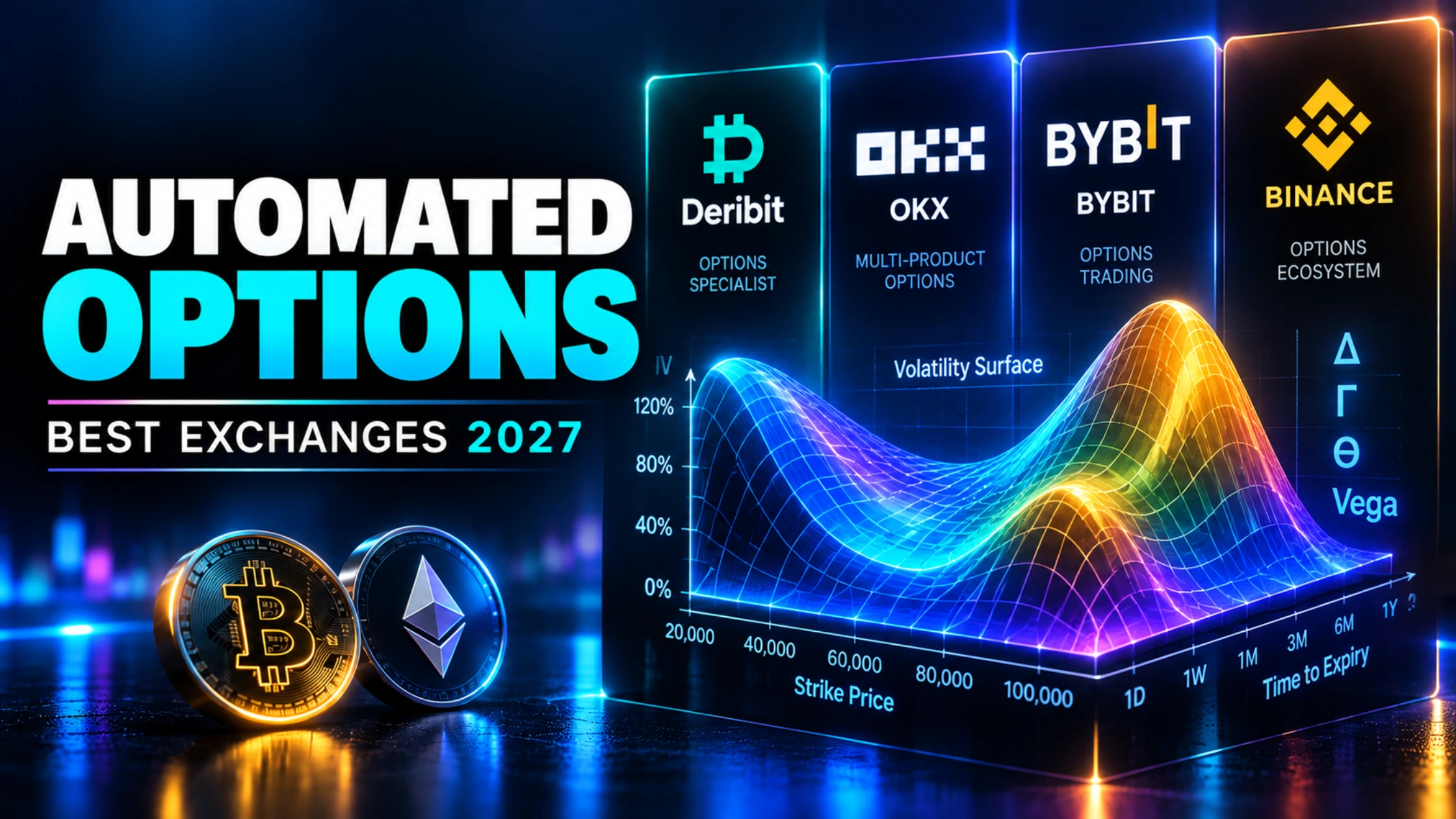
Automated crypto options trading requires more than a fast order endpoint. The strongest venues combine option-chain data, Greeks, reliable order-state feeds, portfolio margin, quote protection, block or RFQ workflows and safe testing infrastructure. The DN Options Automation Readiness Score compares the venues that expose the most useful building blocks for systematic options strategies.
Last verified: 23 September 2026 • Benchmark year: 2027 • Framework: DN Options Automation Readiness v1.0
Deribit currently has the strongest specialist infrastructure for automated crypto options in the DN model, particularly for volatility trading, market making and block execution. OKX and Bybit are stronger fits for traders who want options inside broader portfolio-margin ecosystems. Binance offers a capable options API with IV and Greeks, while Gate and Aevo provide useful alternatives with different execution and custody trade-offs.
DN Evidence Block
- Deribit supports JSON-RPC over WebSocket and HTTP, FIX, independent test and production environments and native Block RFQ workflows.
- OKX exposes option Market Maker Protection in Portfolio Margin mode and programmable order-management infrastructure.
- Bybit V5 supports options inside its unified API, portfolio margin, option-specific MMP and batch option orders.
- Binance Options exposes mark IV plus delta, gamma, theta and vega through its market-data API.
- Gate publishes option market data, Greeks and option order/cancel rate limits of up to 200 requests per second.
- Aevo maintains a Python SDK with REST and WebSocket order examples and an active options product.
Author: Decentralised News Research Desk
Methodology: DN Options Automation Readiness methodology
Primary evidence: Official technical sources
Options automation is a portfolio-state problem, not merely an order-entry problem. The decisive infrastructure is often the ability to observe Greeks, margin offsets, volatility, fills and quote state while cancelling or repricing many orders safely. A fast API with weak portfolio-risk visibility can be less useful than a slightly slower but more complete options stack.
DN Options Automation Readiness Score
| Component | Weight | What DN Assesses |
|---|---|---|
| Options execution infrastructure | 25% | Order APIs, option-chain access, batch orders, order-state handling and specialist options tooling. |
| Automation/API architecture | 20% | REST, WebSockets, FIX or binary connectivity, published limits and integration quality. |
| Greeks & volatility data | 15% | Delta, gamma, theta, vega, implied volatility, mark price and account-level risk visibility. |
| Portfolio margin & offsets | 15% | Cross-product risk offsets and capital-efficient hedging infrastructure. |
| Risk / market-maker controls | 10% | MMP, mass cancel, quote protection, API permissions and failure handling. |
| Block / RFQ infrastructure | 10% | Large or multi-leg execution outside normal visible-book routing where available. |
| Testing & documentation | 5% | Test environments, API guidance, changelogs and migration clarity. |
2027 Automated Options Trading Ranking
| Rank | Venue | DN Score | Best For | Avoid If | Status |
|---|---|---|---|---|---|
| 1 | Deribit | 98/100 | Professional options, volatility systems, market making, Block RFQ | You need a broad retail multi-asset ecosystem more than specialist derivatives infrastructure | LIVE |
| 2 | OKX | 94/100 | Portfolio-margin automation, option MMP and multi-product workflows | Your account or jurisdiction does not expose the required options or PM features | LIVE |
| 3 | Bybit | 92/100 | Unified options + perps automation, batch orders and MMP | Your main requirement is specialist block/RFQ execution | LIVE |
| 4 | Binance | 89/100 | Options bots benefiting from the wider Binance ecosystem and public Greeks | Your strategy depends heavily on specialist options MM or RFQ infrastructure | LIVE |
| 5 | Gate | 85/100 | High-throughput systematic option order management | You require a more mature institutional options ecosystem | LIVE |
| 6 | Aevo | 81/100 | Hybrid/on-chain options automation and Python-driven workflows | You require CEX-style FIX/RFQ depth and mature portfolio-margin infrastructure | LIVE |
Decision-Ready Comparison
| Venue | Costs | Access | Greeks / Risk | Automation Highlight | Custody | Main Risk |
|---|---|---|---|---|---|---|
| Deribit | Tiered options fees; verify current account rate | Jurisdiction and account eligibility apply | Specialist options-risk infrastructure | JSON-RPC WS, FIX, Block RFQ, testnet | Centralised custody while trading | Specialist complexity and access restrictions |
| OKX | Tier-dependent; verify live option fee schedule | Options/PM availability differs by region | Portfolio Margin + option MMP | Private WebSockets, MMP, multi-product account architecture | Centralised custody | Account-mode complexity |
| Bybit | Tier-dependent options fees | Options access depends on account/jurisdiction | Portfolio Margin + Greeks + MMP | Unified V5 API + five-option batch requests | Centralised custody | Liquidity varies sharply by strike/expiry |
| Binance | Contract/account-dependent | Regional options availability varies | Mark IV + delta/gamma/theta/vega | Dedicated options APIs inside a broad ecosystem | Centralised custody | Less specialist than an options-first venue |
| Gate | Contract/tier dependent | Check specific underlying and product access | IV + delta/gamma/vega/theta/rho | Published option order/cancel ceiling up to 200 r/s | Centralised custody | High API capacity does not guarantee liquidity |
| Aevo | Verify current fees and settlement costs | Wallet/region/product constraints apply | Programmable options market data | Python SDK + REST/WebSocket examples | Hybrid off-chain matching / on-chain settlement | Smart-contract and L2 risk |
Operational Status Gate
All six venues in the active comparison were checked against current official technical documentation or an active official product surface on 23 September 2026 and were classified as LIVE for the relevant options or derivatives infrastructure.
Operational status is separate from jurisdictional eligibility. A venue may be live while a specific product, account mode or institutional feature remains unavailable to a particular user.
1. Deribit: Best Specialist Infrastructure for Automated Options
Deribit remains the strongest specialist venue in the DN model because its infrastructure is built around derivatives rather than adding options as a peripheral product.
Its current API guidance documents JSON-RPC over WebSocket as the recommended general interface, JSON-RPC over HTTP, FIX and completely separate production and test environments.
Deribit also exposes Block Trading and Block RFQ workflows through its APIs, while its professional stack includes Market Maker Protection and, for selected professional clients, Starbase infrastructure.
For larger or multi-leg structures, native Block RFQ is particularly useful because it can reduce visible-book impact and leg risk relative to routing every component independently.
Affiliate relationship disclosed. Platform eligibility and product availability vary by jurisdiction.
Referral code: 5969.4030
2. OKX: Strongest Portfolio-Margin Alternative
OKX is a strong fit when options are part of a wider portfolio rather than a standalone book.
Its API currently documents Market Maker Protection specifically for options in Portfolio Margin mode. When configured thresholds are exceeded, tagged pending orders can be cancelled automatically and new MMP-tagged orders can be frozen until reset.
That is valuable for automated quoting because the exchange-side control can act as a secondary line of defence if local risk management fails or volatility changes faster than the bot can reprice.
Affiliate relationship disclosed. Confirm options and Portfolio Margin access in your region and account.
Referral code: 2136301
3. Bybit: Best Unified API for Options + Perpetuals
Bybit V5 supports options through the same broad API framework used for spot and derivatives.
Portfolio Margin can combine margin across inverse products, USDT and USDC derivatives and options, which is useful for strategies that hedge option delta through futures or perpetuals.
Bybit's option MMP configuration currently includes quantity, delta and vega thresholds. Batch option order placement, amendment and cancellation support up to five option orders per request.
That combination is particularly useful for strategies where options are one part of a wider systematic derivatives book.
Affiliate relationship disclosed. Confirm live options access and current fee tier before deployment.
Referral code: 46164
4. Binance: Strong Public Greeks and Broad Ecosystem
Binance's Options market-data API currently exposes mark price, bid and ask implied volatility, mark IV, delta, theta, gamma and vega for option contracts.
That makes it useful for systematic traders already operating inside the Binance ecosystem who want to incorporate options without rebuilding every market-data input independently.
The trade-off is specialisation. Traders whose edge depends on professional volatility market making, complex multi-leg RFQ workflows or specialist block execution may prefer a venue built more explicitly around institutional options trading.
Affiliate relationship disclosed. Options availability varies by jurisdiction.
Referral code: CPA_00SXKU7IO9
5. Gate: High Published Options API Throughput
Gate's Options API exposes underlyings, contracts, books, orders and market data including mark IV, bid IV, ask IV, delta, gamma, vega, theta and rho.
Gate currently publishes maximum option order-placement and cancellation limits of 200 requests per second for the relevant private endpoints.
Important: API throughput is not executable liquidity. A system capable of sending hundreds of orders per second gains little if the target strike has insufficient depth or a wide spread.
Affiliate relationship disclosed. Verify the exact option chain before deployment.
Referral code: UgUVAVoJ
6. Aevo: Hybrid / On-Chain Alternative
Aevo occupies a different position in the market.
It maintains a Python SDK with REST and WebSocket order examples and supports an active options product alongside perpetuals.
Its attraction is the hybrid architecture: off-chain order matching with on-chain settlement. That can appeal to traders who want programmable options infrastructure without relying exclusively on a conventional centralised-exchange settlement model.
The trade-off is that smart-contract, Layer-2 and hybrid-settlement risks sit alongside ordinary exchange, margin and execution risks.
Affiliate relationship disclosed. Verify current asset, chain and options-market support before use.
Referral code: decentralised
The Liquidity Problem Generic Rankings Miss
Options liquidity cannot be represented by one platform-wide number.
A venue can have significant overall options activity while a particular expiry, strike, underlying or multi-leg structure remains expensive to execute.
A production system should query the actual instruments it intends to trade immediately before routing. Platform-level volume is not sufficient evidence of executable liquidity.
Greeks Must Be Treated as State
An automated options portfolio should continuously understand at least:
- net delta,
- gamma,
- vega,
- theta,
- implied volatility,
- mark price,
- underlying or index price.
Exchange-reported Greeks can be useful inputs, but they should not become an unexplained single source of truth for a professional risk engine.
DN rule: Use exchange Greeks as observable inputs. Know how your own risk engine calculates and validates them.
Portfolio Margin Changes the Automation Problem
Options strategies are inherently multi-position.
A long option may offset a short future. A spread can materially reduce net risk compared with its individual legs. A delta hedge can reduce directional exposure without removing gamma or vega.
For automated systems, the important questions are not merely “Can I place the order?” They are:
- What happens to initial margin after the next trade?
- How does maintenance margin change?
- Which positions receive offsets?
- How large is the liquidation buffer?
- What happens under a volatility shock?
Market Maker Protection Is an Exchange-Side Quote Kill Switch
Options market makers can have many resting quotes at once.
When volatility jumps, multiple stale quotes can be executed before a local system fully reprices.
MMP is designed to reduce that failure mode. OKX and Bybit currently document options-specific MMP systems, while Deribit exposes market-maker protection in its professional stack.
Exchange-side protection should be treated as a secondary defence, not a replacement for local inventory, delta, vega and loss limits.
DN Options Automation Selector
The ranking gives the general answer. The selector below creates the legitimate action gap: it maps your actual strategy requirements to a more appropriate shortlist without hiding the core evidence.
Generate Your Options Automation Shortlist
Recommended Options Stack
Do not choose an options venue from the headline score alone
Generate your shortlist, then inspect the live chain for the exact underlying, expiry, strike range and trade size you intend to automate.
The final deployment decision should use: live spread + executable size + margin impact + Greeks + API behaviour + hedge liquidity. Those inputs can change after publication.
How to Test an Options API Before Going Live
- Discover instruments dynamically. Never hard-code expiry or strike universes.
- Pull the complete risk state. Include positions, Greeks, mark IV and available collateral.
- Use deterministic client order IDs. Make duplicate detection possible.
- Test partial fills. Multi-leg assumptions often fail when one leg executes first.
- Test cancel-all and MMP behaviour. Know how to remove quotes during faults.
- Set stale-data thresholds. Stop routing when the book or underlying feed is too old.
- Reconcile after reconnects. Rebuild local state from authoritative exchange data.
Why Testnet Is Not a Volatility Backtest
A test environment is valuable for:
- authentication,
- request signatures,
- order payloads,
- WebSocket subscriptions,
- state machines,
- cancellation logic,
- error handling.
It is not reliable evidence for:
- production spreads,
- queue position,
- real implied-volatility surfaces,
- block/RFQ competition,
- stress-period fills,
- actual liquidation behaviour.
DN Alpha Thesis: The Best Options API Is the Best Risk API
As an automated options strategy becomes more complex, risk-state visibility can matter more than raw order-entry speed.
A venue that lets the system understand portfolio Greeks, margin, quote state, fills and hedge exposure cleanly can support more robust automation than one that merely offers a fast endpoint.
What Would Change the Ranking?
- A venue materially degrades or removes option API access.
- Portfolio-margin support expands or contracts.
- MMP, mass-cancel or RFQ behaviour changes materially.
- Greek or option-chain data becomes materially less useful or reliable.
- Rate-limit policy changes enough to constrain quoting.
- DN later obtains direct production data that contradicts documented readiness.
- A venue becomes restricted, migrated, winding down or inactive for the relevant product.
Methodology
The DN Options Automation Readiness Score is a modelled research framework built from current official technical documentation, visible product availability and platform-status checks.
It does not claim that DN placed live production orders on every venue, that a score equals live liquidity, or that a platform is accessible in every jurisdiction.
The model weights seven dimensions:
- options execution infrastructure,
- API architecture,
- Greeks and volatility data,
- portfolio margin,
- market-maker controls,
- block/RFQ infrastructure,
- testing and documentation.
Where performance has not been directly measured by DN, the evidence classification is exchange-reported or modelled, not observed.
Evidence Classification
| Classification | Meaning |
|---|---|
| Exchange-reported | Capability, limit or feature published in official platform documentation. |
| Modelled | DN score or interpretation derived from documented infrastructure. |
| Calculated | Arithmetic derived from documented numerical inputs. |
| Observed | Direct DN production measurement. This edition does not present readiness scores as observed execution performance. |
Related DN Research
FAQ
What is the best crypto exchange for automated options trading?
Deribit ranks highest in the current DN automation-readiness model because of its specialist options infrastructure, WebSocket and FIX APIs, test environment, market-maker controls and Block RFQ workflows. OKX and Bybit are strong alternatives when portfolio margin and broader multi-product trading are important.
Which crypto exchange is best for an options market-making bot?
Deribit is the strongest specialist candidate in this framework. OKX and Bybit also expose options-focused market-maker protection, while Gate publishes high option order/cancel throughput.
Which exchanges expose option Greeks by API?
Current official documentation exposes Greek or implied-volatility data across major venues including Binance, Bybit and Gate, while Deribit and OKX also provide specialist options risk infrastructure.
Why does portfolio margin matter for options bots?
Options strategies often contain offsetting positions. Portfolio margin can recognise risk relationships between options and derivatives, potentially reducing capital requirements compared with margining every leg independently.
What is Market Maker Protection?
MMP is an exchange-side control designed to cancel or freeze market-maker quotes after configured execution or risk thresholds are reached. It is a secondary defence and should not replace local risk limits.
Should an automated options strategy use block trades?
Block or RFQ workflows become more useful as trade size and strategy complexity rise because they can reduce visible-book impact and leg risk. Minimum sizes, permissions and available counterparties vary by venue.
Primary Research Sources
- Deribit API Guidance — JSON-RPC, WebSocket, HTTP, FIX, test environment and professional API resources.
- Deribit Block Trading — Block RFQ and API workflows.
- OKX API v5 — option MMP and order-management infrastructure.
- Bybit V5 API — unified trading and Portfolio Margin.
- Bybit MMP — option-specific quantity, delta and vega controls.
- Bybit Batch Orders — option batch size and rate-limit behaviour.
- Binance Options Market Data — mark IV and option Greeks.
- Gate Options API — option-chain data, Greeks and order interfaces.
- Gate API v4 — published options rate limits.
- Aevo SDK — Python SDK and REST/WebSocket examples.
Limitations
The principal limitation is that live options liquidity is not static. This article evaluates documented automation infrastructure and product readiness, not the best live price for every strike and expiry.
Before deployment, independently verify:
- the exact option chain and executable depth,
- current fee tier and contract specifications,
- Portfolio Margin eligibility,
- regional access,
- API permissions and rate limits,
- current platform and product status.
Change Log & Corrections
23 September 2026: First 2027 edition. Verified current Deribit, OKX, Bybit, Binance, Gate and Aevo technical infrastructure. Added the DN Options Automation Readiness Score, Operational Status Gate and Options Automation Selector.
Specifications change. To flag an error or provide primary-source evidence for a correction, use the Decentralised News contact page .
Final Takeaway
Automated options trading is not simply automated order placement.
A robust venue must let the system understand what it owns, how its Greeks are changing, how much margin remains, which quotes are still live and how risk is removed when connectivity or pricing fails.
The DN principle: For options automation, choose the venue that gives your system the clearest view of portfolio risk, not merely the fastest way to send an order.
Risk disclosure: Crypto options, Portfolio Margin and automated derivatives trading involve substantial risk. Options can expire worthless, short options can create severe losses, and automated systems can amplify mistakes during volatile markets. API, margin, fee and product rules can change. This research is educational and is not financial or investment advice.
About the Author