The Narrative Heat Map: Which Crypto Story Is Catching Fire Before Price
The Narrative Heat Map: Which Crypto Story Is Catching Fire Before Price
Being early feels impossible and being last feels inevitable, so most people end up buying the story exactly when it stops working. The tell that separates the two is not vibes, it is a four-to-six week lag between where capital quietly goes and where price loudly follows. Here is the map, scored, with the dangerous stages flagged in red.
Decentralised News · Updated June 12, 2026 · Original framework, sourced inputs · Reading time 16 min · Live tool included
Which crypto narrative is catching fire before price? In June 2026, the honest leaderboard is led by real-world assets on fundamentals, with AI-crypto strongest on attention and BTCfi quietly building, while memecoins and last cycle's restaking hype have cooled. But the leaderboard matters less than the lead time: capital enters a sector's protocols weeks before it enters that sector's tokens, and that gap, roughly four to six weeks in the best-documented case, is the only edge a non-insider can actually capture.
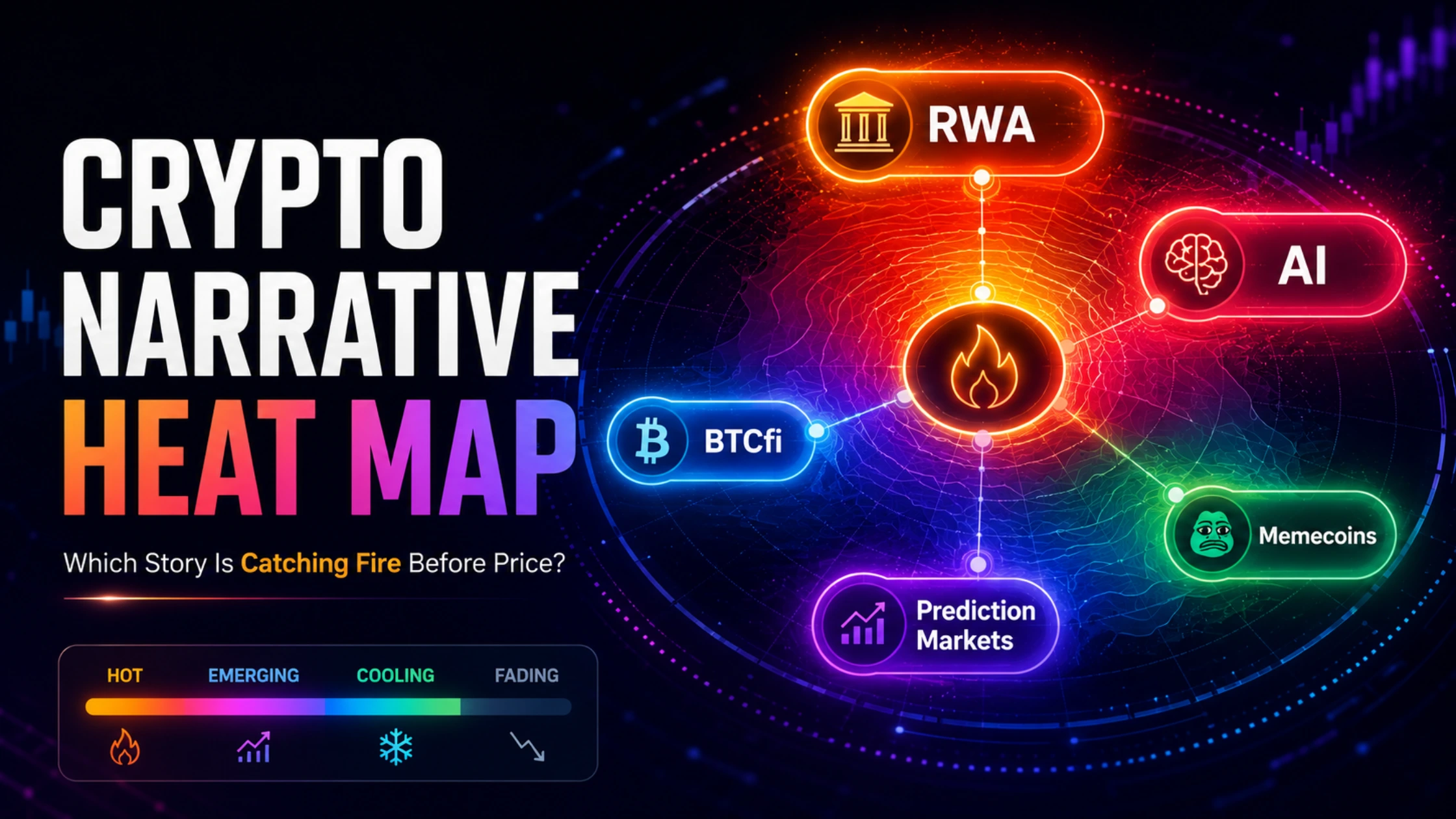
So we built the map that measures it. The DN Narrative Momentum Score reads each major narrative on three independent signals, attention relative to market cap, capital rotation into the sector, and builder activity, combines them into one 0 to 100 momentum reading, and places the narrative on a five-stage rotation clock from dormant to exhausted. Every input is a datestamped, editable board value or a live price proxy, and the model is honest about the one thing narrative tools never admit: a narrative is a reflexive belief engine, and the same momentum that makes it profitable early is what makes it lethal late. This is a Receipts piece for the reader who is tired of being early to nothing and late to everything.
What the narrative hype gets right, and where it lies to you
Crypto runs on stories, and 2026 has a particularly loud chorus of them: AI agents, RWAs, DePIN, restaking, BTCfi, prediction markets, privacy. The professional consensus, from Messari to launchpad desks that live with the consequences, is worth auditing rather than echoing.
Right. Narratives genuinely coordinate capital, and the substance gap is real this cycle. RWA is not a vibe: tokenized value grew from roughly $5.5 billion in early 2025 to about $29.2 billion by April 2026, driven by institutional demand for tokenized treasuries and roughly $17 billion in private credit, and it was the most profitable narrative of 2025 at around 185.8 percent average return. Restaking built real infrastructure, EigenLayer at roughly $13 billion in TVL, within a liquid-staking segment near $44.8 billion on Ethereum. The market is visibly favoring narratives with on-chain revenue, and the clearest 2026 outperformers share that trait rather than pure story.
Wrong. The "find the next narrative and get rich" framing fails on timing and survivorship. The launchpad desks that watched 2025 closely describe narrative fatigue and, tellingly, no single meta that carried the year: most so-called narratives behaved like short-form video trends, loud for a week and dead the next. The retail experience of narratives is systematically late, because by the time a story is legible enough to name in a headline, the capital that drives it has usually already arrived, which is precisely why the lead-time signal matters more than the narrative label. And survivorship is brutal: the same dataset that celebrates the winners quietly buries the DePIN projects, 412 of them at a roughly $35 billion sector valuation, whose individual outcomes vary wildly.
Missed entirely. The exploitable pattern is mechanical, not mystical, and almost no retail-facing narrative content states it plainly: in RWA, accelerating protocol TVL on DeFiLlama has historically preceded governance-token price moves by about four to six weeks, because institutional capital allocates to protocol TVL directly through structured products before rotating into the smaller, less liquid governance-token markets. That lag is the entire edge. It means the signal worth watching is not price and not Twitter, it is the boring TVL line that moves first, and a tool that surfaces the boring line before the exciting one is the only honest way to be early.
The receipts: the June 2026 narrative board
| Narrative | Substance signal | Attention | Capital trend | Est. stage | Momentum |
|---|---|---|---|---|---|
| RWA (tokenized assets) | ~$29.2B TVL | High | Rising | Heating | 78 |
| AI x crypto / agents | Usage < hype | Very high | Mixed | Euphoric | 71 |
| BTCfi (Babylon, Lombard) | TVL building | Rising | Rising | Stirring | 66 |
| Prediction markets | Real usage | Rising | Rising | Stirring | 62 |
| Privacy / ZK | Cyclical | Spiky | Volatile | Heating | 58 |
| Restaking (EigenLayer) | ~$13B TVL | Cooled | Flat | Euphoric→Exhausted | 44 |
| DePIN | ~$35B / 412 proj. | Moderate | Selective | Heating | 54 |
| Memecoins | ~$47B (was $150B) | Faded | Falling | Exhausted | 31 |
Five findings, each one a correction to a headline. Board readings are DN estimates from the sourced inputs, datestamped June 12, 2026, and reproducible in the tool below.
1. The leader on substance is not the leader on noise, and that is the signal. RWA scores highest on momentum because its capital trend is genuinely rising on institutional flows, yet AI-crypto generates more attention. When the loudest narrative and the best-funded narrative are different narratives, the quiet one is usually the better risk-reward, because the loud one has already priced its story. This is the single most useful instinct the board teaches.
2. Euphoric is a high score and a warning at the same time. AI-crypto's 71 is not a buy signal; it is a momentum reading attached to a Euphoric stage, where attention has outrun capital and builders. A pure heat score would flash green here. The honest score flashes green and red together, because reflexivity means the belief is strongest right before it breaks, and the AlphaMind-style desks already describe half-baked "AI plus token" pitches drifting into a blur. High momentum late in a narrative is the most expensive thing in crypto.
3. The early money is in Stirring, and it is boring on purpose. BTCfi and prediction markets score lower than RWA and AI precisely because their attention has not arrived yet, capital and builders are moving while headlines are not. That is the Stirring stage, and by the lead-time logic it is the only stage where a non-insider can still be genuinely early. The reader who wants to feel early should be uncomfortable with how unexciting the early answer is.
4. Yesterday's meta is a value trap dressed as a discount. Restaking built real infrastructure and still carries $13 billion in TVL, but its attention has cooled and capital has flattened, putting it in the Euphoric-to-Exhausted transition. "It is down, so it is cheap" is the exact reasoning that converts a faded narrative into a slow bleed; the board flags it as a stage, not a bargain. Memecoins, down from $150.6 billion to $47.2 billion, are the same lesson in capital letters.
5. The map is reflexive, and pretending otherwise is the lie every other narrative tool tells. A narrative score influences the thing it measures: enough people acting on "RWA is heating" is part of what makes RWA heat, until the belief detaches from the TVL that justified it. The Score is a momentum reading, not a fundamental valuation, and the most honest thing it does is refuse to separate the heat from the danger. That refusal is why it is worth citing.
Read any narrative's stage
The instrument below lets you score any narrative on the three signals, editing the board inputs as fresh TVL and attention data print, and returns the momentum reading plus the estimated rotation stage with its honest warning. The live price proxy contextualises whether price has already moved, which against the rotation stage tells you the most important thing: whether you are looking at a setup or a chase.
Catching fire, or already burned? Score any narrative on the three signals that matter, with capital rotation, the one that leads price, weighted highest. Board inputs are estimates as of June 12, 2026, editable. The model flags the danger stage instead of hiding it.
Educational model, not financial advice and not a prediction. Momentum = capital rotation × 0.40 + attention-to-cap × 0.35 + builder activity × 0.25. Rotation stage is inferred from the balance and trend of the three signals: Stirring (capital and builders lead attention) is the early zone; Euphoric (attention leads, capital and builders flatten or fall) is the danger zone. The capital signal is weighted highest because sector TVL has historically led governance-token price by roughly four to six weeks (DeFiLlama, RWA protocols), the only mechanically early signal. Narratives are reflexive: a high score in a late stage is high danger, not a buy. Board inputs are DN estimates from third-party sources (CoinGecko Crypto Narratives, Messari, DeFiLlama, launchpad research) as of June 12, 2026, not DN measurements, and are editable. Live price proxy via CoinGecko; if the id is invalid or the fetch fails the proxy line is omitted. Other publications may embed this tool with a followed credit link to the canonical page on decentralised.news.
How to actually use a narrative without being its exit liquidity
- Watch the boring line, not the loud one. The capital-rotation signal, sector TVL and stablecoin inflows, leads price by weeks in the best-documented cases, while attention lags into it. If you only have time to watch one thing per narrative, watch TVL on a free dashboard like DeFiLlama, not the timeline. The whole edge is preferring the unexciting signal.
- Treat Stirring as the only honest "early." By the time a narrative is Heating in headlines, the lead time is mostly spent. Stirring, capital and builders moving before attention, is uncomfortable precisely because nothing has confirmed it yet, which is what being early actually feels like. Size accordingly: small, because early also means often wrong.
- Respect Euphoric as an exit, not an entry. The highest momentum readings late in a narrative are the most dangerous trades in crypto, because reflexivity peaks just before it reverses. If your conviction arrives at the same time as everyone's headlines, you are the liquidity. This is the same discipline our DN Short Risk Score applies at the whole-market level.
- Check survival before momentum. A narrative can be heating while most of its tokens are dying, which is the DePIN lesson, 412 projects, wildly varying outcomes. Run any specific token through the base rates before mistaking sector heat for token safety, and remember that the listing pop you are hoping for has its own brutal distribution.
- Get sector exposure where it is actually tradeable. Once the stage and the survival math check out, the execution question is venue and cost; the narratives with the deepest token markets are concentrated on a handful of exchanges, and accessing early-stage sector tokens efficiently is exactly the routing problem our standing comparisons solve. For broad access to emerging-narrative tokens, Bybit and OKX list the widest current sector coverage in our tracking, and the fee drag of rotating between narratives compounds fast enough that the DN Exchange Fee Optimizer pays for itself across a single rotation.
What would change the board
- RWA capital trend flattening while attention stays high would flip it from Heating to Euphoric, the moment the most-cited bull narrative becomes the most crowded trade.
- An AI-crypto usage breakout where on-chain activity finally catches the attention, our DN AI Bubble Gauge is the companion check, would re-rate it from Euphoric back toward Heating on substance rather than story.
- A BTCfi TVL acceleration would move it from Stirring to Heating and close the early window; this is the board's highest-conviction "watch the boring line" candidate right now.
- A privacy catalyst or shock, regulatory or technical, given the sector's spiky, event-driven behaviour and the kind of governance disruptions that have already hit individual privacy tokens, would swing its volatile capital signal hard in either direction.
- A return of broad altseason, Bitcoin dominance falling and the Altcoin Season Index rising well above its current level near 39, would lift every narrative's capital signal at once and temporarily break the selectivity the whole board depends on.
None of these has occurred as of June 12, 2026. Each is checkable by editing the relevant board input in the tool, which is why the model is published rather than the prediction.
The honest bottom line
The narrative question everyone asks has a FOMO answer, what is the next 100x story, and a useful answer, which stage is the story I am looking at actually in, and the gap between them is the difference between being early and being exit liquidity. The real findings are quieter than the hype: capital moves into protocols weeks before it moves into tokens, so the boring TVL line is the edge; the loudest narrative is rarely the best risk-reward because its story is already priced; the only honest "early" is the uncomfortable Stirring stage where nothing has confirmed; yesterday's faded meta is a value trap, not a discount; and every narrative score is reflexive, strongest right before it breaks. The Heat Map is above. It will tell you the stage, flag the danger, and refuse to promise you the top. That refusal, in a category built on promising exactly that, is the entire reason to cite it.
Frequently asked questions
As of June 2026, real-world assets (RWA) lead on substance with roughly $29.2 billion in tokenized value and the strongest rising-capital signal, while AI-crypto leads on attention. The DN Narrative Momentum Score rates RWA highest at 78 in a Heating stage and AI-crypto at 71 in a Euphoric stage, where high momentum doubles as a danger warning because attention has outrun capital.
Watch capital, not attention. Sector TVL and stablecoin inflows have historically led governance-token price by about four to six weeks on DeFiLlama, because institutional money enters protocols before rotating into smaller token markets. The narrative is catching fire early when capital and builder activity are rising while headlines have not arrived yet, the stage the DN model calls Stirring.
Usually the easy money is gone, not all of it. By the time a narrative is loud enough to headline, the lead-time edge is mostly spent and the trade is crowded. The DN Narrative Momentum Score flags this as the Euphoric stage, high momentum but high danger, because reflexive narratives peak just before they reverse. Late entries are chases, not setups.
The memecoin sector deflated from a peak around $150.6 billion in December 2024 to roughly $47.2 billion, a classic Exhausted-stage collapse where attention faded and capital fell together. The 2025 to 2026 market shifted toward narratives with sustainable yield, privacy and real-world utility, leaving pure-attention sectors without the capital rotation needed to sustain them.
A 0-to-100 composite published by Decentralised News that scores any crypto narrative on three signals: capital rotation (40 percent, weighted highest because it leads price), attention-to-cap (35 percent), and builder activity (25 percent, the durability check). It also estimates which of five rotation stages, Dormant, Stirring, Heating, Euphoric or Exhausted, the narrative occupies, flagging late-stage momentum as danger rather than opportunity.
Yes, profoundly. A narrative coordinates capital, coverage and development, and crossing a critical mass triggers reflexivity where belief drives outcomes that validate the belief, until it detaches from fundamentals. This is why the DN model refuses to separate a narrative's heat from its danger: the same momentum that makes a story profitable early is what makes it lethal late.
Real, on current evidence. Tokenized real-world assets grew from about $5.5 billion in early 2025 to roughly $29.2 billion by April 2026, including about $17 billion in private credit, and RWA was the most profitable narrative of 2025 at around 185.8 percent average return, driven by institutional demand rather than retail speculation. The risk is no longer existence but crowding, and whether capital keeps leading attention.
By the DN model's stage logic, BTCfi and prediction markets score in the Stirring stage, capital and builder activity rising while attention has not yet caught up, which is the only stage where a non-insider can still be genuinely early. The discomfort of acting before confirmation is exactly what being early feels like; it also means being frequently wrong, so position sizing matters.
Crypto Twitter is the attention signal, which lags capital. The DN Narrative Momentum Score weights capital rotation highest precisely because it leads price while attention follows, so following the timeline is structurally late. The model also flags the rotation stage and the reflexivity danger, telling you not just that a narrative is hot but whether hot means early or means exit liquidity.
Decentralised News publishes research, not financial advice. Narrative figures are reported third-party estimates from CoinGecko Crypto Narratives, Messari, DeFiLlama, RWA.xyz and launchpad research as of June 12, 2026, and reflect methodology differences across sources; they are not Decentralised News measurements. The four-to-six week TVL-to-price lead time is a documented historical pattern in specific RWA protocols, not a guarantee for any narrative or token. Board stage and momentum readings are DN estimates from those inputs and are editable in the tool. Narratives are reflexive and can reverse without warning; sector heat does not imply individual token safety. Crypto assets are volatile and can lose all value. Some links are referral links that support our free tools at no cost to you. The DN Narrative Momentum Score methodology, alongside the wider instrument suite documented in the editor's books Blockchain Applied and Tokenized Trillions, is open to challenge via the contact page.
About the Author