Crypto OTC vs Order Book: Costs, Break-Even and Settlement
What Matters
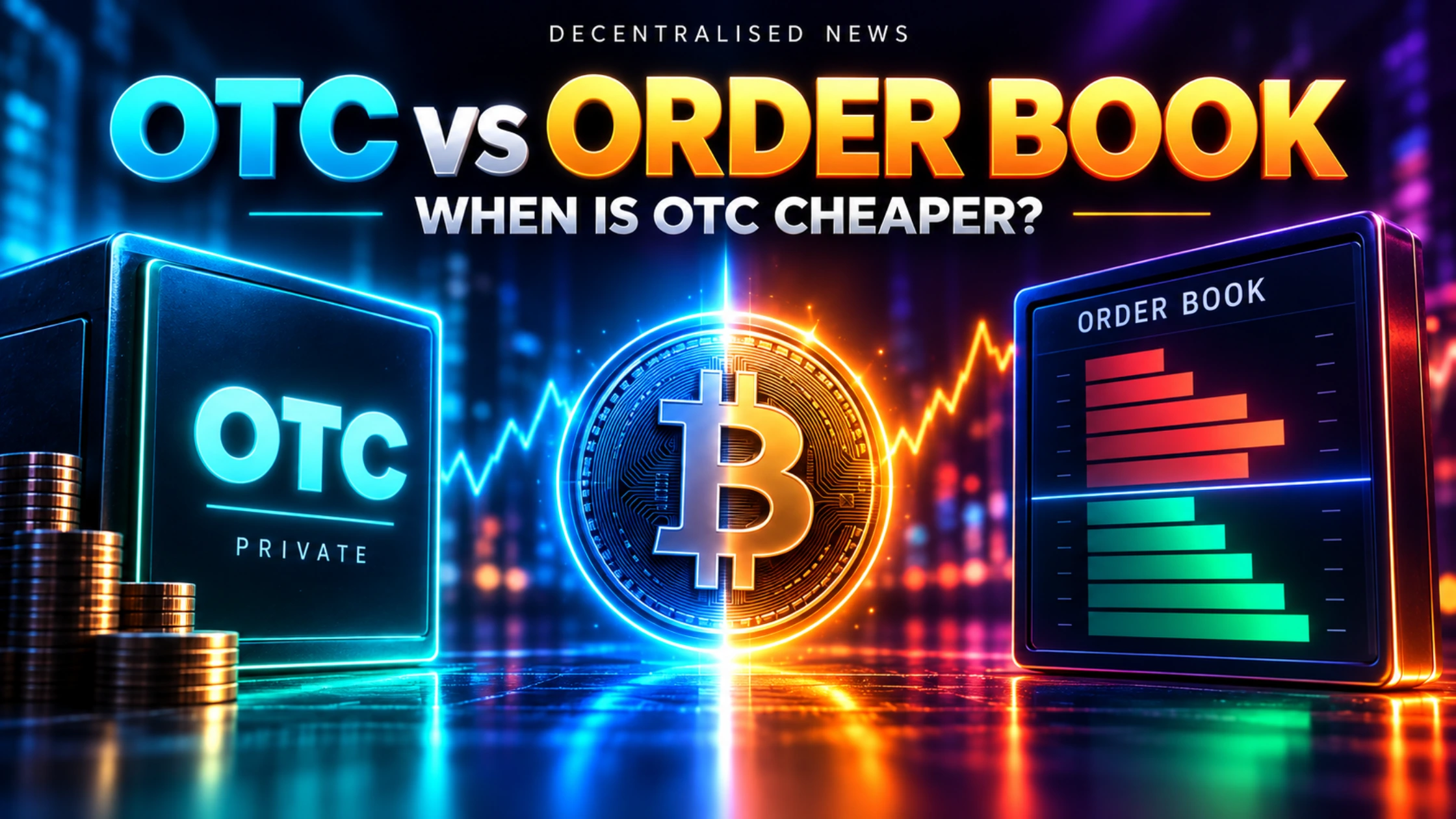
There is no universal trade size at which crypto OTC becomes cheaper. Compare a firm, executable RFQ with the cost of filling the same quantity on the order book, at the same time, including your actual fee tier and settlement costs. A desk minimum is an access condition—not an economic break-even point.
For a $100,000 order, one basis point is $10. A seemingly better OTC quote can lose its advantage after a wire charge, financing or withdrawal cost. Conversely, a low exchange fee does not rescue an order that sweeps thin liquidity.
Evidence Block — checked 31 October 2026
Evidence type: official product documentation and a transparent hypothetical model. DN did not obtain synchronized executable OTC quotes, measure live fills, access private accounts or place trades for this update. The 2027 URL is retained for continuity; it does not imply observations from 2027. Methodology: DN-OTCBE v1.1.
What the evidence supports: route mechanics, published access constraints and settlement differences. What it cannot establish: a cheapest venue, a guaranteed fill or a current market-wide break-even size. No provider is ranked by the illustrative costs below.
OTC, RFQ or order book: compare the route, not just the brand
| Route and official source | Cost and eligibility | Settlement and comparison constraint |
|---|---|---|
| Kraken Bitcoin OTC | The asset page describes an all-inclusive bid/offer and Pro-level verification. Its $100,000 minimum conflicts with the 11 March 2025 announcement lowering OTC to $50,000. Confirm the specific service, account and jurisdiction; do not treat either page as a universal threshold. | The asset page describes instant RFQ settlement from existing funds and flexible settlement within 24 hours, with bank/external-wallet options depending on currency. Account credit is not the same as completed external withdrawal. |
| Binance manual Spot RFQ | The FAQ lists $200,000 minimum and no separate OTC trading fee for verified users; account limits and local terms still apply. It points smaller orders to Convert—a distinct route, not proof that manual RFQ accepts $100,000. | Typically settles immediately to the specified Spot account, including supported subaccounts. Compare the quoted price, not a zero-fee label; deposits and withdrawals remain separate. |
| Coinbase Prime RFQ | Prime-only competitive LP auction. Quotes include fees and commissions; pair/size limits require confirmation with Prime. Financing may be included if selected. Retail Coinbase registration does not establish Prime eligibility. | Fill-or-kill; a quote is held for 3 seconds in the UI or 1 second via API. Acceptance executes and settles instantly within Prime. Expired quotes are not actionable. |
| Public order-book execution (Kraken fee mechanics example) | Fees depend on pair, maker/taker status and account tier. Enter the rate actually applicable to your account; the calculator’s 5 bps default is hypothetical, not Kraken pricing. | Displayed depth is not a fill guarantee. A market order can consume several levels; a passive order may not fill. Withdrawal availability and funding costs must be checked separately. |
The Kraken source conflict is unresolved at the product/account level. The later-access announcement and still-visible asset FAQ cannot establish one minimum for every channel. Ask the desk to confirm the minimum and settlement arrangement for your exact ticket before relying on it. None of these routes is automatically available in every country.
A $100,000 comparison — hypothetical, not an observed quote
Assume the same buy-side reference midpoint and a $100,000 reference notional. The simplified book fills that amount at a 2 bps weighted price deviation. Add an assumed 5 bps taker fee. The hypothetical OTC quote is 12 bps from the same midpoint, with no additional commission or fixed cost.
| Hypothetical input | Order book | OTC/RFQ |
|---|---|---|
| Price deviation | 2 bps / $20 | 12 bps / $120 |
| Separate fee | 5 bps / $50 | 0 bps / $0 |
| Fixed settlement charge | $0 assumed | $0 assumed |
| Total modeled cost | 7 bps / $70 | 12 bps / $120 |
The book is cheaper by $50 under these assumptions. This is not a Kraken, Binance or Coinbase quote. Add a hypothetical $25 OTC settlement charge and its total becomes 14.5 bps / $145, widening the difference to $75. At a different depth snapshot the result can reverse. Prices, fees and dollar conversions here are first-order basis-point approximations, not settlement invoices.
Use the RFQ versus VWAP calculator
Preserved below: the incremental-depth model and six size cohorts—$100k, $250k, $500k, $1m, $5m and $10m. Enter price deviations from one contemporaneous midpoint and liquidity at each level, not cumulative depth. Do not add half-spread again: deviation from midpoint already includes it.
Use an all-inclusive RFQ basis once, then add only genuinely separate charges. This model has an OTC fixed-cost field but no exchange funding/withdrawal field: add those exchange costs separately, or convert them to equivalent bps for the chosen size. Do not reuse that adjusted fee across different sizes when the underlying charge is fixed.
Static fallback: the table includes the default hypothetical results even if your browser does not initialize the calculator. Controls remain disabled unless the calculator initializes. If disabled, use the formulas and worked example, or reload the page to try the interactive version. The tool is a sensitivity worksheet, not a live quote feed.
OTC vs Order Book Break-Even Calculator
Compare the cost of sweeping a simplified public order book against a firm OTC/RFQ quote. Enter incremental liquidity by price level and the calculator estimates your VWAP cost and the first notional where OTC becomes cheaper.
Trade Assumptions
Simplified Order-Book Depth
DN Execution Analysis
Size Sensitivity — hypothetical defaults until recalculated
| Notional | Book Impact | CLOB All-In | OTC All-In | Cheaper Route | Difference |
|---|---|---|---|---|---|
| $100,000 | 2.00 bps | 7.00 bps | 12.00 bps | Order Book | $50 |
| $250,000 | 3.80 bps | 8.80 bps | 12.00 bps | Order Book | $80 |
| $500,000 | 6.40 bps | 11.40 bps | 12.00 bps | Order Book | $30 |
| $1,000,000 | 11.20 bps | 16.20 bps | 12.00 bps | OTC | $420 |
| $5,000,000 | N/A | N/A | 12.00 bps | Insufficient depth | Book too shallow |
| $10,000,000 | N/A | N/A | 12.00 bps | Insufficient depth | Book too shallow |
DN-OTCBE v1.1 Methodology
The depth ladder is intentionally discrete rather than a fitted square-root market-impact model. DN does not assume that one universal market-impact function applies across all crypto assets, venues and volatility regimes.
The model also excludes information leakage, future market movement, counterparty exposure and opportunity cost unless those effects are already incorporated into the prices entered.
Methodology and limitations
For each size, the calculator consumes incremental dollar-depth buckets from the lowest adverse price deviation upward, then takes their dollar-weighted average bps. This is a simplified first-order VWAP-cost proxy; exact execution VWAP requires base-asset quantities and fill prices. The tool adds the entered taker fee and compares that result with OTC quote basis + explicit fee + fixed cost ÷ notional × 10,000.
The break-even search samples 400 evenly spaced sizes up to total entered depth. It reports the first tested size where the OTC model is no more expensive—not an exact continuous crossing or a persistent market threshold. It does not enforce provider minimums, eligibility or maximum tickets. With the default $3m depth, the grid spacing is $7,500 and the first modeled crossing is $600,000. Unsupported sizes are marked insufficient depth, not assigned an OTC winner.
All preloaded prices and sizes are illustrative. The model omits book cancellations, queue position, latency, adverse selection, information leakage, timing risk, credit exposure and custody/operational risk. TWAP, passive limits and smart routing are alternative strategies, but their later fills cannot be fairly compared with an immediate quote without accounting for market movement and non-fill risk. A single static ladder cannot establish a live break-even curve.
Before requesting or accepting an RFQ
- Confirm the contracting entity, jurisdiction, asset, side, quantity, currency and account eligibility. Verify instructions through the provider’s official channel.
- Record the midpoint source and timestamp, depth snapshot, fee tier, firm quote, expiry, separate charges and settlement destination.
- Compare identical quantities and settlement outcomes within the quote’s actual validity window. An old screenshot is not an executable offer.
- Confirm prefunding, transfer limits, banking cutoffs, network choice, required confirmations, withdrawal holds and financing terms. A settled exchange balance is not money received in a bank account.
- Reject an incomplete comparison. If the book lacks depth or no comparable RFQ exists, report the missing evidence rather than declare a winner.
Commercial disclosure and risk
DN has exchange affiliate relationships elsewhere on the site. An ordinary retail referral agreement does not establish coverage for OTC, institutional or Prime clients. This article’s execution-provider links are neutral official documentation routes; no OTC referral entitlement or preferential quote is claimed. Commercial availability is not evidence of execution quality.
Educational analysis only, not personalized investment advice. Crypto transactions involve market, liquidity, counterparty, custody and settlement risk. Confirm current terms directly; never send assets based solely on a third-party comparison or unsolicited desk message.
About the Author