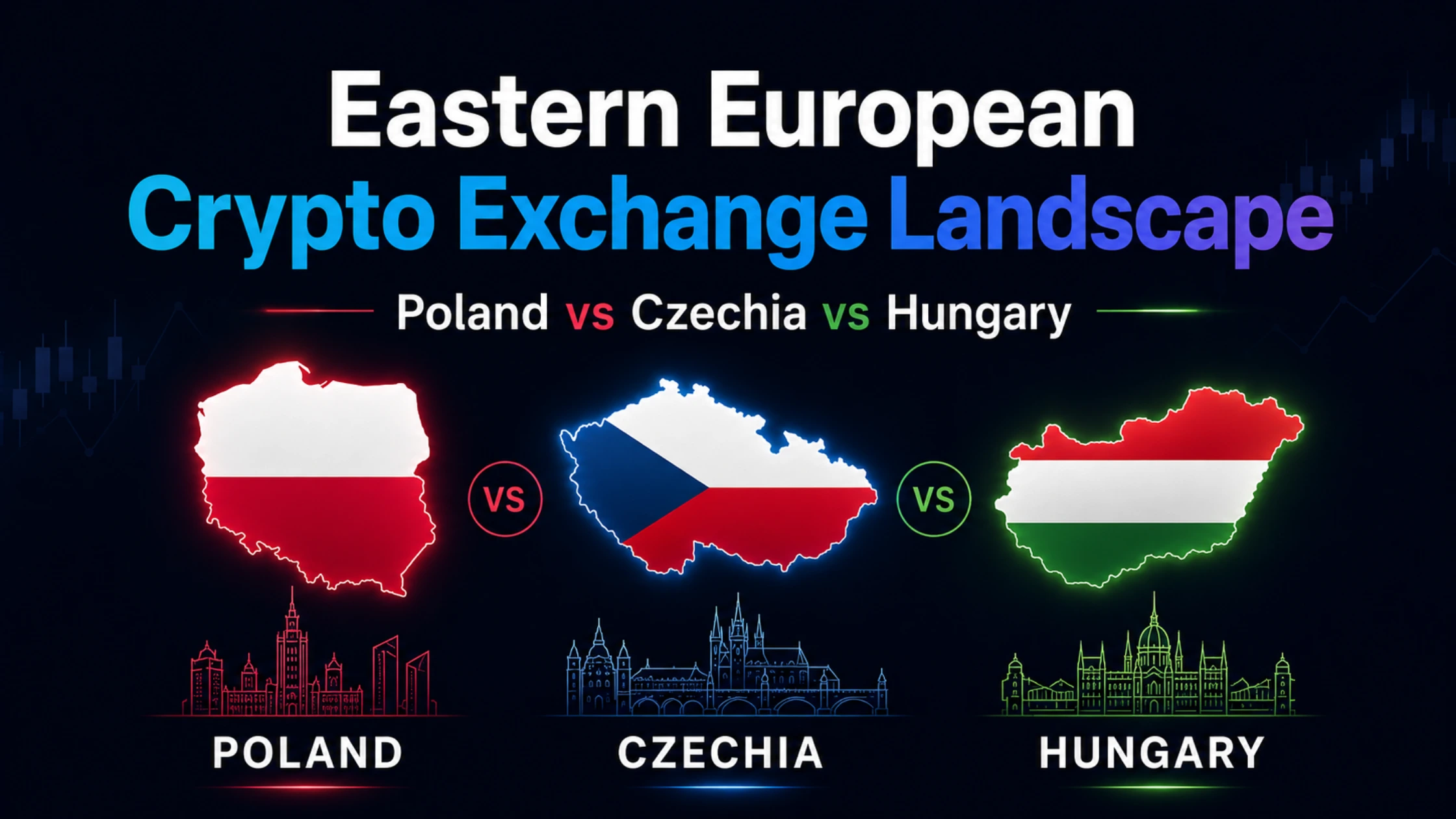
The Eastern European Crypto Exchange Landscape: Poland, Czechia, and Hungary Compared
Last Updated: July 2026 | Reading Time: 12 minutes
Eastern Europe has become one of the most fascinating crypto trading corridors in the world. Not because of regulatory permissiveness — quite the opposite — but because of the collision between MiCA’s harmonized framework, persistent local currency demand, and a technically sophisticated population that built much of the infrastructure the rest of the world now uses.
If you’re trading from Warsaw, Prague, or Budapest, you’re operating in a market that is simultaneously overregulated and underserved. The major global exchanges serve you, but rarely optimize for you. Local platforms exist, but lack depth. And the derivatives you want to trade sit in a gray zone that changes color depending on which regulator you ask.
This guide cuts through that complexity. We’ll examine how MiCA actually affects PLN, CZK, and HUF traders, which platforms handle local payment rails and currency pairs, where to find derivatives without navigating regulatory minefields, and how to structure your trading for tax efficiency across three distinct jurisdictions.
Regulatory Reality: MiCA Implementation in Eastern Europe
The Markets in Crypto-Assets Regulation (MiCA) came into full force in December 2024. By mid-2026, its effects on Eastern European traders are clear — and not always what was predicted.
What MiCA Actually Changed
For centralized exchanges operating in the EU:
- Mandatory licensing as CASPs (Crypto-Asset Service Providers)
- Strict custody requirements and segregation of client assets
- Marketing restrictions, including prohibition of bonuses and leverage incentives
- Mandatory KYC for all transactions, no thresholds
- Stablecoin issuer reserves and redemption requirements
For traders:
- Access to regulated platforms with stronger asset protection
- Loss of high-leverage derivatives on EU-registered exchanges (limited to 1:2 for retail)
- Reduced altcoin availability as exchanges delist unregistered tokens
- Clearer tax guidance but stricter reporting obligations
The Eastern European Specifics
Jurisdiction | MiCA Transposition | Local Twist | Derivatives Status |
Poland | Full MiCA adoption via KNF guidelines | Additional AML requirements for P2P; strict stablecoin reporting | CFD-like crypto derivatives banned for retail; offshore access gray |
Czechia | MiCA via ČNB; historically crypto-friendly | No additional local restrictions beyond MiCA; Prague is EU crypto hub | Same 1:2 leverage cap; offshore trading technically unenforced |
Hungary | MiCA via MNB; slow implementation | Capital gains tax clarified at 15%; strict source-of-funds for large transfers | MNB warnings against offshore platforms; no active blocking |
The Practical Impact
If you’re a retail trader in Warsaw, Prague, or Budapest, you face a choice:
- Trade on EU-licensed platforms — safe, regulated, but limited to 1:2 leverage and restricted altcoin access
- Trade on offshore platforms — full leverage, full markets, but regulatory gray zone and no local consumer protection
- Use DeFi alternatives — no KYC, no leverage limits, but self-custody responsibility and technical complexity
Most serious traders in Eastern Europe use a hybrid: regulated platforms for fiat on/off-ramping and long-term holding, offshore platforms for active derivatives trading, and DeFi for specific strategies.
Best CEX for PLN/CZK/HUF Pairs: KuCoin P2P and Gate.io Local Payment Methods
Local currency pairs matter. Converting PLN to EUR, then EUR to USDT, then trading introduces friction, spread costs, and FX risk. Direct PLN/USDT, CZK/USDT, and HUF/USDT pairs eliminate that drag.
KuCoin: The P2P Local Currency King
KuCoin has invested heavily in Eastern European P2P markets. Their P2P platform supports:
- PLN: Bank transfers (ING, mBank, PKO BP), Blik, PayU
- CZK: Bank transfers (ČSOB, Komerční banka), Revolut, Wise
- HUF: Bank transfers (OTP, Erste, K&H), mobile banking apps
How KuCoin P2P works:
- Select your currency pair (e.g., PLN/USDT)
- Choose a merchant based on price, completion rate, and payment method
- Transfer fiat via selected method
- Merchant releases USDT to your KuCoin wallet
- Trade or withdraw
Typical spreads: 0.5-1.5% over mid-market rate. Merchants compete on price, so spreads tighten during high-activity periods.
Limits: Vary by merchant; typically 1,000-500,000 PLN equivalent per transaction. KYC required for buyers and sellers above certain thresholds.
Why it matters for arbitrage: The PLN/CZK/HUF premiums against EUR can create 0.3-1.2% spreads between local P2P and global USDT markets. Active traders monitor these gaps.
Sign up on KuCoin with referral code CX8QMK4M for trading fee discounts.
Gate.io: The Altcoin Depth Alternative
Gate.io doesn’t match KuCoin’s P2P local currency coverage, but it offers something equally valuable for Eastern European traders: the deepest altcoin markets accessible without mandatory KYC for basic spot trading.
Gate.io advantages:
- 2,000+ trading pairs — highest altcoin breadth of any major exchange
- Startup launchpad — early access to tokens before Binance/KuCoin listing
- HFT-friendly API — sub-10ms order execution for algorithmic traders
- Flexible KYC tiers — basic trading without full verification; higher limits with KYC
Local payment integration:
Gate.io supports EUR SEPA deposits (useful for CZK/PLN traders with EUR accounts) and has integrated third-party fiat gateways (Banxa, Simplex) that accept some Eastern European cards. Not as clean as KuCoin P2P, but functional.
The Gate.io edge: If you’re hunting low-cap gems that haven’t reached mainstream exchanges, Gate.io lists them first. For Polish and Czech traders with strong altcoin research capabilities, this is a significant advantage.
Access early listings on Gate.io with referral code UgUVAVoJ.
Local Exchange Alternatives
Poland: BitBay (now Zonda) remains the largest local exchange. Licensed by KNF. Limited leverage. High fees (0.43% taker). Useful for conservative PLN on-ramping, but not competitive for active trading.
Czechia: CoinMate (operating since 2014) offers CZK pairs with FIO bank integration. Small, reliable, expensive. Useful for older traders uncomfortable with global platforms.
Hungary: No significant local exchange exists. Hungarian traders default to international platforms or P2P.
Derivatives for EE Residents: Bitget and MEXC
MiCA’s 1:2 leverage cap made EU-licensed derivatives irrelevant for serious traders. Eastern European traders have responded by migrating to offshore platforms — a trend regulators acknowledge but haven’t effectively countered.
Bitget: The Copy Trading Derivatives Hub
Bitget has become the dominant offshore derivatives platform for Polish and Czech traders. Three reasons:
- Copy trading infrastructure
Bitget’s copy trading is the most mature in the industry. For traders in time zones 6-7 hours ahead of US markets, following a master trader who operates during liquid hours is attractive. Bitget verifies master trader performance, displays real ROI (not just win rate), and allows granular risk controls.
- Leverage and product range
- Perpetuals: up to 125x on major pairs, 50x on alts
- Futures: quarterly and bi-quarterly settled
- Options: European-style, cash-settled
- Margin: isolated and cross, with portfolio margin for high-volume traders
- Competitive fee structure
- Spot: 0.1% maker, 0.1% taker (0.08% with BGB token discount)
- Perpetuals: 0.02% maker, 0.06% taker
- No deposit fees; withdrawal fees competitive with network costs
EE-specific considerations:
Bitget does not block Polish, Czech, or Hungarian IP addresses. KYC is “recommended” but not enforced for withdrawals under 2 BTC/day. This creates a functional gray zone that thousands of EE traders operate within.
However: Bitget is not EU-licensed. If you lose funds to hacking, fraud, or platform failure, Polish KNF, Czech ČNB, and Hungarian MNB will not assist you. The risk is real.
Follow verified traders on Bitget with referral code nqef.
MEXC: The High-Leverage, Low-KYC Alternative
MEXC occupies a different niche: maximum leverage with minimal friction.
Key features:
- Perpetual leverage: Up to 200x on BTC/ETH, 100x on major alts
- KYC policy: Optional for withdrawals up to 5 BTC/day — among the highest non-KYC limits in the industry
- Kickstarter launchpad: Vote-to-earn model for new token allocations
- Futures bonus programs: New user bonuses up to 5,000 USDT (terms apply)
EE trader profile on MEXC:
Typically younger, higher risk tolerance, smaller capital. The 200x leverage attracts speculators, but the platform’s order book depth on major pairs is sufficient for serious size. Altcoin perpetuals are thinner — expect slippage on >$50K notional.
Regulatory risk: Higher than Bitget. MEXC has faced regulatory actions in multiple jurisdictions. No EU presence. If enforcement escalates, account access could be restricted without warning.
Open an account on MEXC with referral code 16yJL.
The Derivatives Risk Matrix for EE Traders
Factor | EU-Licensed (e.g., Bitstamp) | Bitget | MEXC | DeFi (GMX, Drift) |
Max leverage | 1:2 (retail) | 125x | 200x | 50x (GMX), 20x (Drift) |
KYC required | Mandatory | Optional | Optional | None |
Consumer protection | Strong | None | None | None (smart contract risk) |
Fiat on-ramp | Yes (SEPA) | Limited | No | No |
EE IP blocked | No | No | No | No |
Tax reporting | Automatic | Self-reported | Self-reported | Self-reported |
Recommended for | Conservative holding | Active derivatives | High-risk speculation | Privacy-focused |
DEX Workarounds: SynFutures on Polygon for Synthetic Exposure
For traders who want derivatives exposure without offshore platform risk, DeFi offers alternatives. The challenge: most DeFi perp DEXs are USD-stablecoin denominated, creating the same PLN/CZK/HUF conversion friction as global CEXs.
SynFutures offers a partial solution.
SynFutures V3: Concentrated Liquidity Perps
SynFutures operates on Polygon (now POL), offering perpetual futures with a unique architecture:
Concentrated liquidity AMM for perps:
Instead of traditional orderbooks, SynFutures uses a concentrated liquidity model similar to Uniswap V3. LPs provide liquidity in specific price ranges, and traders swap against these ranges. This creates capital-efficient markets with lower slippage than standard AMMs.
Synthetic exposure without direct leverage:
Rather than borrowing against collateral, SynFutures uses a synthetic model where the protocol mints and burns position tokens based on price movements. This eliminates liquidation risk from collateral shortfalls — a significant advantage for traders concerned about cascade liquidations.
Why Polygon matters for EE traders:
- Low gas fees ($0.01-0.10 per transaction) vs. Ethereum mainnet ($5-50)
- Fast finality (~2.3 seconds)
- EUR on-ramps via Mt Pelerin, Monerium, and other EU-integrated fiat gateways
- Strong Polish and Czech developer community — local Discord support channels
The synthetic EUR/USD stablecoin angle:
SynFutures doesn’t offer direct PLN/CZK/HUF pairs. But it offers EUR/USD perpetuals, which can serve as a FX hedge for EE traders holding USD-stablecoin positions. If you’re long BTC/USD and worried about EUR appreciation against your local currency, a short EUR/USD perp on SynFutures creates synthetic local-currency exposure.
Limitations:
- Lower liquidity than GMX or Drift
- Smaller asset selection (major pairs only)
- Smart contract risk on newer protocol
- No fiat on-ramp directly — must bridge from CEX or use on-ramp service
Trade on SynFutures with referral code decentnews.
Other DeFi Options for EE Traders
GMX (Arbitrum): Deepest liquidity for BTC/ETH perps. No local currency pairs, but excellent for USD-denominated hedging. Use deBridge (code: 20473) to bridge assets from Polygon or Ethereum.
Drift (Solana): Fastest execution, spot-margin cross-collateralization. Requires SOL for gas and wrapped assets for BTC/ETH exposure.
Aevo (Ethereum L2): Options and pre-launch token markets. Best for sophisticated strategies, not basic perp exposure.
Tax Optimization Strategies for EE Jurisdictions
Crypto tax in Eastern Europe is clearer than it was, but still varies significantly by country. Misreporting is common; aggressive optimization is risky.
Poland: The 19% Flat Rate (with Complexity)
Current rules (2026):
- Crypto-to-crypto trades: taxable event (19% flat rate on gains)
- Crypto-to-fiat: taxable event
- Mining income: taxable as business income if systematic
- Staking rewards: taxable at receipt (19%)
- Loss carryforward: 5 years
The PIT-38 form:
Polish taxpayers report crypto gains on PIT-38, filed annually by April 30. Exchanges operating in Poland (BitBay/Zonda) report automatically. Offshore platforms do not.
Optimization strategies:
- Holding period exemption: Poland does not have a holding-period capital gains exemption (unlike Germany’s 1-year rule). Every trade is taxable.
- Entity structuring: Trading through a Polish LLC (sp. z o.o.) allows expense deduction (hardware, software, education, travel to crypto conferences) and potential VAT optimization. Setup cost: ~5,000 PLN. Worth considering above ~200,000 PLN annual trading volume.
- Loss harvesting: Actively realize losses before year-end to offset gains. No wash-sale rule in Poland, so you can re-enter immediately.
- Tooling: Use Koinly (code: 243E6A3F) for automated transaction aggregation across exchanges and wallets. Polish language support is adequate.
Czechia: The Individual vs. Business Distinction
Current rules (2026):
- Individual investors: 15% capital gains tax if holding >3 years and total annual crypto income <100,000 CZK. Otherwise, progressive income tax (15-23%).
- Business traders: 15% flat corporate tax + social/health contributions if classified as systematic trading.
The “systematic trading” trap:
Czech tax authorities have aggressively reclassified individual traders as business activities. Indicators: frequent trading, leverage use, algorithmic execution, trading as primary income source. If reclassified, you owe back taxes plus penalties.
Optimization strategies:
- Stay below systematic thresholds: Limit trading frequency, maintain separate employment income, document trading as hobby/investment rather than business.
- Use regulated platforms: ČNB-licensed exchanges create a presumption of investment activity.
- Holding period: The 3-year exemption is powerful. For long-term holdings, Czechia is among the most favorable EU jurisdictions.
- Entity structuring: Less common than Poland due to higher corporate tax and social charges. Consider only for very high volume.
Hungary: The Simplified 15% Capital Gains
Current rules (2026):
- Capital gains: 15% flat rate on crypto gains (same as securities)
- Mining: taxable as self-employment income (15% personal income tax + 18.5% social contribution = 33.5% effective)
- Staking: treated as capital gains at sale (not at receipt)
- No holding period exemption
The MNB reporting requirement:
Hungarian taxpayers must declare crypto holdings above 100,000 HUF (~260 EUR) annually. MNB receives this data. Non-reporting triggers penalties.
Optimization strategies:
- Timing of realization: Since staking is taxed at sale, not receipt, delay selling staked assets to defer tax.
- Mining vs. holding: If mining, consider selling hashrate rather than self-mining to avoid self-employment classification.
- Cross-border structuring: Some Hungarian traders establish Estonian OÜ companies (0% corporate tax on retained earnings) for trading activities. Complex, requires substance, not recommended without specialist advice.
Cross-Border Considerations
Many Eastern European traders operate across jurisdictions — Polish citizens in Prague, Czech students in Budapest, Hungarian remote workers in Warsaw. Tax residency determines obligations, not citizenship.
Key rule: You are tax resident where you spend >183 days/year and have your “center of vital interests.” Playing jurisdictional arbitrage without genuine relocation is tax evasion, not optimization.
Building Your Eastern European Trading Stack
Conservative Stack (Capital Preservation)
Function | Platform | Rationale |
Fiat on-ramp | BitBay/Zonda (PLN), CoinMate (CZK) | Local license, SEPA, consumer protection |
Holding | Ledger/OneKey hardware | Self-custody, no counterparty risk |
Basic trading | KuCoin P2P + spot | Deep markets, local currency access |
Tax tracking | Multi-exchange, local language support |
Active Trader Stack (Derivatives Focus)
Function | Platform | Rationale |
Fiat on-ramp | KuCoin P2P | Best PLN/CZK/HUF coverage |
Spot/altcoin hunting | Deepest altcoin markets | |
Derivatives | Best copy trading, leverage, EE access | |
High-risk speculation | Highest leverage, low KYC | |
DeFi hedge | Synthetic exposure, no platform risk | |
Cross-chain | Fast bridging between chains | |
Security | OneKey Pro | Multi-chain hardware signing |
Privacy-Focused Stack
Function | Platform | Rationale |
Fiat on-ramp | P2P cash (Bisq, local meetups) | No KYC link |
Trading | ZK privacy, no KYC | |
Spot | Non-custodial, transparent | |
Bridge | Privacy-preserving cross-chain | |
Wallet | OneKey air-gapped | Maximum key security |
Final Thoughts
Eastern European crypto trading in 2026 is defined by contradiction. MiCA brought clarity and protection, but also constriction. The same regulation that makes your local exchange trustworthy makes it useless for sophisticated strategies. The offshore platforms that offer freedom offer no safety net. And the DeFi alternatives that eliminate counterparty risk demand technical competence that most traders haven’t developed.
The traders who thrive here are not the ones who choose a single lane. They’re the ones who build a stack — local for fiat, offshore for derivatives, DeFi for specific exposures — and manage the complexity deliberately.
Poland’s 19% flat rate, Czechia’s 3-year holding exemption, and Hungary’s simplified 15% capital gains each create different optimization opportunities. But none of them matter if you don’t track transactions, report accurately, and structure activities to match your declared intent.
The Eastern European crypto market is mature enough to be profitable and young enough to be misunderstood. That asymmetry is the edge.
Ready to build your EE trading stack? Start with local currency access on KuCoin (code: CX8QMK4M), explore derivatives on Bitget (code: nqef), and hunt altcoin alpha on Gate.io (code: UgUVAVoJ). For synthetic DeFi exposure, trade on SynFutures (code: decentnews). Secure everything with OneKey hardware (code: 46Z9TD).
Disclaimer: This article is for educational purposes only and does not constitute financial, tax, or legal advice. Cryptocurrency trading involves substantial risk including total loss of capital. Offshore exchange usage may violate local regulations depending on your jurisdiction and trading activity. Tax rules in Poland, Czechia, and Hungary are subject to change; consult a qualified local tax advisor before structuring trading activities. MiCA compliance is evolving; verify current requirements with KNF, ČNB, or MNB as applicable.
About the Author