DN tax reconciliation guide · 20 November 2026 · United States
Short answer: Form 1099-DA is a broker information return, not automatically a complete crypto tax ledger. IRS instructions for 2026 require digital asset gross-proceeds reporting and basis reporting on covered securities, with noncovered-asset and qualifying stablecoin/NFT exceptions. Your self-custody transfers, older purchases and records from multiple venues may therefore produce legitimate reconciliation gaps.
What matters
First identify whether an apparent mismatch is a missing historical acquisition, a different instrument definition, a transfer misclassification or an actual broker error. Do not automatically treat every mismatch as fraud, a new tax, or permission to disregard official forms.
Seven reasons your 1099-DA and your ledger may differ
| Mismatch source | Why it happens | Evidence to assemble |
|---|---|---|
| Inbound transfer with no purchase history | Broker sees disposition but may lack original acquisition details | Preserve original exchange fill, wallet transfer hash and date |
| Covered versus noncovered asset treatment | Basis reporting requirements differ by classification and year | Record source and covered status rather than assume all basis is broker-reported |
| Cross-platform swaps and bridges | Records can misclassify exchanges or duplicate one movement | Link originating and destination transaction records |
| Fee and settlement currency mismatches | The broker and individual may record different components or timestamps | Reconcile fees, asset units, USD valuation and time |
| Airdrops, staking or rewards | Acquisition and income histories may be outside the broker’s data | Document income events, valuations and subsequent disposal |
| Qualifying stablecoin/NFT reporting methods | Some optional IRS methods require different report fields | Read the broker’s chosen reporting treatment and the IRS instructions |
| Corrections and consolidated records | A revised tax form may supersede an earlier version | Retain original, corrected version, date and reason |
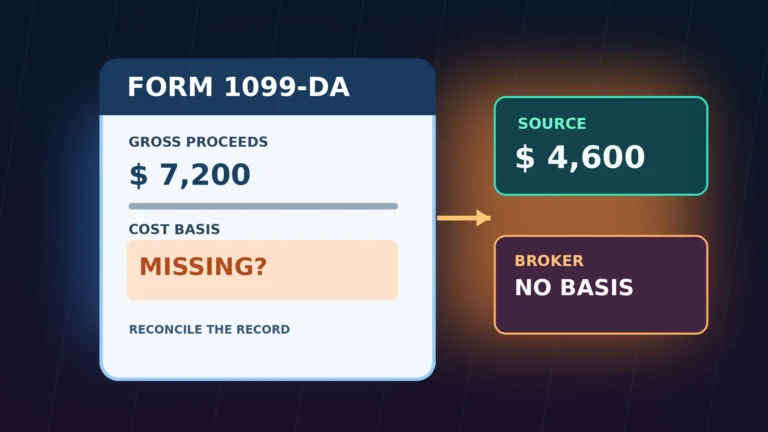
Worked example: missing cost basis
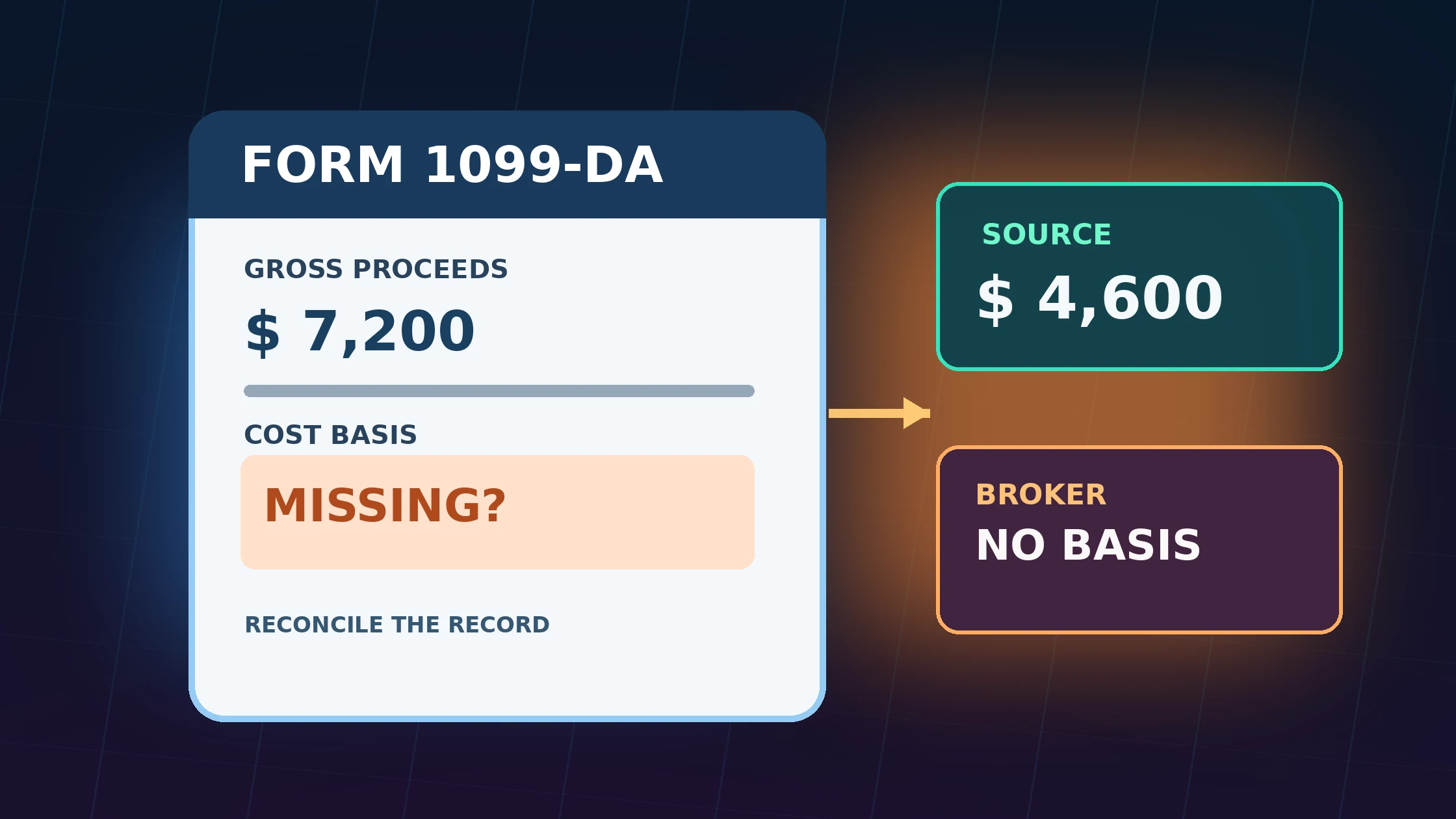
Suppose you purchased one unit of an asset for $400 on Platform A, moved it to a private wallet, deposited it to Platform B and sold it there for $700 before fees. Platform B may know the $700 gross proceeds but not your $400 acquisition cost. The correct analysis depends on the actual transaction facts and applicable tax rules. The illustration implies a $300 simple difference before costs and adjustments, not a final tax bill.
Reconstruct the transaction sequence, keep the original purchase confirmation and transfer trail, and check whether the broker classified the disposed asset as covered or noncovered. Consult a qualified professional on tax basis and adjustments.
DN 1099-DA Reconciliation Instrument
This is a documentation audit, not a filing tool.
What to do before you file
- Retrieve the current broker Form 1099-DA and all amendments.
- Download 2026 transaction records and identify every disposal and fee.
- Separate self-transfers from sales, while retaining network fees and transaction hashes.
- Reconstruct original cost basis across accounts and wallets.
- Preserve supporting records rather than relying on an imported dashboard alone.
- Request a correction from the broker if a reported fact is genuinely wrong.
- Consult qualified tax advice about reporting discrepancies and filing obligations.
Primary evidence and update policy
- IRS Instructions for Form 1099-DA (2026): covered and noncovered basis reporting and optional methods.
- IRS Form 1099-DA overview.
- IRS digital assets tax guidance.
- DN CARF and DAC8 records guide, which concerns a different international service-provider reporting regime.
Method: This is an American information-reporting reconciliation guide based on the current 2026 IRS instructions as reviewed on 20 November 2026. Neither the illustration nor checklist predicts a user’s final tax amount. If instructions change, this article needs a dated revision before the next filing season.
Disclosure: No tax-software affiliate is inserted without verifying the programme and regional support. General education, not tax or legal advice.
Frequently asked questions
What is Form 1099-DA?
It is an IRS information return used by covered digital asset brokers to report certain digital asset sales and exchanges.
Does 1099-DA necessarily report my complete gains?
No. Gross proceeds and basis reporting depend on sale date, covered status, broker information, and applicable exceptions. Reconcile with your own records.
What changes for sales after 2025?
IRS 2026 instructions require basis reporting for covered digital asset securities, while basis reporting for noncovered assets can be voluntary.
Why is my basis missing?
A broker may not have received your historical acquisition data, or a transaction may not be within covered-security basis rules.
Do transfers between my own wallets count as sales?
An internal transfer is not inherently a disposal, but its records and fees must be reconciled with any subsequent sale.
Can I simply replace the 1099-DA figures with my own estimates?
Do not arbitrarily alter a broker-reported figure. Reconcile against official statements and seek corrections or qualified tax assistance when needed.
Does a qualifying stablecoin sale have special reporting rules?
IRS instructions contain optional reporting methods for qualifying stablecoins and specified NFTs; the fields required may differ.
Does this guide provide tax advice?
No. It provides an evidence checklist based on IRS instructions; personal facts and tax treatment require qualified advice.
About the Author