How Does a Covered Call Work in Crypto? The DN Options Strategy Builder and Greeks for 2026
How Does a Covered Call Work in Crypto? The DN Options Strategy Builder & Greeks for 2026
Build any options strategy, watch the payoff curve form, and read the Greeks — a visual education in the fastest-growing corner of crypto derivatives.
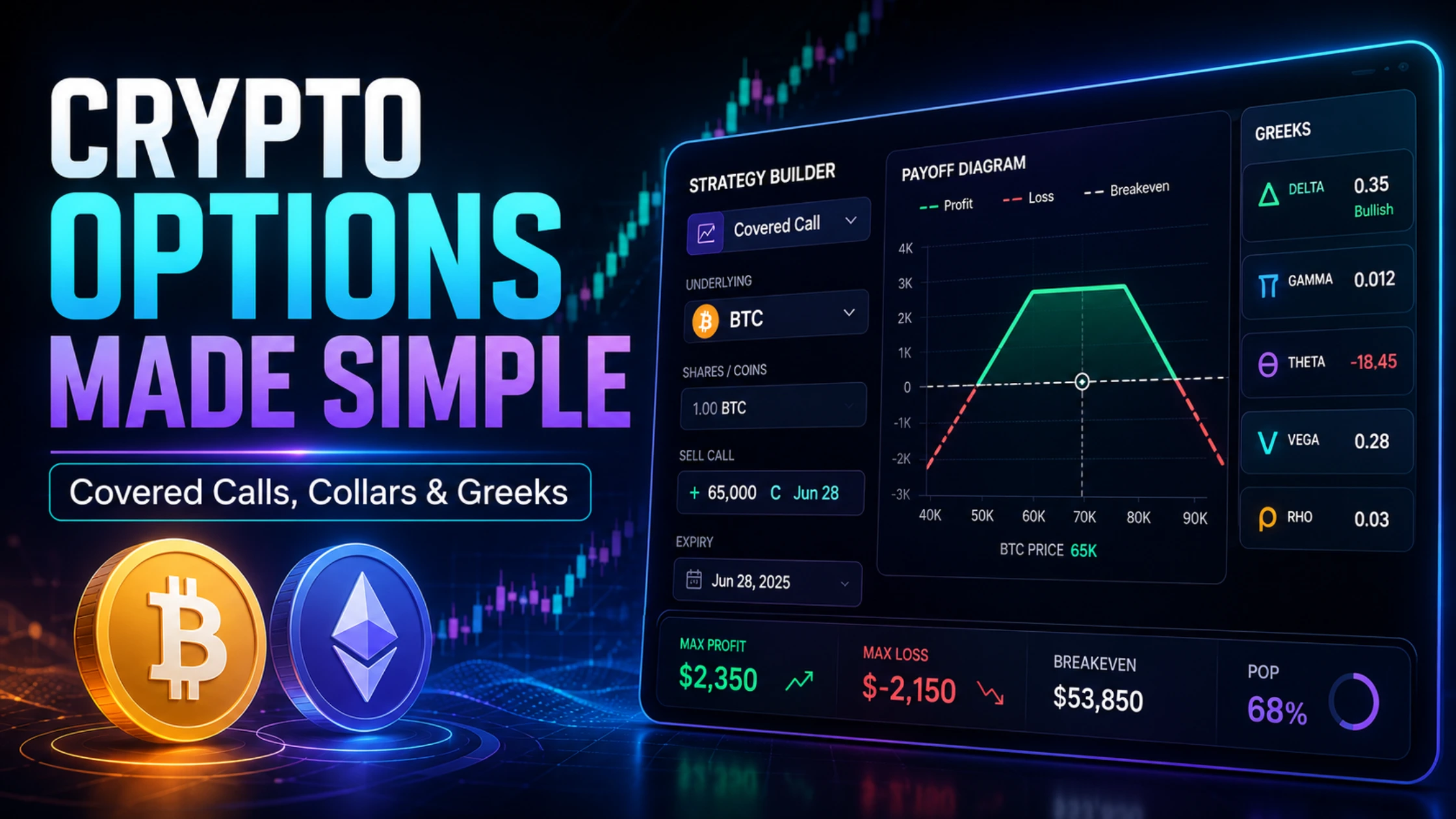
A covered call means owning an asset and selling a call option against it: you collect the option premium as income, and in exchange you cap your upside above the strike price. It profits in flat-to-modestly-rising markets and cushions small declines, but does not protect against a large drop. The builder below constructs covered calls, straddles, collars and spreads, prices every leg with Black-Scholes, draws the payoff curve, and shows the live Greeks — delta, gamma, theta and vega — so you can see exactly how each strategy behaves before risking a cent.
Crypto options are where the smart money is quietly moving. They let you express views that spot and perpetuals cannot — profiting from a sideways market, insuring a portfolio against a crash, betting on a volatility spike around a catalyst, or generating yield on assets you already hold. Yet most crypto options content is a wall of jargon with no picture attached, which is a problem, because options are a fundamentally visual instrument. You do not understand a strategy until you can see its payoff curve.
So we built the picture. Choose a strategy below and the tool prices every leg, draws the profit-and-loss curve at expiry, marks your break-evens, and reports the Greeks that govern how the position moves day to day. Change the volatility, the time to expiry or the strike width and watch the whole shape respond. This is options education the way it should be taught — by seeing.
Advanced — risk-free rate
—
Why options are crypto's next frontier
Spot trading gives you one dimension: up or down. Perpetuals add leverage but keep you trapped in that same straight line, with a liquidation price waiting at the end of it. Options open a second dimension entirely — they let you trade volatility itself, define your risk to the exact dollar, generate income from holdings, and buy insurance against a crash. A maturing market always grows an options layer, and crypto's is now expanding faster than any other segment, as institutions arrive demanding the same hedging tools they use everywhere else.
The catch is that options are genuinely harder than spot, and most explanations make them harder still by burying the intuition under formulas. The truth is simpler: every options strategy is just a shape — a profit-and-loss curve that tells you, at a glance, where you make money, where you lose it, and how much of each is possible. Learn to read the shape and you have learned options. The builder above exists to put that shape in front of you for any structure you choose.
Reading a payoff diagram
The chart plots your profit or loss at expiry on the vertical axis against the underlying's price on the horizontal axis. The green zone is profit, the red zone is loss, and the dashed line marks today's spot price. Where the curve crosses from red to green is your break-even — the price the asset must reach for the trade to make money. The highest point the curve reaches is your maximum profit; the lowest, your maximum loss. Some curves flatten into a ceiling or floor, meaning capped profit or capped risk; others keep climbing, meaning unlimited upside.
This single picture answers every question that matters about a position before you place it. A flat line that sits in profit across a wide range is an income trade. A V-shape that profits from a move in either direction is a volatility trade. A curve capped on both ends is a defined-risk structure. Once you can recognise these shapes, the names stop mattering and the behaviour becomes obvious.
The four core structures
Almost every options strategy is a variation on four basic intentions, all of which the builder will draw for you:
- Directional with defined risk — the long call or put. Buy a call to bet on a rise, a put to bet on a fall. Your maximum loss is the premium you pay; your upside is large. The cleanest way to take a leveraged directional view without a liquidation price.
- Income — the covered call. Own the asset and sell a call against it. You pocket the premium as yield and cushion small declines, in exchange for capping your gains above the strike. The workhorse of yield-generation on long-term holdings.
- Protection — the collar. Own the asset, buy a put for downside insurance, and sell a call to pay for that insurance. Your loss and your gain are both fenced into a defined band — sleep-at-night positioning for a large holding through uncertain times.
- Volatility — the straddle or strangle. Buy a call and a put together to profit from a big move in either direction, regardless of which way. The trade you put on before a catalyst when you expect fireworks but cannot call the direction.
Spreads — buying one option and selling another further out — are simply these intentions made cheaper and risk-defined. A bull call spread is a cheaper, capped version of a long call; a bear put spread does the same on the downside. Selecting each in the builder shows exactly how selling the further leg lowers your cost while capping your reward.
The Greeks, demystified
The Greeks measure how your position's value changes as the world changes, and you only need four to trade well. Delta is your directional exposure — how much you gain or lose per dollar the underlying moves; a delta of 0.5 behaves like half a unit of the asset. Gamma is how fast that delta itself changes as price moves, the source of an option's explosive non-linearity near the strike. Theta is time decay — the value an option bleeds every day simply because expiry draws closer, the rent a buyer pays and a seller collects. Vega is your exposure to volatility itself; a long option gains value when implied volatility rises, even if price does not move at all.
These four numbers explain behaviour that baffles new traders. Why did your call lose money even though price rose? Theta and falling vega outweighed delta. Why did a small move produce an outsized gain near expiry? Gamma. The builder reports your net Greeks for the whole position, so you can see at a glance whether you are long or short direction, time and volatility — the three things every options trade is really a bet on.
d₁ = [ ln(S/K) + (r + σ²/2)·T ] ÷ (σ·√T) , d₂ = d₁ − σ·√T
Where to trade crypto options
Crypto options liquidity is concentrated on a small number of venues, and execution quality matters even more here than in spot because wide spreads quietly destroy options returns. These are the desks we use and rate:
Frequently asked questions
How does a covered call work in crypto?
You hold a crypto asset and sell a call option against it at a strike above the current price. You immediately collect the option premium as income. If the price stays below the strike at expiry, you keep both the asset and the premium; if it rises above, your asset is effectively sold at the strike, capping your upside. It generates yield and cushions small declines but does not protect against a large drop.
What is a straddle and when do you use it?
A long straddle is buying a call and a put at the same strike and expiry. It profits if the price moves sharply in either direction and loses the combined premium if the price stays flat. Traders use it ahead of a known catalyst when they expect a big move but cannot predict the direction.
What are the option Greeks?
The Greeks measure how an option's value responds to change. Delta is directional exposure per dollar of price movement, gamma is how fast delta changes, theta is daily time decay, and vega is sensitivity to implied volatility. Together they describe how a position behaves day to day, beyond the simple payoff at expiry.
What is a collar and why use one?
A collar means owning the asset, buying a protective put below the price and selling a call above it. The sold call pays for the protective put, so downside is insured cheaply, but upside is capped. It is a defensive structure for protecting a large holding through an uncertain period at low or zero net cost.
Are crypto options European or American style?
The major crypto options venues use European-style options, which can only be exercised at expiry, not before. This is why Black-Scholes — a European-style model — prices them well, and it is the model this builder uses to price every leg.
What is the difference between an option and a perpetual?
A perpetual gives linear leveraged exposure with a liquidation price and ongoing funding. An option gives non-linear exposure for a one-time premium, with defined maximum loss for a buyer and no liquidation. Options let you trade volatility and time, not just direction, which perpetuals cannot do.
This tool and article are for educational and informational purposes only and do not constitute financial, investment or trading advice. Options trading is complex and high risk; selling options can carry large or, in some structures, unlimited losses. All prices are theoretical Black-Scholes estimates per one unit of the underlying and assume European-style exercise and constant volatility; real option prices reflect a live volatility surface and may differ materially. Always verify on your exchange and consider consulting a licensed financial professional. Decentralised News may earn a commission from exchanges linked in this article at no additional cost to you.
About the Author