How to Check if a Token Is a Rug Pull or Scam in 2026
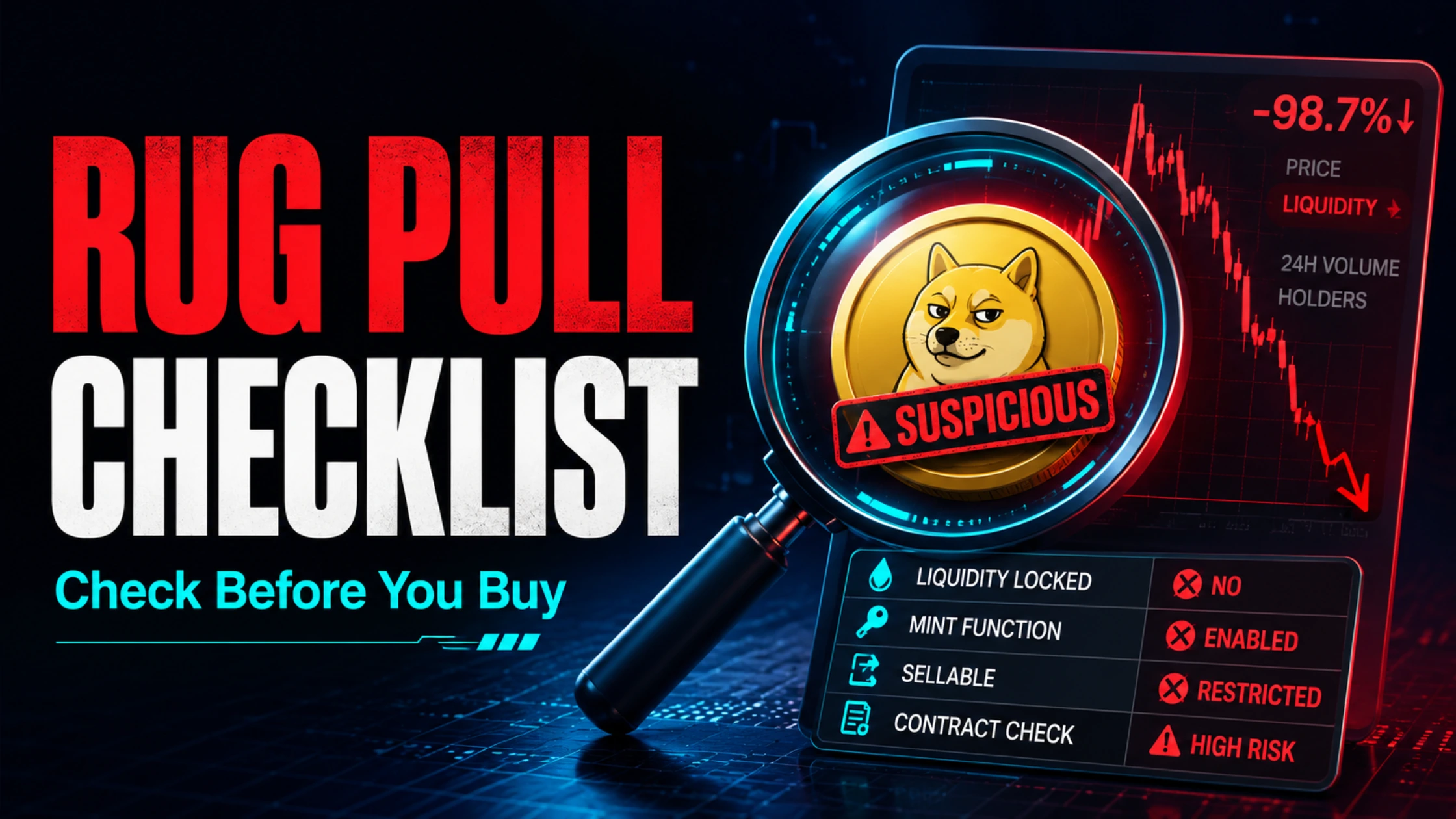
How to Check if a Token Is a Rug Pull or Scam in 2026: The DN Rug Risk Scanner
Before you ape into a new token, run it through the checks that actually catch rugs — liquidity, mint authority, sell ability and concentration — and get a clear red, amber or green verdict.
To check if a token is a rug pull, verify four things before anything else: whether liquidity is locked or burned (so the team cannot pull it), whether the mint authority is renounced (so they cannot print unlimited supply), whether you can actually sell it (not a honeypot), and whether the contract is verified and free of dangerous functions. Then check holder concentration and liquidity depth. The scanner below deep-links your contract to live explorers and honeypot checkers, walks you through each test, and computes a DN Rug Risk Score with a red, amber or green verdict. No tool can guarantee a token is safe — but a single failed critical check is usually enough to walk away.
A rug pull is the crypto scam that hurts most because it is dressed as opportunity. A new token launches, a chart goes vertical, a community buzzes, and the fear of missing out does the rest. Then the team pulls the liquidity, disables selling, or mints a billion new tokens, and the price goes to zero in a single block. The victims did nothing wrong except skip the ten minutes of checks that would have shown the trap. Those checks are not secret or technical; they are a fixed, knowable list, and almost every rug fails at least one of them loudly.
This scanner turns that list into a guided process. It will not pretend to magically declare a token "safe" with one click; no honest tool can, because the data that catches rugs lives across explorers, locker contracts and trade simulators that no single free widget can fully read for you. Instead it deep-links your exact contract to the right live tools, tells you precisely what to look for, and scores what you find into a clear verdict. The result is better than a black box: you learn to see the traps yourself, which protects you on the next token too.
For newer tokens, trading on a major exchange that has already vetted and listed the asset removes much of this risk. Once you hold for the long term, move coins off exchanges into self-custody.
Anatomy of a rug
Almost every rug pull works through one of a small number of mechanisms, and understanding them is what makes the checks obvious rather than arbitrary. The first and most common is the liquidity pull: the team holds the pool's liquidity provider tokens and, once enough buyers are in, removes the liquidity entirely, leaving holders with a token they cannot sell into any market. If the liquidity is locked in a reputable time-locker or the LP tokens are burned, this attack is impossible — which is why it is the single most important thing to verify.
The second is the mint attack: if the contract's mint authority is still active, the team can create unlimited new tokens at will, dumping them into the pool and crushing the price to nothing. Renounced mint authority closes this door. The third is the honeypot: a contract written so that buys succeed but sells silently fail, trapping every buyer. You only discover it when you try to exit and cannot. The fourth is the slow bleed of malicious contract functions — hidden blacklists, transfer pauses, or a tax the team can raise to one hundred percent after you buy. Each of these leaves fingerprints that the right check will catch before you commit a cent.
The checklist explained
The scanner's checks map directly onto those attacks, weighted by how lethal each one is. Liquidity locked or burned carries the most weight because the liquidity pull is the most common and most total rug. Mint authority and the honeypot sell test follow closely, since an active mint or an unsellable token are each fatal on their own. Contract verification and permissions catch the malicious-function rugs: an unverified contract is a black box you cannot trust, and a verified one may still hide blacklist, pause or modifiable-tax functions worth flagging.
Below the critical four sit the distribution checks. Holder concentration matters because if one non-liquidity wallet holds a large share, that wallet can dump and tank the price regardless of any other safeguard. Liquidity depth tells you how easily the price can be manipulated; a token with thin liquidity is a toy for whoever holds the most. Token age and tax level round it out, because brand-new tokens carry the highest base rate of fraud and extractive or modifiable taxes are a quiet way to bleed holders. Each link in the tool sends your specific contract to the live tool that answers that check, so you are reading real data, not guessing.
Reading the score
The DN Rug Risk Score runs from zero, meaning no red flags were found in any check, to one hundred, meaning the token fails comprehensively. A green verdict, below twenty-one, means the critical protections are in place and nothing obvious is wrong. An amber verdict, up to forty-five, means there are real risks worth pausing over — a short liquidity lock, moderate concentration, a very new token. A red verdict, above that, means walk away.
One feature matters more than the number itself: a single failed critical check forces a red verdict no matter how clean everything else looks. A token can pass every other test, but if you cannot sell it, or its liquidity is unlocked, that one fact is the whole story. This is deliberate, because rugs are not a balance of pros and cons; they are a single fatal flaw waiting to be triggered. It is also why "can't tell" counts as risk throughout: if you cannot verify a critical protection, the honest assumption is that it is absent. A high score because you could not check is the tool correctly telling you that you do not have enough information to risk your money.
Safe entry practice
No scanner, free or paid, can promise a token is safe, and anyone claiming otherwise is selling you a false sense of security. A clean green score reduces your risk; it does not remove it. The most reliable protection remains the oldest one: only risk what you can afford to lose entirely, especially on new, low-liquidity tokens, and treat every fresh launch as a high-probability loss until proven otherwise over time.
For most readers, the bigger lesson is that the easiest way to sidestep rug risk is to skip the most dangerous arena. Tokens that have been listed on a major centralised exchange have already cleared a basic vetting and listing bar that random DEX tokens have not, which is why trading newer assets on a vetted venue removes a large slice of this risk at a stroke. And once you hold anything for the long term, custody it yourself in a hardware wallet, where no exchange failure or malicious contract approval can reach it. Due diligence on the token, a vetted venue to trade it, and self-custody to hold it — that is the full stack of protection, and the scanner is the first layer of it.
Frequently asked questions
How do I check if a token is a rug pull or scam?
Verify four critical things before buying: is liquidity locked or burned, is the mint authority renounced, can you actually sell it (not a honeypot), and is the contract verified without dangerous functions. Then check holder concentration and liquidity depth. The scanner above deep-links your contract to live explorers and honeypot tools, guides you through each check, and scores the result. A single failed critical check is usually enough reason to walk away.
What is the DN Rug Risk Score?
It is a transparent weighted score from zero (no red flags found) to one hundred (fails comprehensively), based on your answers to the checklist. Critical checks like liquidity and sellability carry the most weight, and a single fatal failure forces a red verdict regardless of the total. It scores red flags found — it does not certify safety.
What does it mean if liquidity is not locked?
It means the team can withdraw the trading liquidity at any moment, leaving you holding a token with no market to sell into — the most common rug pull. Locked (in a reputable time-locker) or burned liquidity makes this impossible, which is why it is the highest-weighted check. Unlocked liquidity alone is enough to force a red verdict.
What is a honeypot token?
A honeypot is a contract written so that buying works but selling silently fails, trapping every buyer. You only discover it when you try to exit. Always run a new token through a honeypot simulator before buying; if it reports you cannot sell, or that the sell tax is extreme, do not touch it.
Can a scanner guarantee a token is safe?
No. No tool, free or paid, can guarantee safety, because teams can change behaviour, exploit unknown bugs or act maliciously after launch. A clean score lowers your risk by ruling out the obvious traps, but new and low-liquidity tokens remain high-risk. Only ever invest what you can afford to lose entirely.
What is the safest way to trade new tokens?
The lowest-risk path is to trade newer tokens on a major centralised exchange that has already vetted and listed them, rather than buying unknown contracts directly on a DEX. For long-term holdings, move your coins into a hardware wallet for self-custody, beyond the reach of exchange failures or malicious contract approvals.
This tool and article are for educational and informational purposes only and do not constitute financial advice or an endorsement of any token. The DN Rug Risk Score reflects your own answers to a checklist and is not a certification of safety; a green or low score means no major red flags were identified in these specific checks, not that a token is safe to buy. The scanner links to independent third-party tools for verification and is not responsible for their accuracy. Cryptocurrency tokens, especially new and low-liquidity ones, are extremely high-risk and many are scams; you can lose your entire investment. Always do your own research and never invest more than you can afford to lose. Decentralised News may earn a commission from exchanges and services linked here at no additional cost to you.
About the Author