Best Intent-Based DEXs 2027: Which Solvers Actually Improve Your Trade?
What matters
An intent route earns its place when the user receives a better comparable outcome after fees, timing and failed attempts are counted. This guide supplies a measurement method and an illustrative calculator, not a measured venue ranking. Solver concentration needs its own denominator and ownership evidence. Neither a better fill than the displayed quote nor a large solver roster establishes competitive execution.
Evidence reviewed: 12 November 2026
Documented: protocol mechanisms and available observation interfaces. Illustrative: the calculator defaults and numerical examples below. Not established: a DN comparative execution sample, a current venue winner, a measured top-three solver share or a causal agent-specific slippage estimate. The title’s 2027 horizon is a planning horizon; it is not a claim to have collected future results.
Define the improvement before ranking the route
A signed intent normally constrains an acceptable outcome while allowing another participant to arrange execution. This separates the user’s requested result from the route used to deliver it. The comparison still begins with an ordinary question: what could this same user have received through a feasible alternative at the relevant time?
Three baselines answer different questions. Improvement against the displayed quote measures quote-to-fill change. Improvement against the signed minimum measures distance from a user constraint, which may be deliberately loose. Improvement against a contemporaneous alternative estimates a routing advantage. A venue can beat the first two while underperforming the third. Keep all three labels attached to their denominators.
The alternative must match chain, token contracts, direction, quantity, recipient, allowances, deadline and relevant access restrictions. A screen quote that the account could not execute is weak evidence. A transaction simulation records a possible route at a particular state, not an execution that actually happened. Simulating alternatives avoids spending on unnecessary duplicate trades, but introduces counterfactual uncertainty that the results must retain.
Use one unit and charge each cost once
For a common output-value unit, define I = realized intent output − costs paid separately by its user and B = comparable alternative output − its separately paid costs. The net advantage is 10,000 × (I − B) / B, provided B > 0. Dollar edge is I − B only when the inputs genuinely use the same dollar valuation basis.
Do not subtract an aggregator fee twice if the quote already includes it. Do not subtract a solver’s gas bill from the user again when that cost is already reflected in the delivered amount. Conversely, account for approvals, transaction fees, separately invoiced charges and conversion costs when they fall inside the comparison boundary. A token balance is not automatically a dollar value: record the valuation source, timestamp and treatment of depegging or transfer taxes.
Constructed example: intent output of $9,990 with no separately paid user gas is compared with alternative output of $9,987 and $5 gas. The output-only difference is approximately 3.00 basis points. The alternative’s net value is $9,982, so the net advantage is approximately 8.01 basis points and $8. Against a displayed intent quote of $9,985, quote improvement is approximately 5.01 basis points. These are three valid calculations with three meanings; none is an observed venue result.
A more ambitious “user surplus capture” percentage also needs a credible estimate of all surplus available to distribute. The user’s minimum alone does not supply that estimate. Without an identified opportunity set, keep the user outcome and disclosed fee allocation separate instead of inventing a capture ratio.
What the documented architectures change
| System | Documented mechanism | Evidence the comparison should retain |
|---|---|---|
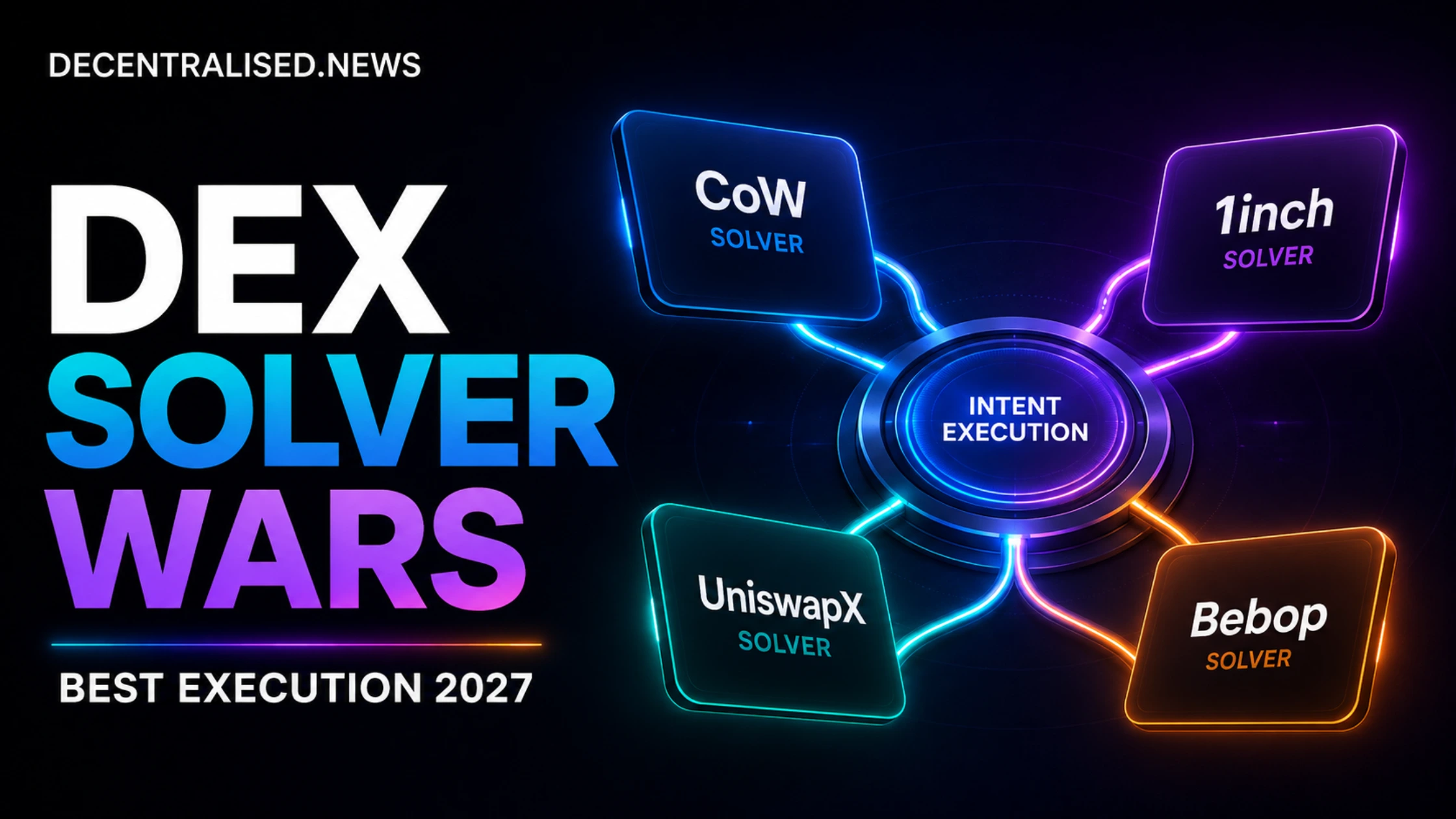
| CoW Protocol | Combinatorial competition can select compatible solutions across pairs and solvers. Its current guidance separates a reported score from the solver’s estimate of economic value. | Auction and order identifiers, selected solutions, executed amounts, fee allocation and settlement outcome. One auction need not mean one winner. |
| 1inch Fusion | The intent mode uses third-party resolvers and dynamic pricing; the product family also distinguishes classic and cross-chain modes. | The specific mode, chain, quote and auction configuration, expiry, resolver information where available, and the user’s final received amount. |
| UniswapX | The current filler integration guide describes RFQ followed by exclusive Dutch auctions, with timestamp-based Dutch V2 and block-based Dutch V3 timing. | Order type, reactor, quote and exclusivity parameters, decay schedule and settlement. Preserve the documentation version because integrations change. |
| Bebop | Its official description separates a private-market-maker RFQ API from JAM solver auctions and describes a router that considers both. | Which path produced the quote and fill, quote validity and fees. A blended router result does not identify a private-liquidity advantage by itself. |
These are mechanism descriptions, not performance findings. CoW’s competition rules and bidding guide, the 1inch API introduction, Uniswap’s current filler guide, and Bebop’s maintained project documentation support the distinctions. They do not supply a synchronized DN sample across the four venues. [1] [2] [3] [4] [5]
In particular, CoW’s documented reported score combines user surplus, protocol fees and partner fees. The user receives the user-surplus component. Execution costs belong to the separate value estimate described in that guide. Treating the auction score as a pure user saving, or applying an old simplified score formula to current auctions, can misstate the result. [2]
Measure reliability without discarding inconvenient orders
Define an eligible submitted order before observing its result. Count full fills, partial fills, expiry, execution failure, cancellation and unresolved cases separately. Explain which cancellations are user decisions and which follow a route failure; do not silently exclude all cancellations. A 99% fill rate is not interpretable without the count, deadline, eligibility rule and treatment of pending orders.
Time-to-fill needs a start event and an end event. Quote request to response measures a different delay from signature to settlement. Keep clock source and precision with each timestamp. Report a median and an adverse tail alongside the number of observations. Pending orders are censored observations, not zero-duration successes. An expiry is not an infinitely long completed fill.
For execution tails, define the adverse-loss variable first: for example, max(0, −net advantage in bps). Its 95th percentile answers a different question from the 95th percentile of signed improvement. Show both favorable and adverse results where useful. A convenient average should not conceal a small number of substantial losses, while a tiny cohort should not receive a confident tail estimate.
Build a solver concentration ledger with a declared denominator
Outline 15 belongs inside this execution study because concentration can affect the choice of comparison, sample and fallback. Start with a fixed window, chain, order type and size cohort. Publish at least two views when the data permit: share of executed order count and share of comparable executed value. A solver that handles many small orders can lead one view and trail the other.
For nonnegative shares sᵢ summing to one, calculate HHI = Σsᵢ² and effective count = 1 / HHI. Also show the top-three share, the actual observed participant count and the unmapped fraction. In an illustrative three-solver market, shares of 80%, 10% and 10% give HHI 0.66 and an effective count of about 1.52. Shares of 50%, 30% and 20% give HHI 0.38 and an effective count of about 2.63. Both have a 100% top-three share. That headline alone hides an important distributional difference.
These values describe a chosen distribution; they do not prove collusion, monopoly power or poor fills. Map operator entities separately from addresses. Keep confirmed relationships distinct from suspected clusters and unknown ownership. Never equate a new address with an independent competitor. If identities are missing, report concentration among the identified subset with its coverage, rather than pretending the subset is the whole market.
Orderbook and solver-competition interfaces can support this work, but they require joins, deduplication, stable identifiers and an explicit treatment of multi-solution auctions. Count an executed order once in the order-share denominator; do not count every candidate bid as another completed user trade. Retain failures and absent API fields in a separate coverage ledger. [6]
Test price and concentration together without inventing causation
Split deep pairs from thin markets, and small orders from larger ones. Match market state and collection windows. A route may appear better because it receives easier orders, has access to a different token set or is sampled during calmer periods. A concentration change may accompany a fee reform or altered demand. Describe these confounders before attributing an outcome to the number of solvers.
Preserve paired observations where feasible, and publish missing quotes, simulation failures and excluded orders. A predeclared sample target helps discipline collection, but “100 observations” is not a universal guarantee that a few basis points are meaningful. Dependence between adjacent orders, volatile tails and many pairwise comparisons all affect uncertainty. Set the precision objective first, then report what the collected sample can support.
Do not identify autonomous-agent traffic from wallet speed alone. Do not infer an anonymity premium by comparing pools with different collateral, access, liquidity or credit terms. Do not turn protocol rules against score inflation into evidence of a measured spoofing attack. CoW documents competition constraints; incident frequency and agent-specific loss require their own labeled observations. [1]
The practical routing decision can be modest: retain a route that improves comparable net outcomes within the user’s deadline, keep a viable fallback, and monitor the adverse tail. Publish the sample and uncertainties before naming a market winner. For multi-chain commitments and refunds, use the separate DN cross-chain execution guide; this single-route calculator does not establish cross-chain rollback reliability.
Machine-readable Intent Execution and Solver Concentration Record
Schema urn:dn:intent-execution-observation:v1, version 1.0.0. Copy the blank JSON below and retain non-sensitive references for the defined review. All unknowns remain explicit. Change basis to self_reported_review and supply a real calendar review date and subject when completing it. The schema checks structure only; it does not fetch or authenticate a reference. No API or live dataset is implied.
| Area key | Meaning |
|---|---|
orderAndVersion | Order/auction reference, chain, token contracts, direction, quantity, order type, reactor and protocol version. |
quoteAndAuthority | Displayed quote, signed minimum, recipient, access conditions, authority and expiry; references only. |
baselineAndValuation | Feasible matched alternative, state/timestamp, common valuation unit and separately paid cost boundary. |
outcomeAndCosts | Realized full/partial fill, delivered amounts, actual separately paid costs, expiry/cancellation/failure/pending state. |
eventTimes | Quote request, response, signature, submission and settlement; clock source, precision and timezone. |
cohortAndCoverage | Collection window, eligibility, sizes, missing quotes, failures, exclusions and unresolved outcomes. |
operatorMapping | Known operator/address mapping, evidence, suspected relationships and unmapped coverage kept separate. |
concentrationDefinition | Order-count or executed-value denominator, deduplication, shares, multi-solution treatment and independent recomputation references. |
Each area has status (unknown, reference_recorded or issue_recorded), reference and notes. A recorded reference or issue requires a non-empty reference. Unknown means unresolved; it is not an observed zero or a failure finding. Preserve private source documents in their authorized system rather than embedding account numbers or credentials.
Copy blank record JSON
{
  "recordType": "intent-execution-observation",
  "schemaVersion": "1.0.0",
  "basis": "blank_template",
  "reviewedDate": null,
  "subject": null,
  "areas": {
    "orderAndVersion": {
      "status": "unknown",
      "reference": null,
      "notes": null
    },
    "quoteAndAuthority": {
      "status": "unknown",
      "reference": null,
      "notes": null
    },
    "baselineAndValuation": {
      "status": "unknown",
      "reference": null,
      "notes": null
    },
    "outcomeAndCosts": {
      "status": "unknown",
      "reference": null,
      "notes": null
    },
    "eventTimes": {
      "status": "unknown",
      "reference": null,
      "notes": null
    },
    "cohortAndCoverage": {
      "status": "unknown",
      "reference": null,
      "notes": null
    },
    "operatorMapping": {
      "status": "unknown",
      "reference": null,
      "notes": null
    },
    "concentrationDefinition": {
      "status": "unknown",
      "reference": null,
      "notes": null
    }
  },
  "boundary": "This record does not independently verify evidence, measure performance or authorize an action."
}
Documented JSON Schema
{
"$schema": "https://json-schema.org/draft/2020-12/schema",
"$id": "urn:dn:intent-execution-observation:v1",
"title": "Intent Execution and Solver Concentration Record",
"description": "An entered evidence record. Schema validation checks structure, not authenticity, legal permission or physical or financial outcomes.",
"type": "object",
"additionalProperties": false,
"required": [
"recordType",
"schemaVersion",
"basis",
"reviewedDate",
"subject",
"areas",
"boundary"
],
"properties": {
"recordType": {
"const": "intent-execution-observation"
},
"schemaVersion": {
"const": "1.0.0"
},
"basis": {
"enum": [
"blank_template",
"self_reported_review"
]
},
"reviewedDate": {
"type": [
"string",
"null"
],
"pattern": "^\\d{4}-\\d{2}-\\d{2}$",
"format": "date"
},
"subject": {
"type": [
"string",
"null"
],
"maxLength": 240
},
"areas": {
"type": "object",
"additionalProperties": false,
"required": [
"orderAndVersion",
"quoteAndAuthority",
"baselineAndValuation",
"outcomeAndCosts",
"eventTimes",
"cohortAndCoverage",
"operatorMapping",
"concentrationDefinition"
],
"properties": {
"orderAndVersion": {
"type": "object",
"additionalProperties": false,
"required": [
"status",
"reference",
"notes"
],
"properties": {
"status": {
"enum": [
"unknown",
"reference_recorded",
"issue_recorded"
]
},
"reference": {
"type": [
"string",
"null"
],
"maxLength": 1000
},
"notes": {
"type": [
"string",
"null"
],
"maxLength": 2000
}
},
"allOf": [
{
"if": {
"properties": {
"status": {
"enum": [
"reference_recorded",
"issue_recorded"
]
}
}
},
"then": {
"properties": {
"reference": {
"type": "string",
"minLength": 1
}
}
}
}
]
},
"quoteAndAuthority": {
"type": "object",
"additionalProperties": false,
"required": [
"status",
"reference",
"notes"
],
"properties": {
"status": {
"enum": [
"unknown",
"reference_recorded",
"issue_recorded"
]
},
"reference": {
"type": [
"string",
"null"
],
"maxLength": 1000
},
"notes": {
"type": [
"string",
"null"
],
"maxLength": 2000
}
},
"allOf": [
{
"if": {
"properties": {
"status": {
"enum": [
"reference_recorded",
"issue_recorded"
]
}
}
},
"then": {
"properties": {
"reference": {
"type": "string",
"minLength": 1
}
}
}
}
]
},
"baselineAndValuation": {
"type": "object",
"additionalProperties": false,
"required": [
"status",
"reference",
"notes"
],
"properties": {
"status": {
"enum": [
"unknown",
"reference_recorded",
"issue_recorded"
]
},
"reference": {
"type": [
"string",
"null"
],
"maxLength": 1000
},
"notes": {
"type": [
"string",
"null"
],
"maxLength": 2000
}
},
"allOf": [
{
"if": {
"properties": {
"status": {
"enum": [
"reference_recorded",
"issue_recorded"
]
}
}
},
"then": {
"properties": {
"reference": {
"type": "string",
"minLength": 1
}
}
}
}
]
},
"outcomeAndCosts": {
"type": "object",
"additionalProperties": false,
"required": [
"status",
"reference",
"notes"
],
"properties": {
"status": {
"enum": [
"unknown",
"reference_recorded",
"issue_recorded"
]
},
"reference": {
"type": [
"string",
"null"
],
"maxLength": 1000
},
"notes": {
"type": [
"string",
"null"
],
"maxLength": 2000
}
},
"allOf": [
{
"if": {
"properties": {
"status": {
"enum": [
"reference_recorded",
"issue_recorded"
]
}
}
},
"then": {
"properties": {
"reference": {
"type": "string",
"minLength": 1
}
}
}
}
]
},
"eventTimes": {
"type": "object",
"additionalProperties": false,
"required": [
"status",
"reference",
"notes"
],
"properties": {
"status": {
"enum": [
"unknown",
"reference_recorded",
"issue_recorded"
]
},
"reference": {
"type": [
"string",
"null"
],
"maxLength": 1000
},
"notes": {
"type": [
"string",
"null"
],
"maxLength": 2000
}
},
"allOf": [
{
"if": {
"properties": {
"status": {
"enum": [
"reference_recorded",
"issue_recorded"
]
}
}
},
"then": {
"properties": {
"reference": {
"type": "string",
"minLength": 1
}
}
}
}
]
},
"cohortAndCoverage": {
"type": "object",
"additionalProperties": false,
"required": [
"status",
"reference",
"notes"
],
"properties": {
"status": {
"enum": [
"unknown",
"reference_recorded",
"issue_recorded"
]
},
"reference": {
"type": [
"string",
"null"
],
"maxLength": 1000
},
"notes": {
"type": [
"string",
"null"
],
"maxLength": 2000
}
},
"allOf": [
{
"if": {
"properties": {
"status": {
"enum": [
"reference_recorded",
"issue_recorded"
]
}
}
},
"then": {
"properties": {
"reference": {
"type": "string",
"minLength": 1
}
}
}
}
]
},
"operatorMapping": {
"type": "object",
"additionalProperties": false,
"required": [
"status",
"reference",
"notes"
],
"properties": {
"status": {
"enum": [
"unknown",
"reference_recorded",
"issue_recorded"
]
},
"reference": {
"type": [
"string",
"null"
],
"maxLength": 1000
},
"notes": {
"type": [
"string",
"null"
],
"maxLength": 2000
}
},
"allOf": [
{
"if": {
"properties": {
"status": {
"enum": [
"reference_recorded",
"issue_recorded"
]
}
}
},
"then": {
"properties": {
"reference": {
"type": "string",
"minLength": 1
}
}
}
}
]
},
"concentrationDefinition": {
"type": "object",
"additionalProperties": false,
"required": [
"status",
"reference",
"notes"
],
"properties": {
"status": {
"enum": [
"unknown",
"reference_recorded",
"issue_recorded"
]
},
"reference": {
"type": [
"string",
"null"
],
"maxLength": 1000
},
"notes": {
"type": [
"string",
"null"
],
"maxLength": 2000
}
},
"allOf": [
{
"if": {
"properties": {
"status": {
"enum": [
"reference_recorded",
"issue_recorded"
]
}
}
},
"then": {
"properties": {
"reference": {
"type": "string",
"minLength": 1
}
}
}
}
]
}
}
},
"boundary": {
"const": "This record does not independently verify evidence, measure performance or authorize an action."
}
},
"allOf": [
{
"if": {
"properties": {
"basis": {
"const": "self_reported_review"
}
}
},
"then": {
"properties": {
"reviewedDate": {
"type": "string"
},
"subject": {
"type": "string",
"minLength": 1
}
}
}
}
]
}
DN Solver Outcome Simulator
Compare an intent-based execution with a standardized alternative route. The calculator compares the entered outcomes after directly paid gas. Defaults are illustrative; its grade is an uncalibrated scenario label, not a venue rating.
Trade Observation
DN Execution Analysis
What the Same Solver Edge Is Worth at Different Order Sizes
| Trade Size | Gas-Adjusted Edge | Dollar Value |
|---|
DN-ISQB v1.0 Methodology
Positive numbers indicate that the intent execution outperformed the standardized alternative supplied by the user.
The counterfactual is an entered estimate. A measured comparison would require synchronized route evidence, reference timestamps, a defined cohort and uncertainty. No comparative live dataset is represented by this calculator.
Explore Intent-Based Execution
CoW Swap Intent-based EVM trading using solver competition and batch auctions. DN referral code: DECENTRALISED.Using the retained calculator honestly
The calculator above is a scenario aid. Its defaults are illustrative, not API observations. Enter positive, comparable quote and alternative values, separately paid gas, and a documented timing boundary. The existing interface converts blank, negative or non-numeric numeric fields to zero and caps entered reliability at 100%. It does not authenticate a quote, query a venue or reject every economically invalid comparison. Do not interpret a zero-divisor fallback as measured zero improvement.
The output-only field compares received amounts before the entered gas. Gas-Adjusted Advantage compares the two net values. Declared trade value is contextual: changing that input alone does not recompute the entered quote, received amount or fees. The size table applies the same computed basis-point edge to four reference notionals; it assumes a constant edge and does not simulate liquidity, fixed gas or achievable large-order execution.
The A–F label is an uncalibrated scenario convention. A requires at least 5 basis points of entered net advantage, at least 99% entered reliability and an entered adverse tail no greater than 10 basis points. Subsequent bands use other fixed thresholds in the retained model. No dataset establishes that these bands predict future outcomes. A zero entered tail can mean an assumed scenario; it must never represent missing empirical tail evidence. Time-to-fill is displayed separately and is not part of that grade.
Frequently asked questions
Which intent DEX is best in this review?
No measured winner is established. The current article compares mechanisms and specifies the evidence needed to compare outcomes. Protocol documentation alone cannot rank realized user execution.
Does gasless execution eliminate transaction costs?
It can remove a separate gas payment by the swapper. Economic costs may still affect the quoted or delivered amount. Compare net user outcomes and avoid charging an embedded cost twice.
Does more solver competition necessarily improve price?
A roster, active bidder count, winning share and independently controlled operator count are different measures. Relate a clearly defined concentration series to comparable execution observations before making an empirical claim.
Can a fast wallet be labeled an AI agent?
No. Timing and repeated behavior can identify a research cohort, but do not establish software identity, human control or the purpose of its transactions. Agent-specific claims need documented labels and uncertainty.
What would make this a measured DN benchmark?
A published collection window, matched order and baseline records, reproducible fee treatment, coverage and exclusion counts, protocol versions, independent operator mapping where asserted, and an uncertainty analysis. No such comparative dataset is represented as published here.
Sources and review boundaries
- CoW Protocol: competition rules — combinatorial selection, settlement and conduct constraints.
- CoW Protocol: recommended bidding strategy — current distinction between reported score, user surplus, fee components and execution-cost-adjusted value.
- 1inch: Swap API introduction — classic, intent and cross-chain modes; intent resolvers and dynamic pricing. Retrieved documentation supports architecture, not comparative fills.
- Uniswap: Fillers Overview — current RFQ/exclusive Dutch integration paths and role distinctions. Legacy pages and deployed contracts may describe older paths; record the actual order version.
- Bebop: maintained official project overview — PMM RFQ, JAM and router distinction. Provider marketing language is not independent proof of execution superiority.
- CoW Protocol: orderbook API reference — observation interface; availability is not a completed sample.
Corrections and changelog
12 November 2026: merged intent-slippage and solver-concentration coverage into this existing canonical. Removed unmeasured “Live” leaderboard placeholders, an unrechecked active-solver count, unsupported comparative performance numbers and the proposed composite leaderboard weights. Corrected the current CoW score description and the calculator’s output-only label. Retained its functioning scenario interface, with its input, grade and scaling limits stated explicitly. Added a versioned observation record and removed the redundant Article schema with its incorrect canonical URL; the site supplies the Article shell.
For a correction, identify the protocol version, observation window, order or document reference, and the specific disputed statement. Do not send credentials, private order flow or personal account information. A later empirical result should be published with its data boundary and methods, rather than silently replacing an illustrative number.
About the Author