What Matters
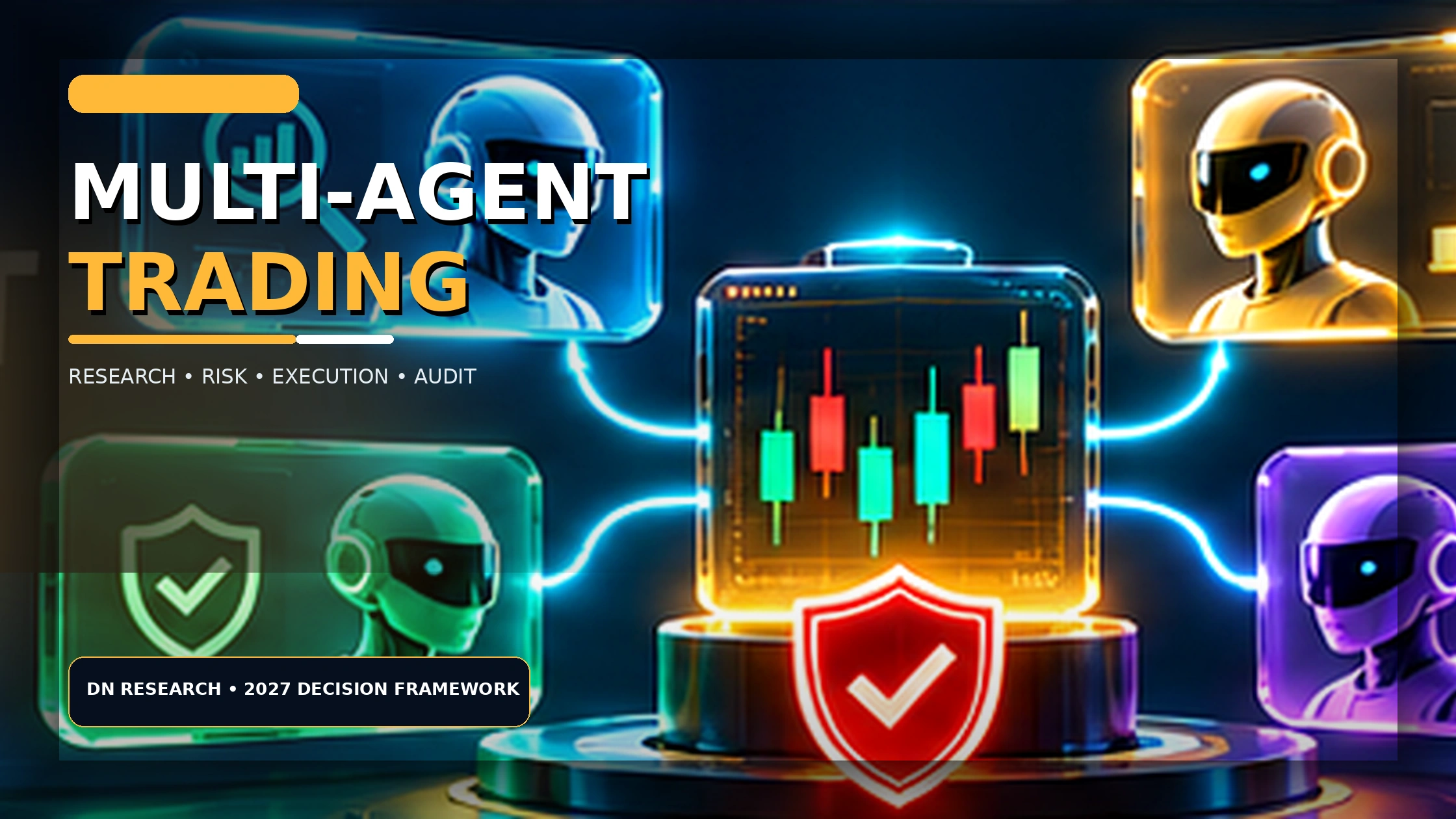
A multi-agent trading team is useful when different jobs need different evidence and authority. A researcher can gather data, a strategist can propose a trade, a risk manager can reject it, an execution agent can place a bounded order and an auditor can reconcile the result. More agents do not create alpha by themselves. The advantage comes from role separation, independent checks and a workflow that makes disagreement visible.
DN Evidence Block
Reviewed: 19 November 2026. Primary evidence: LangGraph graph and supervisor documentation; Microsoft AutoGen team patterns; NIST AI Risk Management Framework; SEC market-access risk-control principles; DN research on observability, fail-safes and trade-thesis lineage.
Boundary: no public multi-agent framework proves durable trading outperformance. The architectures below are operating patterns, not performance claims.
Why Split One Trading Agent Into a Team?
A single agent can read news, calculate indicators, propose an order and send it. That simplicity reduces latency and cost, but it also concentrates reasoning, data access and financial authority inside one component. If the prompt, data or model is wrong, there may be no independent challenge before capital moves.
Multi-agent systems introduce explicit roles. LangGraph models workflows as shared state, nodes and edges, while AutoGen provides team patterns such as round-robin, selector groups, swarms and directed graph workflows. Those frameworks make coordination possible; they do not decide whether the financial architecture is safe.
| Role | Primary question | Permitted output | Should control money? | Evidence to retain |
|---|---|---|---|---|
| Researcher | What happened and what evidence supports it? | Sourced facts, datasets and uncertainty | No | URLs, timestamps, raw data and transformations |
| Market analyst | What regime, liquidity and volatility conditions exist? | Features, scenarios and invalidation levels | No | Feature versions, data windows and calculations |
| Strategist | What trade, if any, follows from the evidence? | Trade thesis with entry, exit and size proposal | Normally no | Thesis, assumptions, expected costs and alternatives |
| Risk manager | Does the proposal fit policy and capital limits? | Approve, resize, defer or reject | Veto authority, not unrestricted execution | Limit checks, exposure and rejection reason |
| Execution agent | How can the approved action be executed safely? | Bounded order with venue, price and deadline | Yes, within narrow policy | Order payload, client ID, receipt and fills |
| Auditor | Did the intended and actual outcomes match? | Reconciliation and exception report | No | Positions, balances, fees, slippage and incidents |
Four Coordination Patterns
1. Supervisor Architecture
A supervisor chooses which specialist acts next. This is easy to understand and works well when one orchestrator maintains the task state. The weakness is concentration: a flawed supervisor can route around dissent, omit evidence or repeatedly call expensive agents.
2. Directed Graph
A graph defines fixed and conditional transitions: research must finish before strategy, risk approval must precede execution, and reconciliation must follow every order. This structure is often preferable for finance because authority can be encoded in the workflow instead of left to conversational improvisation.
3. Debate and Critic
One agent proposes a position while another attempts to falsify it. The result can improve evidence quality, but only if the agents use independent sources and incentives. Two agents using the same model, prompt template and data provider may produce the appearance of debate without real independence.
4. Parallel Specialists With Deterministic Aggregation
Several specialists score liquidity, trend, fundamentals and operational risk. A deterministic policy combines those scores and refuses execution when required evidence is missing. This reduces dependence on one narrative but requires careful calibration and version control.
DN Rule
The risk manager must be able to stop the team without asking the team for permission. Hard limits on position size, leverage, daily loss, permitted venues and counterparties should be enforced outside the language-model conversation.
Conflict Resolution: What Happens When Agents Disagree?
Consensus is not automatically safe. A majority of correlated agents can be wrong, while one specialist may identify a decisive risk. Financial workflows need explicit conflict rules:
- Risk veto: a policy breach blocks the trade regardless of votes.
- Evidence threshold: missing or stale primary data forces defer rather than guess.
- Confidence is not authority: a confident model cannot increase capital limits.
- Human escalation: material new counterparties, leverage changes and model upgrades require review.
- Time limit: if the team cannot resolve disagreement before the opportunity expires, it does nothing.
Cost Versus Alpha
Each additional agent adds model calls, data access, orchestration latency and failure modes. A research team may justify that cost for a daily allocation decision, but not for a sub-second execution loop. The high-frequency path should be deterministic and pre-authorized; language models are better suited to slower research, exception handling and policy explanation.
Measure the team against a simpler baseline. If the multi-agent system produces the same trades with more latency and cost, it is organizational theatre. The useful question is whether independent roles reduce errors, improve rejection quality, capture better evidence or make incidents easier to reconstruct.
Reference Architecture
- Ingest market and onchain data into a versioned evidence store.
- Run parallel research agents with source and timestamp requirements.
- Build a structured thesis containing expected edge, costs and invalidation.
- Pass the thesis to an external risk service that applies deterministic limits.
- Require explicit approval for new markets, venues, contracts or authority.
- Send a bounded order to an execution service with a client order ID.
- Reconcile fills, balances and resulting exposure before any retry.
- Store the complete decision record for audit and evaluation.
DN’s Trade Thesis Lineage, Agent Observability and Bot Fail-Safe Benchmark provide the supporting evidence and operational controls.
DN Multi-Agent Trading Architecture Test
Score one proposed team. Higher scores mean more concentrated authority and weaker independence.
This screens architecture, not strategy profitability.
Worked Example
A research agent finds rising exchange inflows and negative news sentiment. A strategist proposes a short. The risk agent detects that the account already has correlated short exposure and rejects the original size. A deterministic policy allows only one-third of the proposal, while the execution service refuses the order because spread exceeds the maximum.
The valuable outcome is not a profitable trade; it is that each decision and rejection is attributable. A solo agent might have collapsed research, sizing and execution into one opaque response.
Methodology and Limitations
DN compared multi-agent patterns by role separation, evidence independence, authority boundaries, conflict resolution, shared-state design, operational cost and reconciliation. We did not benchmark proprietary trading performance. Framework capabilities and APIs change, and the presence of an orchestration feature does not make a system financially safe.
Frequently Asked Questions
Do multi-agent trading systems always outperform a single agent?
No. They can improve role separation and review, but also add cost, latency, state drift and correlated errors.
What is the safest multi-agent role to automate first?
Research and evidence collection are safer starting points than direct execution. Keep the risk gate and transaction authority independent.
Should the risk manager be another language model?
It may use a model for analysis, but hard financial limits should be enforced by deterministic code or an external policy service.
How should agents resolve disagreement?
Use explicit rules such as evidence thresholds, veto rights, deterministic limits and human escalation rather than letting the loudest agent win.
What should be logged?
Inputs, sources, model and prompt versions, tool calls, proposals, objections, approvals, orders, fills, costs and final reconciled outcomes.
Primary Sources
- LangGraph: Graph and Multi-Agent Workflows
- Microsoft AutoGen: Teams
- NIST AI RMF Core
- SEC: Market Access Risk Controls
Editorial disclosure: no framework, model provider or exchange paid for inclusion or conclusions.
About the Author