The Open AI Agent Stack 2027: A Practical Architecture and Cost Guide
The Open Agent Stack 2027: What to Build, Buy and Measure
An agent is more than a model plus a prompt. The production stack needs bounded tools, recoverable workflows, explicit approvals and a cost ledger tied to completed tasks.
By Decentralised News Research · Last verified: 24 September 2026 · 2027 planning guide · Suggested slug: open-agent-stack-2027
Meta description: Build an open AI agent stack for 2027. Compare frameworks, tools, memory, security and observability, then model monthly cost per successful task.
What Matters
Start with one workflow and one measurable outcome. Choose an orchestration layer that can pause, resume and log actions; put model calls behind a cost ledger; scope tools to the minimum authority; and require human approval for irreversible steps. The DN Stack Builder estimates cost per successful task and shows which layer to add next. Its inputs are assumptions, not vendor quotes.
DN Evidence Block
Evidence window: official documentation reviewed 24 September 2026. Sample: LangGraph, CrewAI, Temporal, LiteLLM, MCP, OpenTelemetry and OpenAI Agents SDK. Decisive facts: LangGraph documents persistence and interrupts; Temporal documents durable workflow execution; LiteLLM documents routing and spend tracking; MCP specifies tool connectivity. These are documented capabilities, not DN-tested reliability scores. Original asset: the DN Stack Builder and the five-layer selection framework below. Review: DN editorial desk; no named external technical reviewer commissioned. Method and limitations.
The DN thesis: optimize for a completed task
The agent stack's economic unit is a verified successful task, not a token, tool call or polished demo. A stack with cheaper inference can cost more if retries, human rescue and failures rise. DN calls this the Completion Cost Gap: the difference between apparent per-attempt spend and the fully loaded cost of one accepted outcome.
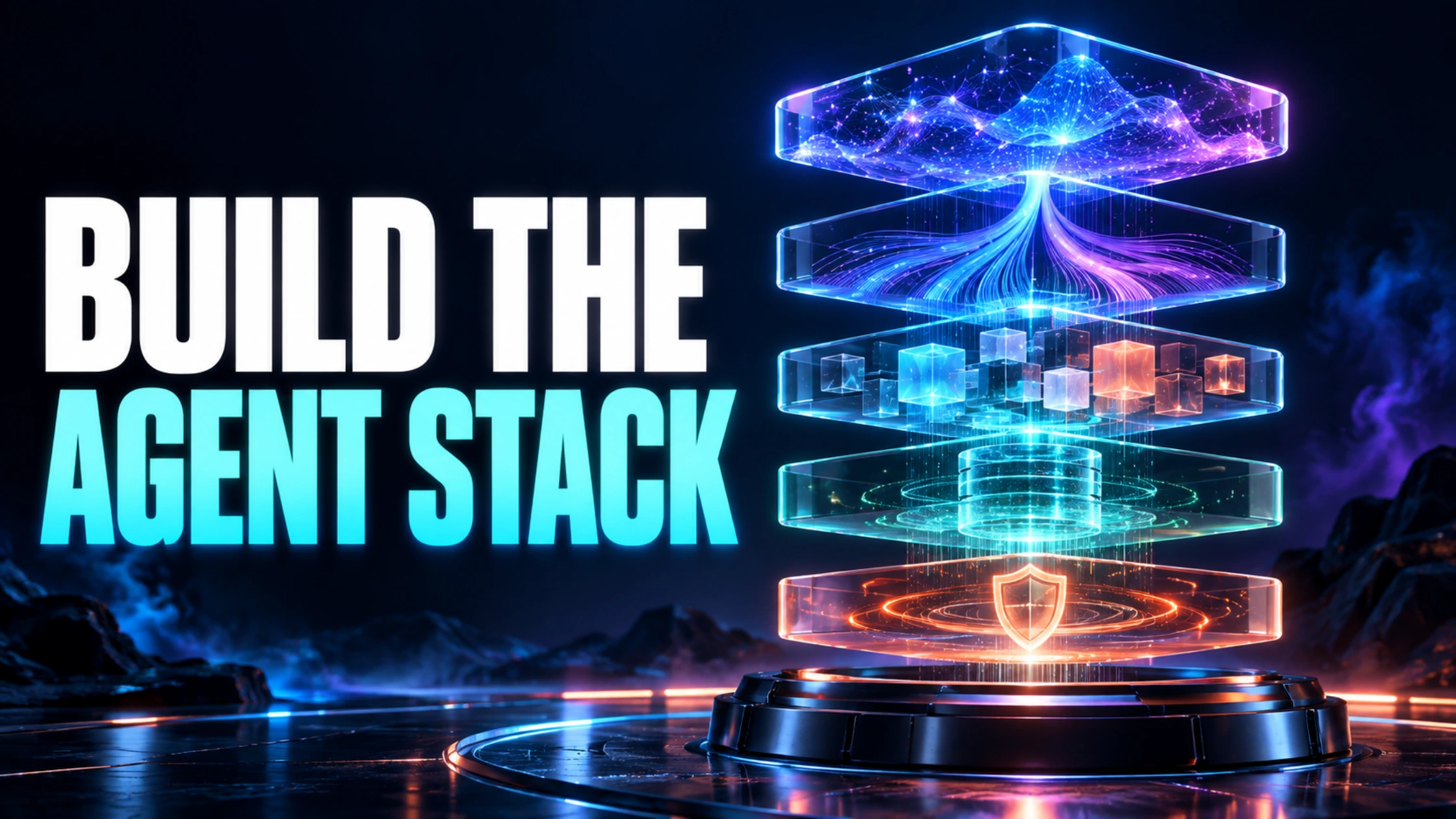
| Layer | Minimum viable choice | Add when | Failure to inspect |
|---|---|---|---|
| 1. Model access | Direct model API; record tokens and spend | A gateway when models or teams multiply | Unbounded calls, provider lock-in, silent fallback |
| 2. Orchestration | Explicit state machine or small agent loop | Durable checkpoints for long, interruptible work | Duplicate side effects after retries |
| 3. Tools and data | Typed APIs and narrow credentials | MCP where reusable tool integration helps | Excess permissions and untrusted tool output |
| 4. Memory and state | Task-scoped records and retrieval | Persistent stores when cross-session recall is needed | Stale facts, leakage and context bloat |
| 5. Evaluation and controls | Trace IDs, test set, approval gates, kill switch | Continuous evaluation and incident response at scale | “Success” counted without outcome validation |
These are architecture choices, not a vendor ranking. A simple deterministic workflow can outperform a multi-agent design for a constrained task. Add agents only when autonomy has a measurable payoff.
Open Agent Stack Builder
Enter your own observed or budgeted values. The calculator assumes independent attempts and a constant success rate. It estimates fully loaded monthly cost and cost per accepted task. No values below are live vendor prices.
Formula: successful tasks = attempts × accepted-outcome rate; total = attempts × (model/tool cost + review minutes × hourly rate ÷ 60 + rejected share × rework cost) + monthly fixed cost; cost per accepted task = total ÷ successful tasks. Partial task quality, correlated failures, infrastructure scaling and regulatory costs are excluded.
Choose the stack by workflow
| Use case | Starting architecture | Why it fits | Avoid if | Cost and access |
|---|---|---|---|---|
| Solo research assistant | Direct API + typed read-only tools + small evaluation set | Few moving parts; inspect citations and task outcomes | Needs durable, multi-day execution | Usage-based API and hosting; cloud account required |
| Multi-step operations | LangGraph or explicit workflow + persisted state + approval gates | Documented interrupts and persistence support review and resumption | Team cannot maintain state and checkpoints | Framework is open source; model, storage and hosting costs remain |
| Long-running business process | Durable workflow engine such as Temporal + bounded agent step | Recoverable process envelope around nondeterministic model calls | Simple short task needs no workflow service | Operational overhead; self-host or managed infrastructure |
| Many models or teams | Gateway such as LiteLLM + per-team keys and spend tracking | Central routing, fallback and budgets | One model with low volume makes gateway overhead wasteful | Gateway hosting and upstream model charges |
| Reusable tools across clients | MCP server with narrow OAuth scopes and audit logs | Standardized tool exposure | A plain API is simpler for one internal client | Server hosting, auth and maintenance |
Custody and access: these are developer components, not custodians of user funds by default. Financial actions require separate wallet/key management, transaction policy and an emergency stop. Regional access and model availability depend on the selected providers and should be checked before deployment.
Implementation path
- Define acceptance: write ten representative tasks and a human-verifiable pass/fail rule for each.
- Constrain authority: begin with read-only tools; isolate credentials by task and environment.
- Instrument every attempt: capture task ID, model cost, elapsed time, tool calls, approvals and final outcome.
- Run 100 repetitions: report acceptance rate, tail latency, retries, human rescue and cost per accepted task.
- Add durable state: only when interruptions, long waits or retries justify it; make external actions idempotent.
- Expand access: require human approval for messages, writes and payments until failure rates and rollback are measured.
A beginner can start with a read-only research workflow. A professional team should version test cases and instrument outcomes. An institution should add identity, role-based access, audit retention, incident response and legal review.
What would prove the thesis wrong?
If a simpler prompt-plus-API implementation consistently delivers the same accepted-outcome rate, recovery, safety and cost for the target workload, the extra layers do not earn their overhead. Conversely, if an added gateway, graph or memory store reduces fully loaded cost per accepted task across repeated trials, it earns a place. DN would change the recommended order if independent matched-workload evidence showed durable, safer autonomy without explicit workflow controls.
Methodology and limits
This is a documentation-based architecture review, dated 24 September 2026, not a hands-on benchmark or audited vendor comparison. Capabilities were mapped from vendor and standards documentation; the selection table reflects DN editorial judgment. No uptime, performance or security score is assigned. The builder uses editable hypothetical inputs and does not fetch current pricing. Review product status, licenses, security advisories, regional terms and prices before publication or procurement. Proposed maintenance: quarterly capability review, monthly pricing check if prices are later displayed, and a visible change log.
Change log: v1.0, 24 September 2026: initial framework and scenario calculator. Corrections: contact the editorial team through DN Contact with the claim, primary evidence and date.
Official documentation and next steps
- LangGraph overview and interrupts.
- Temporal durable execution.
- LiteLLM gateway documentation.
- Model Context Protocol introduction and 2026 specification update.
- CrewAI documentation.
- OpenAI agent developer quickstart.
- OpenTelemetry semantic conventions.
For a crypto-oriented platform decision, use the DN Pathfinder. Product documentation links here are neutral official links. No affiliate relationship or referral code is asserted in this article.
Frequently asked questions
What is an open agent stack?
A collection of interoperable components for model access, orchestration, tools, state, evaluation and security that a team can inspect or substitute.
Do I need a multi-agent framework?
Only if delegation improves measured outcomes. Begin with one bounded workflow and compare cost per accepted task.
Is MCP the same as an agent framework?
No. MCP defines a way to expose tools and context. Orchestration decides when and how an agent uses them.
When does durable execution matter?
When work must survive restarts, approvals or long waits, or when retries need controlled recovery.
Should every agent have long-term memory?
No. Store only the state the task needs; persistent memory adds privacy, staleness and cost risks.
What is the best agent model?
There is no universal winner. Compare accepted outcomes, latency and full cost on your own tasks.
How should I measure agent ROI?
Compare accepted-task cost and time with the existing workflow, including reviews, rework, incidents and fixed infrastructure.
Can agents safely make payments?
Payments need separate transaction limits, allowlists, approval policy, logs, revocation and incident response. Test them before granting authority.
Are the calculator's defaults market prices?
No. They are illustrative assumptions for exploring a workload; replace them with observed costs.
Disclosure: DN may earn revenue from eligible partners elsewhere on the site. This article contains no affiliate CTA. Provider inclusion reflects documented fit and does not imply hands-on testing or endorsement. AI systems can fail and financial actions can cause irreversible loss.
About the Author