What Are SpaceX, OpenAI and Anthropic Really Worth? The DN Pre-IPO Valuation Calculator
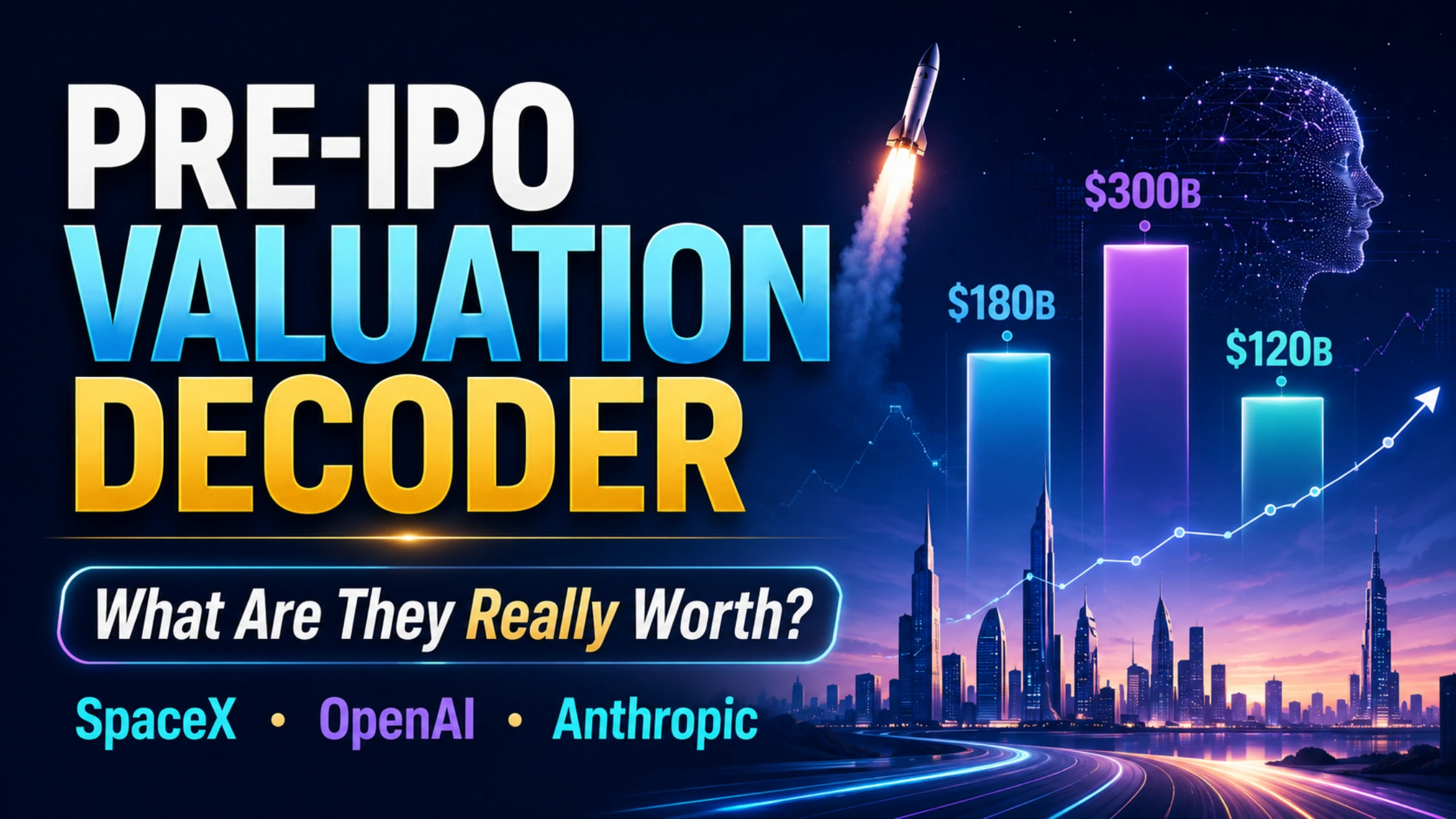
What Are SpaceX, OpenAI and Anthropic Really Worth? The DN Pre-IPO Valuation Decoder for 2026
Turn a scary private valuation into a grounded verdict — implied multiples, growth-adjusted comparables, and how many years a company must grow to justify its price.
A private company's headline valuation comes from its last funding round or secondary-market share price, not from a public market, so it can reflect investor hope as much as business reality. To judge it, divide the valuation by annual revenue to get a revenue multiple, then compare that to what similar listed companies trade at — adjusted for growth, since faster-growing firms justify higher multiples. The DN IPO Reality Score below does exactly this, scoring 0–100 how grounded a valuation is in fundamentals versus future expectation, and showing how many years of growth it would take to grow into the price.
Some of the most valuable companies on earth cannot be bought by ordinary investors. SpaceX, OpenAI, Anthropic, Stripe and Databricks are household names with eye-watering valuations, yet they trade privately, their numbers drip out in fragments, and the figures quoted in headlines — three hundred billion here, sixty billion there — arrive with no context for whether they are reasonable or absurd. The result is a vacuum of understanding that the entire internet is searching to fill.
This decoder fills it. Enter a private company's valuation and a little about its business, and it derives the revenue multiple the market is paying, compares that to how comparable public companies are priced, and returns a single grounded verdict: the DN IPO Reality Score. It does not tell you a private valuation is right or wrong — no one can — but it tells you how much of that number rests on today's business and how much rests on a future that still has to be delivered.
—
Why private valuations mislead
When a headline says a company is "valued at three hundred billion dollars," it almost never means a market of buyers and sellers agreed on that price. It usually means a single late-stage funding round priced a small slice of new shares at a level that, multiplied across all shares, implies that figure — or that shares changed hands on a secondary market at that mark. Both are real signals, but neither is the broad, liquid, continuous price discovery a public listing provides. A private valuation is a point estimate struck by a handful of sophisticated investors with their own incentives, not a consensus.
That matters because private valuations are sticky and reflexive on the way up. Each round is priced off the last, momentum and scarcity inflate the number, and the absence of short-sellers or daily marking means nothing pulls an overheated valuation back down until an IPO finally tests it against the public market. This is why so many richly-valued private companies "down-round" or stumble when they list: the public market reprices them against the cold arithmetic of revenue and comparable businesses. The decoder runs that arithmetic ahead of time.
Reading the cap table
The valuation headline also hides what you would actually own. Private companies carry layers of preferred shares with liquidation preferences, option pools that dilute everyone, and convertible structures that reshuffle the equity at IPO. A number that looks like a clean market capitalisation is really the top of a stack, and ordinary common shares sit at the bottom of it. Future dilution — new shares issued to raise capital, reward employees and convert earlier instruments — means the effective price you pay per dollar of revenue is higher than the raw multiple suggests, which is why the decoder lets you fold expected dilution into the calculation. The more a company must dilute on the path to listing, the more revenue it has to generate just to stand still.
The comparables method
The cleanest way to sanity-check any valuation is to ask what the public market pays for similar businesses. If listed software companies growing twenty-five percent a year trade at around a dozen times revenue, then a private software company should command something in that neighbourhood — more if it grows faster, less if it grows slower. The decoder formalises this: it takes a peer revenue multiple for the sector, scales it up or down by how the company's growth compares to typical peer growth, and produces a justified multiple. Comparing the company's actual multiple to that justified level reveals the premium — the "air" — baked into the price.
Justified multiple = peer multiple × (company growth ÷ peer growth)
Premium = effective multiple ÷ justified multiple
A premium near one means the valuation is grounded in what comparable companies actually fetch. A large premium does not automatically mean "overvalued" — hyper-growth and category dominance can justify paying ahead of fundamentals — but it does mean you are buying expectation, not current reality, and the score makes that explicit. The most useful single output is the time dimension: at its current growth rate, how many years must the company grow before its revenue justifies the price at a normal multiple? That number turns an abstract valuation into an intuitive bet on execution.
Priced near or below what comparable companies justify for this growth. Reasonable on fundamentals.
A growth premium, but within a justifiable range for a category leader.
Significant future growth already priced in. The business must keep executing to grow into it.
Valuation requires exceptional, sustained execution to justify. High expectation, high risk.
Priced far beyond any comparable fundamentals. Almost entirely a bet on a transformed future.
How retail can get exposure now
Until recently, owning a piece of a top private company before its IPO was the exclusive preserve of venture funds and insiders. That is changing. A growing set of crypto-native and tokenized products now offer ways to gain exposure to pre-IPO names and their eventual listings, alongside the traditional route of waiting for the IPO and buying through a broker. Each path carries its own risks — counterparty, liquidity, tracking error and regulatory uncertainty among them — and availability varies by jurisdiction, so understanding what you are actually buying matters more here than almost anywhere else.
Frequently asked questions
What is SpaceX, OpenAI or Anthropic worth?
Each carries a headline private valuation from its latest funding round or secondary-market trades, but that figure reflects what a few late-stage investors paid for a slice of equity, not a public-market consensus. Load the company into the decoder above with its latest reported valuation and revenue to see the implied multiple, how it compares to listed peers, and the DN IPO Reality Score. Figures shown are illustrative and should be updated with current data.
How do you value a private company?
The most common method is comparables: divide the valuation by annual revenue to get a revenue multiple, then compare it to what similar public companies trade at, adjusting for growth since faster-growing firms justify higher multiples. This shows whether a valuation is grounded in fundamentals or pricing in a great deal of future growth.
What is the DN IPO Reality Score?
It is a 0–100 score from Decentralised News measuring how grounded a private valuation is in fundamentals versus future expectation. It compares the company's effective revenue multiple, including expected dilution, to a growth-adjusted peer multiple. Above 80 is grounded; below 40 means the price relies heavily on a transformed future.
Can I invest in SpaceX or OpenAI before they IPO?
Increasingly yes, through crypto-native pre-IPO perpetuals and tokenized-equity products on certain exchanges, or by waiting for the IPO and buying through a broker. Each route carries counterparty, liquidity and regulatory risks, and availability depends on your jurisdiction, so understand exactly what you are buying first.
Why are private valuations so high?
Private valuations are set by a small number of late-stage investors and tend to be sticky and reflexive, with each round priced off the last and no short-sellers or daily marking to pull an overheated number back. They reflect scarcity, momentum and growth optimism, which is why companies are sometimes repriced sharply when they finally face the public market at IPO.
What does "years to grow into the valuation" mean?
It estimates how many years a company must keep growing at its current rate before its revenue would justify the valuation at a normal peer multiple. It turns an abstract price into an intuitive bet: the more years required, the more the valuation depends on sustained, uninterrupted execution.
This tool and article are for educational and informational purposes only and do not constitute financial, investment or trading advice, nor a valuation opinion on any company. Private-company financials are often estimated, unverified and outdated; all figures shown are illustrative and must be checked against the latest reported data. The DN IPO Reality Score is a simplified model based on comparables and user inputs, not a substitute for due diligence. Pre-IPO and tokenized-equity products carry significant risks including counterparty, liquidity, tracking and regulatory risk, and may be unavailable or restricted in your jurisdiction. Always do your own research and consider consulting a licensed financial professional. Decentralised News may earn a commission from services linked in this article at no additional cost to you.
About the Author