Is Your Exchange Safe? The DN Proof-of-Reserves Trust Grade for 2026
Is Your Exchange Safe? The DN Proof-of-Reserves Trust Grade for 2026
A transparent rubric for grading exchanges on how openly they prove they hold your money — the question FTX made permanent.
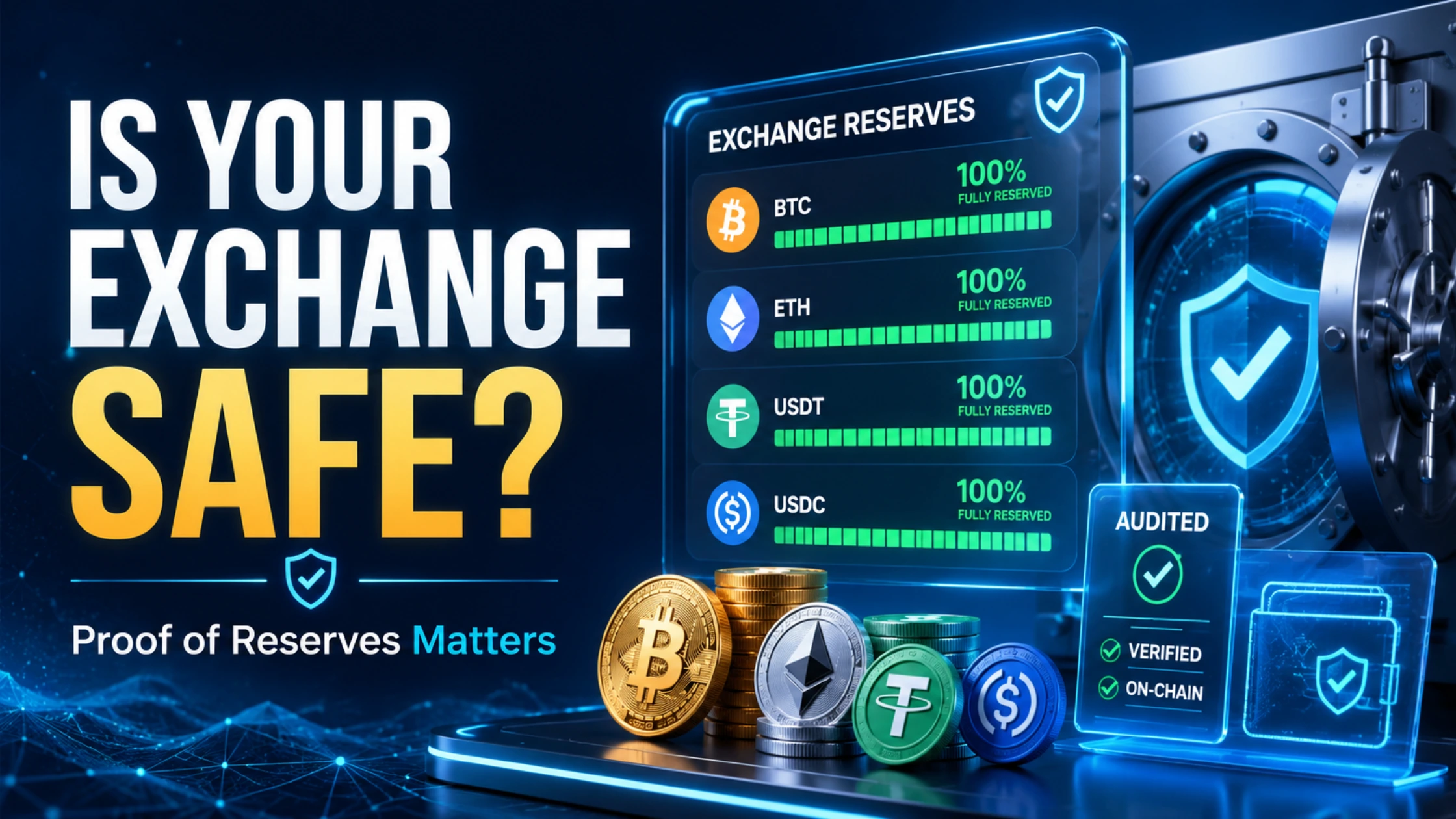
Proof of reserves is a cryptographic method by which an exchange demonstrates it holds enough assets to cover customer deposits, typically using a Merkle tree that lets each user verify their balance is included. It proves assets exist at a moment in time, but on its own does not prove solvency, because it does not always account for liabilities. The DN Trust Grade scores an exchange on six transparency factors — whether it publishes proof of reserves, how often, by what method, whether liabilities are included, whether an independent party verifies it, and whether users can self-verify — producing an A-to-F grade. Use the board and rubric below to grade any venue, and remember the ultimate answer is self-custody.
On a November weekend in 2022, the world learned that one of the largest, most-trusted crypto exchanges had been operating on a lie. FTX did not have customer funds; it had IOUs, a sister hedge fund quietly spending deposits, and a balance sheet held together with its own invented token. Billions in user money evaporated. The lesson was burned into the industry permanently: an exchange telling you your funds are safe means nothing. Proof means everything.
Proof of reserves was the industry's answer — a way for an exchange to cryptographically demonstrate it actually holds what it owes. But proof of reserves is not a single thing, and the gap between a rigorous, independently verified, liabilities-inclusive attestation and a marketing-page snapshot is enormous. This tool grades that gap. It scores exchanges on the transparency of their reserve practices and assigns a DN Trust Grade, so the vague question "is this exchange safe?" gets a structured, defensible answer.
—
The FTX lesson
The collapse of FTX was not a hack or a market accident. It was the discovery that customer deposits a company swore were safe and segregated had been lent, spent and gambled away, hidden behind a balance sheet nobody outside could inspect. The exchange looked legitimate — sponsorships, regulatory charm offensives, a celebrated founder — right up until the moment users tried to withdraw and found the cupboard bare. The single most important takeaway is that trust, reputation and marketing are worthless as guarantees. The only thing that protects a depositor is verifiable proof, and the burden of that proof must sit with the exchange.
Every reserve-transparency practice in crypto today exists because of that weekend. The question "does this exchange actually have my money?" stopped being paranoid and became basic hygiene. Proof of reserves is the mechanism the industry reached for, and understanding what it does and does not prove is now essential knowledge for anyone who keeps a balance anywhere but their own wallet.
What proof of reserves actually proves
At its best, proof of reserves works like this. The exchange takes a cryptographic snapshot of every customer's balance and arranges them into a Merkle tree — a structure that produces a single fingerprint, the Merkle root, representing all liabilities. It then proves control of on-chain wallets holding at least that much in assets. Crucially, each user can independently check that their own balance was included in the tree, so the exchange cannot quietly omit liabilities to make its reserves look sufficient. The most advanced versions add zero-knowledge proofs, which let the exchange prove solvency without leaking individual balances.
But proof of reserves has real limits, and honest analysis must state them. A snapshot proves assets existed at one moment; an exchange could borrow funds to pass the check and return them after. It proves assets but not always liabilities — an exchange can show a wallet full of coins while hiding debts owed elsewhere, which is precisely the trap that makes assets-only attestations weak. And it says nothing about whether those assets are encumbered, lent out, or genuinely the exchange's to hold. This is why the rubric weights liability inclusion and independent verification so heavily: a proof of reserves that ignores liabilities is closer to theatre than proof.
The grading rubric
The DN Trust Grade is a transparent, weighted score across six factors. There is no black box — you can see exactly what earns and loses points, and grade any exchange yourself:
The gateway. An exchange that publishes nothing verifiable cannot be trusted on its word alone, and forfeits the largest single block of points.
A one-off snapshot from a year ago is nearly worthless. Real-time or continuous attestation scores highest; monthly is strong; quarterly or ad-hoc proofs leave long windows of darkness.
A zero-knowledge-plus-Merkle proof is the gold standard; a plain Merkle tree is solid; a mere attestation or self-published wallet list is far weaker and easier to game.
The factor that separates real solvency proof from asset theatre. Showing assets without liabilities proves little; true proof covers both sides of the ledger.
A reputable third party attesting to the proof guards against the exchange marking its own homework.
The ability for any user to confirm their own balance is in the tree is what makes the proof trustless rather than a press release.
The scores roll into a letter grade: A-plus for exemplary programmes, down through B for solid, C for adequate, and D or F for exchanges whose transparency is weak or absent. Importantly, even an A grade is a grade for transparency, not a certificate of solvency or safety — it means the exchange gives you the tools to verify, not that verification is unnecessary.
The safest venues now
In the wake of FTX, the major exchanges that survived and thrived are largely those that moved fastest on transparency, and our recommended venues tend to score well precisely because they invested in real proof-of-reserves programmes. That alignment is not a coincidence — we are not willing to send readers toward exchanges that cannot prove they hold deposits. Among the venues that publish ongoing, user-verifiable proof of reserves:
For comparison and impartiality, note that some reputable venues take a different route: a regulated, publicly listed exchange may rely on audited financial statements and regulatory oversight rather than on-chain Merkle proofs. That is a legitimate alternative transparency model the rubric does not directly capture, and it is worth weighing alongside proof of reserves rather than dismissing.
The real answer: not your keys, not your coins
Every word above comes with a caveat that the genuinely safe option is not to leave assets on any exchange at all. Proof of reserves reduces counterparty risk; it does not eliminate it. An exchange can pass every check and still be hacked, frozen by regulators, or fail tomorrow. The only way to fully remove exchange risk is self-custody — holding your own keys in a hardware wallet such as a Ledger device. Use exchanges to trade, and the most transparent ones when you do, but treat them as venues to pass through, not vaults to store wealth in. The coins you are not actively trading belong in your own custody.
Frequently asked questions
Is my exchange safe?
No exchange is perfectly safe, but you can assess relative trust by how transparently it proves it holds your funds. Check whether it publishes proof of reserves, how often, whether the proof includes liabilities and is independently verified, and whether you can confirm your own balance. The DN Trust Grade scores exactly these factors. The safest option remains self-custody.
What is proof of reserves?
Proof of reserves is a method, usually using a Merkle tree, by which an exchange cryptographically demonstrates it holds assets covering customer deposits, while letting each user verify their balance is included. Advanced versions use zero-knowledge proofs to show solvency without revealing individual balances.
Does proof of reserves prove an exchange is solvent?
Not by itself. It proves assets existed at a snapshot in time, but unless it also accounts for liabilities and is independently verified, it can be incomplete or gamed — for example by borrowing assets to pass the check, or by showing assets while hiding debts. True solvency proof must cover both assets and liabilities.
Which exchanges have proof of reserves?
Most major exchanges introduced proof-of-reserves programmes after the FTX collapse, including Kraken, OKX, Bybit and Binance, among others. Cadence and method vary significantly, which is what the DN Trust Grade measures. Always check an exchange's current transparency page, as practices change.
What is the DN Trust Grade?
It is a transparency score from Decentralised News that grades an exchange A to F on six factors: whether it publishes proof of reserves, how often, by what method, whether liabilities are included, whether it is independently verified, and whether users can self-verify. It measures transparency of reserve practices, not guaranteed solvency.
Is my crypto safer in self-custody?
For assets you are not actively trading, generally yes. Self-custody in a hardware wallet removes exchange counterparty risk entirely — no exchange can lose, freeze or misuse funds you hold yourself. The trade-off is that you become fully responsible for securing your keys. The common approach is to trade on transparent exchanges but store long-term holdings in self-custody.
This tool and article are for educational and informational purposes only and do not constitute financial, investment or trading advice, nor an audit, endorsement or guarantee regarding any exchange's solvency or safety. The DN Trust Grade scores disclosed transparency practices as understood at publication and may not reflect current status; exchange practices and financial condition change over time. Always independently verify an exchange's current proof of reserves before depositing funds, and understand that no proof eliminates risk. Cryptocurrency holding and trading is high risk. Decentralised News may earn a commission from exchanges and services linked in this article at no additional cost to you.
About the Author