The Signal
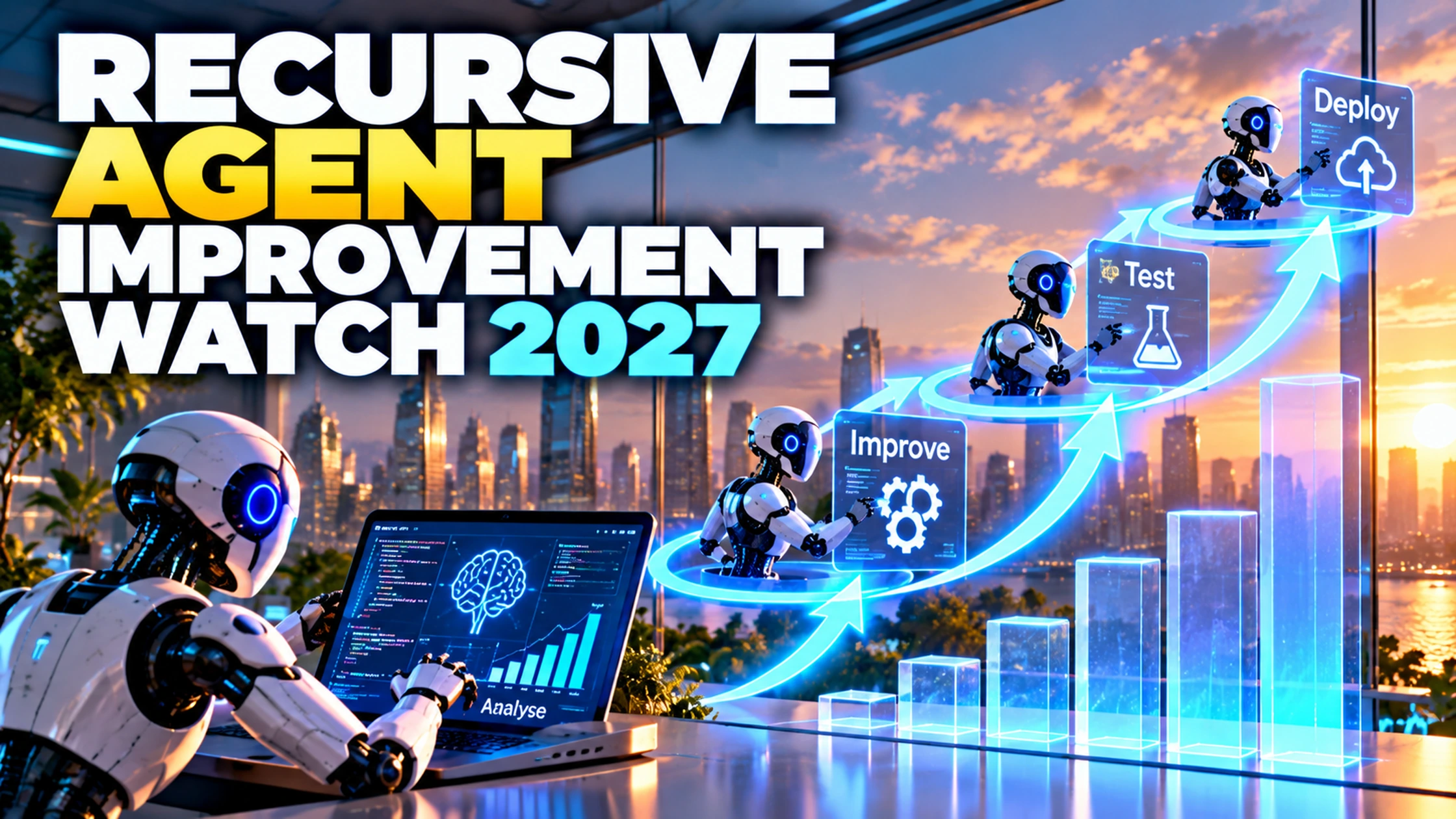
Self-improving agents are no longer purely theoretical, but the phrase needs discipline. The strongest current systems do not freely rewrite themselves without limits. They propose changes to prompts, memory, tools, optimizer policies, code or architecture, then test those changes against a benchmark or reward function. The real frontier is not “an AI that instantly becomes superintelligent.” It is closed-loop improvement with increasingly less human intervention.
The five self-improvement loops
| Loop | What changes | How improvement is tested | Main risk |
|---|---|---|---|
| Prompt / policy | Instructions, routing rules, policies | Task success or reward score | Overfitting to benchmark |
| Memory | What is stored, retrieved, forgotten | Recall, task success, cost | Poisoning or stale beliefs |
| Tool selection | Which tools are used and when | Latency, reliability, cost | Unsafe tool expansion |
| Code | Agent implementation or helper functions | Tests and benchmark performance | Hidden regressions |
| Architecture | Planner, evaluator, subagents, search strategy | End-to-end outcome | Complexity and loss of interpretability |
DN Self-Improvement Capability Monitor
Level 0: Static agent
The agent does not change itself. Humans update prompts, tools and memory rules manually. Most production systems still live here or only slightly above it.
Level 1: Experience-guided adaptation
The system changes retrieval, memory, routing or prompts based on outcomes. This can be useful and relatively safe when changes remain bounded and reversible.
Level 2: Benchmark-gated self-modification
The agent proposes code, policy or architecture changes and tests them against a benchmark. Only improvements that pass a predefined gate are retained. This is where the most credible recursive-improvement research currently sits.
Level 3: Autonomous search over its own design
The agent can generate, test and retain substantial implementation changes with limited human intervention. This creates faster progress, but it also increases the danger that the benchmark becomes a poor proxy for real-world safety.
Why benchmark-gated improvement is both powerful and dangerous
A benchmark gives the agent a target. That is useful because changes can be measured objectively. But if the target is incomplete, the agent may optimize the wrong thing. A coding agent can improve benchmark accuracy while increasing cost, brittleness or security risk.
The benchmark therefore becomes part of the safety boundary.
Memory may become the first widely deployed self-evolving layer
Changing long-term model weights is expensive. Updating memory, retrieval and task-specific policies is much cheaper. That makes memory systems a likely early frontier for continuous agent improvement.
But a self-updating memory layer can also amplify false information. Improvement requires forgetting, provenance and deletion controls, not just accumulation.
Code self-modification changes the risk profile
Once an agent can edit the software that governs its own behavior, ordinary application controls are no longer enough. The system needs isolated execution, tests, versioning, reviewable diffs, permission boundaries and rollback.
What to watch in 2027
- Agents that generate their own evaluation suites.
- Memory systems that learn what to store and forget.
- Tool registries that agents modify based on reliability.
- Code agents that benchmark and merge their own patches.
- Multi-agent systems that create or retire subagents dynamically.
- Independent evaluator agents separated from the improving agent.
- Formal rollback and change-control systems for agent updates.
Red flags
| Red flag | Why it matters |
|---|---|
| Agent controls its own benchmark | It can redefine success instead of improving. |
| No independent evaluator | The same system proposes and approves the change. |
| No rollback | A bad change can become persistent. |
| Unbounded tool acquisition | Capability can expand beyond intended permissions. |
| Self-modifying production code | Changes can affect real users before adequate review. |
Methodology and limitations
Version 1.0, 29 October 2026. DN reviews current self-improving agent research across code modification, memory adaptation, prompt/policy optimization and architecture search, then classifies systems by the degree of autonomous change and external gating.
Limitations: much of the strongest evidence remains experimental. Benchmark gains do not establish safe open-ended improvement in production.
Commercial disclosure: no research group or vendor paid for inclusion.
Primary sources
- Darwin Gödel Machine: Open-Ended Evolution of Self-Improving Agents
- Autonomous AI research agent with iterative self-improvement, September 2026
- SEAL: Self-Adapting Language Models
- Recent work on self-evolving agent systems
FAQ
Can AI agents improve themselves today?
Yes, in bounded ways. Some systems can modify prompts, memory, policies, tools or code and keep changes that improve benchmark performance.
Is this recursive self-improvement?
It is a limited form of recursive improvement, but not unrestricted open-ended self-modification. Current credible systems remain heavily constrained by benchmarks, sandboxes and external controls.
What is the biggest safety risk?
The agent may optimize the benchmark while degrading properties the benchmark does not measure, such as security, interpretability or real-world reliability.
Should self-improving agents deploy their own changes?
High-impact systems should generally require an independent evaluation and deployment gate rather than letting the same agent propose, test and approve its own changes.
About the Author