Money Stories · Original fiction · 10 minute read
“The front door,” Arthur told the empty hall, “is included.”
He waited, giving his imaginary buyers time to admire it. They were a young couple. He had not settled their names, but the man wore shoes he would not be allowed to wear beyond the mat.
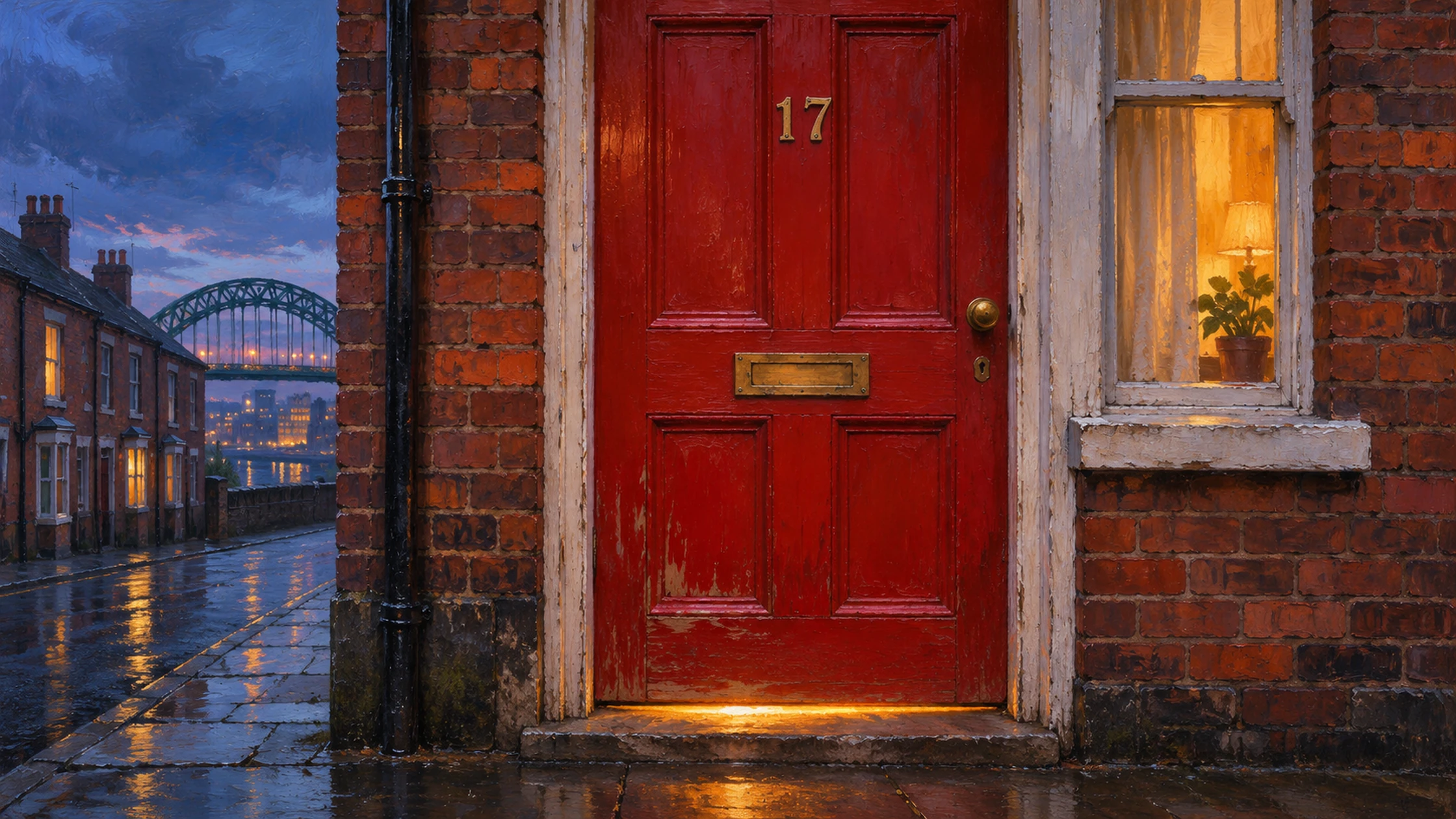
The door was red, with a brass seventeen that Margaret had polished whenever she was expecting somebody important. Arthur had delivered letters for thirty-eight years. He knew how many people concealed their house numbers behind flowers and then complained about the post. Seventeen had never concealed anything.
“Original features,” he tried.
The letterbox was from a hardware shop in 1998. He decided he would not say original.
His daughter Helen found him there on Saturday morning, holding a mug.
“Who are you talking to?”
“People with muddy shoes.”
She looked down at her own boots.
“Not you.”
She had brought an electric heater again. He took it from her before she could carry it upstairs.
The boiler had been condemned by the engineer, switched off, and left with a warning Arthur obeyed. Hot water came from the kettle until the move or a replacement; the portable heating made individual rooms usable and the electricity bill disagreeable. Helen had suggested staying with her. He had suggested, in return, that she spend three nights sharing a bathroom with her own children before offering it to anybody else.
“You don’t have to sell,” she said.
“You bring that thing every time.”
“Because you’re cold every time.”
He had five thousand pounds in accessible savings beyond the money for ordinary pension-funded bills. Repairing the house could consume a substantial part of it. Staying was a possible decision; he did not like being told it was an effortless one.
On Helen’s phone, the automated valuation service she’d tried put Number Seventeen at £320,000. The spring estimate had been lower. According to the screen, Arthur had gained money while doing nothing about the damp mark above the back door.
He made her show him the number twice.
“That’s an estimate,” she said.
“It looks very sure of itself.”
The service did show a range and a warning. The large number was what he remembered after the screen went dark.
“Through here,” he told the imaginary couple the following Wednesday, “is the dining room.”
The room contained a dining table, so the statement was defensible. It also contained a sewing box, a box of batteries, two broken radios and Margaret’s coat. Three years after her death, the coat remained on the same hook. He had moved it once to paint and put it back while the paint was still tacky.
The imaginary woman asked whether the room could be opened up.
“You’d have to ask somebody who knows,” Arthur said.
He found this answer surprisingly pleasant. He did not have to make the place suitable for their entire imagined life.
The first real agent arrived with no such grand ambition. She asked when the roof had last been inspected, noted the boiler and looked at completed sales of comparable houses. She thought the online figure optimistic for this house in its present condition.
Arthur showed her the phone.
“It hasn’t been inside,” she said.
“Neither have you, until today.”
“That’s why I’m here.”
He liked her a little for not laughing.
The flat Helen had found near his friends was no longer the £230,000 possibility they had discussed over tea. That listing had gone. The ground-floor flat he actually liked would cost £238,000 if the seller accepted his offer. It was twelve minutes from the club when he walked at his own pace. He had checked this, including a stop to talk.
It had less room than he wanted and a service charge he initially regarded as an insult. The solicitor would need to check its existing lease, the accounts, the reserve and any planned works. Arthur and Helen put the quoted ongoing charges into his pension budget alongside the other bills. The smaller home did not abolish maintenance; some decisions would belong to other people.
“I thought there would be ninety thousand left,” he said.
Helen turned over the paper on which they had once subtracted a guessed flat price from an estimated house value.
“I did too.”
It helped that she did not call his disappointment a misunderstanding.
“Upstairs,” Arthur told his visitors, “are two generous bedrooms.”
He tested generous by standing beside the wardrobe in the smaller one. There was enough room to turn round if a person had not brought any luggage.
That had been Helen’s room. Her height marks were on the inside of the door frame, where Margaret had said nobody would see them. He had photographed them and got the measurements blurred. The dates came out beautifully.
The first real viewing was on a wet afternoon. The prospective buyer removed his shoes without being asked and stood in damp socks. He came with his partner, who wanted to know where the winter sun reached.
Arthur took them into the back bedroom.
“Along that wall, in the morning.”
The woman looked at the wall rather than the floor area. For a moment he wanted her to buy it. Then the man asked about the boiler, and Arthur wanted the whole business cancelled.
He showed them the engineer’s report.
Their offer was £280,000. After negotiation, it became £285,000. Their financing still required checks; the agent’s evidence that they could proceed was not money in Arthur’s account. His offer on the vacant flat was accepted at £238,000, also subject to contract.
“Thirty-five thousand less,” he told Helen.
“Than the website.”
“I know what I’m comparing.”
She let him be cross. Later, when he asked whether she thought he should hold out, she said she could not know what another buyer might pay or how long that buyer would take.
“I can help you work out whether this move works,” she said. “I can’t make the offer feel like the number you liked.”
He sat with that for an afternoon. Then he asked the solicitor to send the full cost estimate.
They went through it together: £3,420 for the selling agent, including VAT; £2,580 for legal work, searches and the other listed conveyancing charges across both transactions; £2,260 in stamp duty; £540 for the flat’s survey; £1,200 for removals. Ten thousand altogether. They put each quote beside its line, so the total could be traced back to somebody who had actually been asked.
The sale would release £37,000 after buying the flat and paying those costs. Not ninety thousand. Still enough to matter.
He owned the house outright. It had been his only home throughout his ownership, with no letting or exclusive business use; the solicitor checked his circumstances and confirmed full main-home tax relief for the sale. The flat would replace it as his only home. There was no mortgage balance waiting to eat another part of the difference.
Helen pushed the paper towards him.
“Does it work?”
“The money does.”
She waited.
“I’m still here,” he said.
“The garden,” Arthur informed nobody, “is easily maintained.”
A bramble had grown through the fence. He looked at it from the back step and amended his speech.
“There is a garden.”
By then the survey had been paid, £540 from his savings, and £260 paid to the solicitor on account. Those amounts were already inside the ten-thousand-pound total. His five thousand had become £4,200. The buyers’ offer had not refilled it.
The legal enquiries took weeks. There were questions about the flat’s lease and a missing receipt for work at Number Seventeen. Arthur found it in Margaret’s sewing box, beneath a packet of hooks. He did not find that charming. He sat on the stairs, holding the receipt, furious with the small continuing labour of being the person left to know where things were.
Helen arrived that evening with food. He told her he wanted more time.
“We can ask,” she said.
He had expected persuasion. He had prepared to resist it.
“Three weeks,” he said. “After the contracts. To pack.”
“All right.”
The buyers wanted an earlier date. The flat’s seller did not mind. Through the solicitors, they found a completion date all parties accepted, three weeks after exchange. His buyer’s deposit covered what the flat’s seller required; the conveyancers specifically agreed to pass that amount down the chain. He did not have to invent a purchase deposit from the £4,200. Nor could he spend the deposit coming up the chain as though it were spare money.
Before exchange, the solicitor checked that both transactions were ready and explained the commitments. Arthur signed. When contracts were exchanged, the date acquired a weight it had not possessed when everyone had merely said yes.
He put a calendar on the kitchen wall. He packed one cupboard a day and gave himself the right to do a cupboard badly.
The imaginary tours ceased. Real men came to measure furniture for the removal van. One of them described the sideboard as awkward.
“It always was,” Arthur said.
On completion day, Number Seventeen was no longer full of their things. It was full of the places where their things had been.
Arthur checked the rooms because there was work to do, and he understood work better than farewell. He took the meter readings. He left the engineer’s paperwork where they had agreed. He did not remove the red door or the brass number.
Helen found him looking at the hook.
Margaret’s coat had gone into a box Arthur had labelled Coat. He was not obliged to decide its entire future before lunch.
The linked sale and purchase completed that day. After the flat price and the remaining agent, legal and stamp-duty amounts, the solicitor sent £39,000 to his account. Added to his £4,200 savings, it made £43,200. He paid the £1,200 removal bill. Forty-two thousand remained: the original five thousand plus thirty-seven thousand released by the move, all costs counted once.
He checked the bank entry before telling Helen it had arrived. He had become particular about that word.
In the flat, the boiler made a noise he did not recognise. A working noise. The survey and service records had been checked before he committed; he still stood listening as though it might change its mind.
He had one narrow room for things that did not yet have places. The coat went there. The sideboard fitted, after the men removed its legs and put them back. Arthur thanked them and watched the van leave without his furniture inside it.
The following Saturday Helen came with a loaf under one arm. For the first time in months, she had no heater.
“Where do you want this?”
“Kitchen.”
She opened the wrong door.
“Through here,” Arthur said.
He showed her. Then he showed her where the plates had gone, and which cupboard looked like a cupboard but contained the boiler, and the patch of morning light he had not expected on the little table.
When he reached the end of the flat, Helen was still beside him. Nobody asked what it was worth.
Money behind the story
An automated estimate is not a buyer’s commitment. GOV.UK distinguishes an accepted offer from exchange of contracts in England and Wales. Its conveyancing guidance explains completion, settlement of relevant costs and transfer of the remaining balance.
Arthur’s invented sale releases GBP285,000 − GBP238,000 purchase − GBP10,000 total transaction costs = GBP37,000. Costs are GBP3,420 agency fees, GBP2,580 legal/search charges, GBP2,260 stamp duty, GBP540 survey and GBP1,200 removals. These are scenario quotations, not Newcastle market averages.
The tax assumptions matter. He is UK-resident, replaces his sole main residence, buys an existing residential lease and has no mortgage. The illustrated standard SDLT is 2% of GBP113,000 above GBP125,000: GBP2,260. His sale satisfies all Private Residence Relief conditions, including continuous sole-main-home use, no letting or exclusive business use, small grounds and no purchase solely for gain. Different facts can change tax and available proceeds.
From GBP5,000 existing free savings, GBP800 pays the survey and part of the legal bill before completion, leaving GBP4,200. The linked completion releases GBP39,000 after the purchase and remaining completion charges; paying removals leaves GBP42,000 altogether. The prepaid GBP800 is already within total costs. Deposits pass along only under the agreed conveyancing arrangement; they are not spending money. Ongoing household and flat charges remain separately budgeted, and future repairs remain possible.
Financial sources checked 25 November 2026. Story figures and outcomes are illustrative. General financial education, not individual financial advice.
Stay with the story: three questions
- Which number in a decision is an estimate, which is an offer, and which is money you can actually use?
- Have you counted each transaction cost once, including amounts paid before the main receipt arrives?
- What timing or practical condition would make a financially workable change one you could also live with?
About the Author