The Trader’s Guide to DEX Architectures: Order Books, Oracles, and MEV
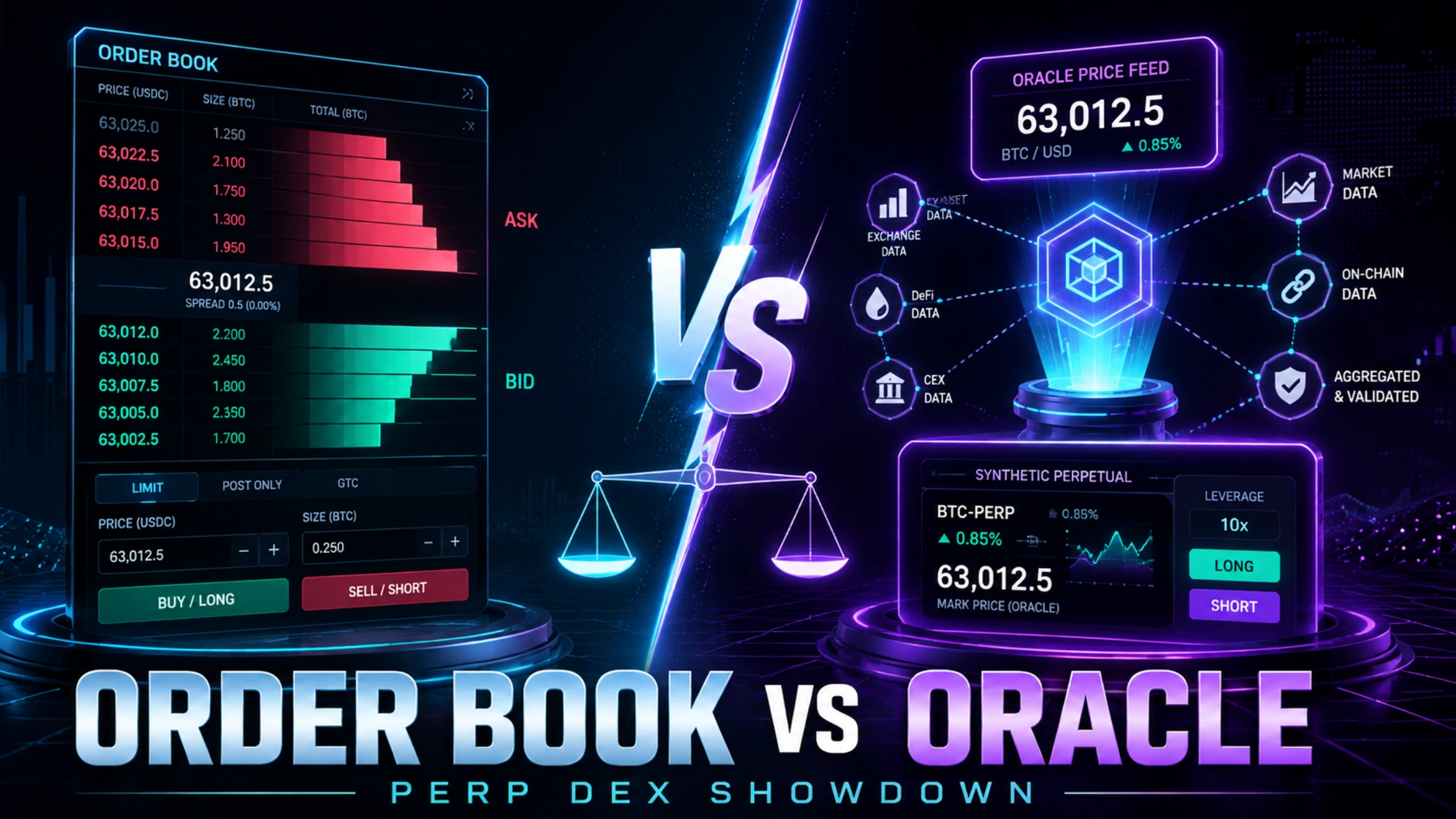
Order Book vs. Oracle Perpetual DEX: Which Matching Architecture Wins in 2026?
Key Takeaways (DN Architecture Benchmarks)
- Order Book DEXs (CLOBs) like edgeX and Paradex deliver true onchain price discovery, negative maker fees for liquidity providers, and deterministic limit order execution.
- Oracle & Pool-Based DEXs like Jupiter Perps and gTrade excel at high-leverage synthetic trading across crypto, forex, and commodities with zero price impact on trade entry—filling orders directly against liquidity pools and oracle feeds.
- MEV & Latency Protection: Central Limit Order Books are more vulnerable to toxic latency arbitrage, while Oracle-based platforms face unique risks from oracle latency lag and flash crash liquidations.
Featured Architecture Outlets & VIP Execution Portals
Experience zero-slippage execution or low-latency CLOB order book trading using our official partner portals:
- 🔹 Jupiter Perps (Solana JLP Pool): Trade Jupiter Perps on Solana — Referral Code:
whj8az405rdo - 🔹 edgeX (High-Speed CLOB): Launch edgeX Order Book Perps — Referral Code:
DECENTRALISED - 🔹 gTrade (Oracle Synthetic Engine): Trade Forex, Stocks & Crypto on gTrade — Referral Code:
decentralised - 🔹 Paradex (Starknet ZK CLOB): Launch Paradex Zero-Knowledge Perps — Referral Code:
decentralised
1. The Central Limit Order Book (CLOB) vs. Synthetic Oracle Divide
As decentralized derivatives volume scales toward multi-billion dollar daily averages, the underlying matching engine architecture dictates everything: execution slippage, liquidation cascade mechanics, fee tiers, and trader profitability.
The decentralized perpetual market has consolidated around two dominant execution models:
- Central Limit Order Book (CLOB / Order Book DEXs): Buyers and sellers submit bid/ask quotes into an active order book (either onchain or off-chain matched with ZK-settlement). Prices are formed organically via real-time supply and demand.
- Oracle-Based Synthetic Engines (Oracle & Pool DEXs): Trades are executed synthetically against a unified liquidity vault or virtual pool (like Jupiter's JLP pool or gTrade's gDAI vault) using real-time price feeds. Orders are filled at the exact oracle index price, regardless of local order size.
Understanding which matching engine fits your trading style—whether you are an algorithmic market maker, a high-leverage swing trader, or a macro forex speculator—is critical to preserving trading margin.
2. DN Slippage & Oracle Lag Index (DN-SOLI) Framework
To audit matching engine efficiency, Decentralised News subjects order book and oracle platforms to continuous automated stress tests using five quantitative pillars:
- Price Impact at $100k Order Size: Measuring fill price deviation from the global spot index on initial position entry.
- Oracle Delay Delta (ODD): The millisecond timestamp gap between off-chain spot market price updates and onchain oracle price updates.
- Maker Fee Rebate Potential: Availability of negative fees for market-making liquidity providers.
- MEV & Front-Running Resistance: Susceptibility to sandwich attacks, order re-ordering, or toxic latency arbitrage.
- Liquidation Cascade Buffer: Protocol mechanism performance during market-wide >15% flash crashes.
3. Architecture Feature & Risk Matrix
Below are the empirical benchmarks comparing Order Book and Oracle DEX execution models:
| Performance Metric | Order Book DEX (e.g., edgeX / Paradex) | Oracle & Pool DEX (e.g., Jupiter / gTrade) |
|---|---|---|
| Price Discovery Mode | Native Organic (Bid / Ask Spreads) | External Oracle Index Benchmark |
| Price Impact on Large Trades | Variable (Depends on Order Book Depth) | Zero Price Impact |
| Supported Asset Types | High-Volume Crypto Assets | Crypto, Stocks, Commodities & Forex |
| Maker / Taker Fee Dynamic | Negative Maker Fees (-0.005%) / Low Taker Fees | Flat Pool Swap Fees + Borrowing Spreads |
| Primary Execution Risk | Order Book Thinning during Volatility | Oracle Latency Lag & Spread Spikes |
| Best Persona Match | Quant Market Makers & Scalpers | Position Traders, Swing Traders & Macro |
4. Protocol Deep Dive: CLOB vs. Oracle Leaders
1. Jupiter Perps — Solana's Liquidity Engine Powered by JLP
Jupiter Perps is the dominant decentralized futures platform on Solana. Built around the multi-asset JLP (Jupiter Liquidity Pool) token, Jupiter enables traders to open high-leverage positions on Solana with zero price impact and minimal slippage.
Execution Engine: Trades execute directly against the JLP pool using Pyth and Switchboard oracle price feeds, allowing $500k+ position sizes on SOL, BTC, and ETH without moving order book depth.
💡 Trader Pro Tip: Trade on Jupiter Perps via Code whj8az405rdo to optimize swap routing fees and earn LP yield multipliers.
2. edgeX — Ultra-High-Speed Central Limit Order Book
edgeX delivers institutional-grade matching engine speeds for quantitative and high-frequency traders. Built as a dedicated derivatives app-chain, edgeX processes thousands of order cancellations and replacements per second.
Execution Engine: Off-chain order matching paired with transparent on-chain settlement, providing sub-30ms order confirmation speeds without gas fees on unfilled order edits.
💡 Trader Pro Tip: Register on edgeX via Code DECENTRALISED for exclusive maker fee discounts.
3. gTrade (Gains Network) — Zero-Slippage Synthetic Trading
gTrade is the premier oracle-based synthetic derivatives platform operating across Arbitrum and Polygon. Instead of relying on an order book, all trades are collateralized by the gDAI vault. Orders are filled directly at the exact Chainlink oracle price.
Execution Engine: Guaranteed zero price impact for large market entries across 150+ crypto pairs, global stock indices, gold, oil, and major forex pairs (e.g., EUR/USD).
💡 Trader Pro Tip: Start trading on gTrade via Partner Link decentralised to access institutional-grade synthetic execution.
Frequently Asked Questions (FAQ)
Is an order book DEX better than an oracle DEX for day trading?
It depends on your strategy. Order book DEXs (like edgeX and Paradex) are better for high-frequency scalping, algorithmic grid trading, and limit order execution. Oracle DEXs (like Jupiter Perps and gTrade) are superior for swing trading large positions with zero price impact.
How do oracle-based DEXs like Jupiter Perps offer zero price impact?
Oracle DEXs do not rely on an order book of buyers and sellers. Instead, trades are collateralized against a central liquidity pool (e.g., JLP or gDAI) and priced according to real-time aggregate oracle feeds, filling orders under the deployed market's index-price, capacity, price-impact and fee rules; execution is not guaranteed for unlimited size.
What is the main advantage of L2/L3 order books like edgeX and Paradex?
High-speed app-chain order books match orders off-chain at sub-50ms speeds while settling batches onchain securely. This can change order-editing costs and information exposure, depending on the implementation. It does not establish immunity from front-running, adverse ordering or all other forms of MEV.
DEX Routing, JIT Liquidity and the Return a Pool Actually Earns
Decision extension · 13 November 2026. Choose market structure for the task: executable size, order control, latency, acceptable information exposure and capital requirements. An aggregator, an AMM and an order book are not mutually exclusive layers. A route can combine them, and headline volume does not reveal whether an AI agent or a person chose it.
Follow the liquidity behind the quote
0x describes its RFQ system as professional market makers supplying private off-chain quotes that settle on-chain, alongside aggregated on-chain liquidity. This establishes a routing mechanism, not a conclusion about every quote's compensation arrangements or realized execution quality. 0x RFQ explanation.
Record the actual sources used by a quote, the size, expiry, required approvals, all explicit fees and the minimum accepted output. A route using a private market maker is not automatically payment for order flow. To make that claim, identify who pays whom, for which service, under which agreement and whether it affects the user's route.
Distinguish an indicative price from an executable quote and a completed fill. A comparison should preserve unsuccessful requests, expired quotes and the costs of retries. An attractive quoted output can be unusable because the wallet, asset, chain, account or customer is ineligible for the route.
JIT liquidity is not a synonym for a harmful sandwich
Uniswap Labs' September 2022 research describes concentrated liquidity supplied immediately around a swap and examines a historical May 2021–July 2022 sample. It reports potential execution improvement for large trades and analyzes competition among liquidity providers. Those historical findings are not a current market-wide prevalence estimate or a finding that every JIT strategy benefits every participant. Uniswap JIT research.
DN's proposed evaluation separates the trader's realized output, existing LP fee allocation, the new LP's costs and any ordering advantage. A strategy can improve one outcome while changing another participant's revenue. A claim of harm requires a defined counterfactual, not merely the presence of a mint and burn around a swap.
Do not label rapid execution as AI activity without controller or workflow evidence. This review establishes no billions-of-dollars extraction figure and no universal causal effect. An event study would need a declared sample, chain versions, fees, price reference and treatment of failed attempts.
Order book or AMM: begin with the required action
An order-book workflow may require queue position, cancellations, amendments and partial-fill handling. An AMM workflow requires the relevant liquidity curve, pool state, transaction ordering and price-impact limits. Oracle-priced derivatives add feed and position-capacity dependencies. None of these categories is exclusively designed for humans or automatically preferred by agents.
Compare the same asset, size, side and acceptance time. Include unsuccessful order changes, funding, borrow costs, settlement, approvals and operational work where they fall within the task. A market order, resting limit order and conditional position exit are different workloads, even when they use the same token pair.
A design that reduces one front-running path does not establish immunity from every MEV or execution risk. A quoted index price does not guarantee a fill of unlimited size at that price. Actual capacity, price impact, fees and protocol checks need the deployed version's rules.
Separate pool fees from total LP return
GMX's liquidity documentation distinguishes pool structures and separates fee measures from performance relative to an underlying-token benchmark. Its current documentation also contains market-specific migration notices. This is a reason to inspect the exact pool and date rather than carry a legacy pool's fee assumptions into a new market. DN has not measured an LP's realized return in this review. GMX liquidity documentation.
A total-return record should identify deposits, withdrawals, units held, value per unit, separately paid distributions, trading-counterparty PnL exposure, inventory price changes, hedging and costs. A fee already retained in the pool's net asset value must not be added again as a separate payment. Different pools and vaults can allocate these components differently.
Fictional no-cash-flow example: an LP position starts at 100 units of value, ends at 98 and receives three units of distributions outside the position. Its total gain is one unit before other costs. If those three units were already included in the reported ending value, adding them again would overstate the return. This example is not a performance result for GMX or another protocol.
For a period with deposits and withdrawals, a simple ending-minus-starting balance can confuse contributions with profit. Reconcile cash flows and choose a money-weighted or time-weighted method appropriate to the decision. Explain the chosen method instead of annualizing a short favorable interval and calling it a guaranteed APY.
Do not infer that every liquidity provider is retail, that every counterparty is an AI agent, or that LPs must always lose. A meaningful comparison needs actual positions, strategy definitions, complete cash flows and a common benchmark.
DN Execution and LP Return Evidence Matrix
The downloadable record below is a blank review template. It preserves the evidence needed for one route or pool; it is not a provider rating or a measured return series.
| Field | Evidence required |
|---|---|
| task | Asset contracts, side, size, order type, deadline and accepted outcome |
| route | Provider, liquidity sources, quote version, expiry and actual fill status |
| incentives | Fees, rebates, referral or routing payments and their stated recipient |
| ordering | Submission path, observed events and counterfactual limitations |
| pool | Exact contract/version, backing assets and exposure to trader PnL |
| cash_flows | Deposits, withdrawals, units, NAV and separately paid distributions |
| return | Method, benchmark, charges and no double-counted income |
| unresolved | Missing observations, attribution gaps and next review trigger |
Complete the template offline with permitted reference labels. Blank fields remain unknown. Downloading it does not fetch quotes, inspect a pool, connect a wallet or submit a trade.
Method and limits: primary-documentation review, original DN decision matrix and a fictional bookkeeping example. No route sweep, JIT event study, agent-attribution study or LP performance cohort was collected. Older product descriptions on this page retain their original evidence date; this extension does not certify those deployments or refresh every quoted figure.
About the Author