Where Your Perp Actually Settles: Solana vs Ethereum vs App-Chains
Where Your Perp Actually Settles: Solana vs Ethereum vs App-Chains
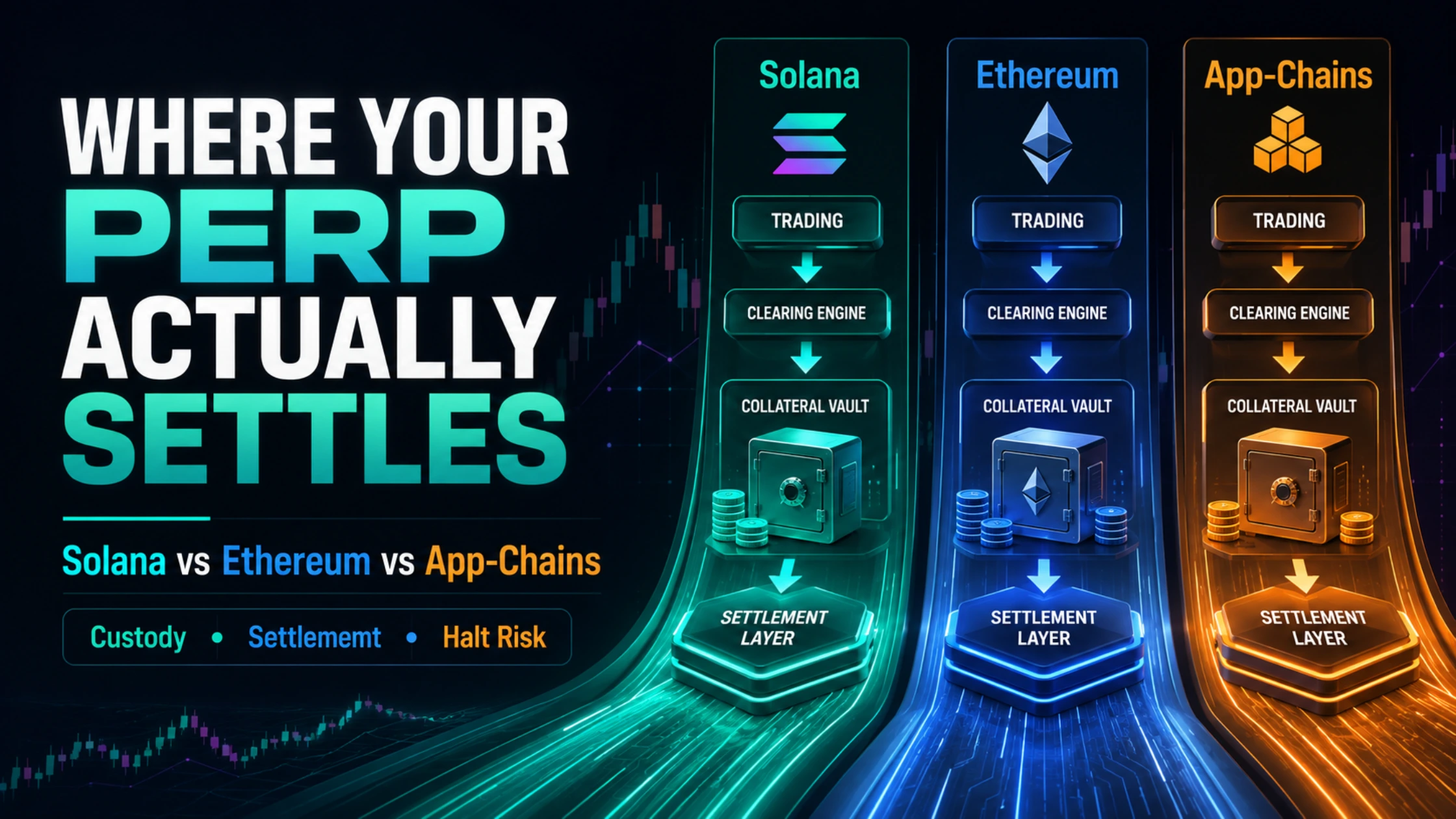
Every perp DEX promises self-custody. Almost none explain what that means when the chain halts, the sequencer stalls, or the matching engine is exploited. The DN Settlement Stack Map shows exactly who holds what, and what breaks, on each architecture.
Decentralised News · Updated June 12, 2026 · Editorially maintained, quarterly refresh · Reading time 12 min
Are perp DEXs safe, and who actually holds your funds? The honest answer is that a perp DEX removes the single largest risk of a centralized exchange, no company can quietly lend out or lose your deposit the way FTX did, but it replaces that risk with a different set that most traders never inspect: the risk that the chain your funds settle on halts, that the Layer 2 sequencer stalls, that the smart-contract program holding collateral is exploited, or that an off-chain matching engine you are trusting misbehaves. "Self-custody" is true on every one of these venues and means a different thing on each. The DN Settlement Stack Map below pulls apart exactly who holds what, where it settles, and what breaks under stress, for the major architectures.
This matters more after every cycle's failures. The lesson of FTX was custody: never let a company hold your keys. But the perp DEXs that answer that lesson are not interchangeable, and the marketing word "decentralized" hides architectures whose failure modes are wildly different. A Solana outage, an Ethereum rollup sequencer pause, a Cosmos validator fault and a trusted-execution-environment side channel are four different ways to have a bad day, and which one you are exposed to is decided entirely by where your chosen venue settles.
The four questions that actually define custody
"Who holds my funds?" is really four questions, and a venue's architecture answers each differently. The Settlement Stack Map scores every venue on exactly these:
- Who holds the keys? Are your funds in a wallet only you can sign for, in a smart-contract program governed by code, or in an account an operator can touch? This is the custody axis, and it is the one the word "self-custody" is supposed to answer but often blurs.
- Where does it settle? Which ledger is the source of truth for your balance, a base Layer 1, a Layer 2 rollup, an app-specific chain, or an off-chain engine that periodically writes to a chain? Settlement location determines what has to keep working for your balance to be real.
- What breaks in a halt? If the underlying network stops producing blocks, can you close a position, withdraw, or even read your balance? Different chains halt with different frequencies and different consequences, and a frozen position during a violent move is a liquidation you cannot prevent.
- What does an exploit reach? If the matching engine, the bridge, or the settlement contract is compromised, how much of your capital is in blast radius? A bug in a single market is survivable; a bug in the bridge holding all deposits is not.
The architecture taxonomy
Five structural patterns cover essentially every venue in the market. This is the reference taxonomy the Map encodes, from most to least self-sovereign on the custody axis:
| Architecture | Who holds funds | Halt exposure | Exploit blast radius |
|---|---|---|---|
| Cosmos app-chain | Chain-native, non-custodial | App-chain validator set | Chain module or market contract |
| Solana app-level | On-chain program (code-governed) | Whole Solana network | The program and its accounts |
| Ethereum L2 rollup | Bridged to L2, contract-held | Sequencer (then L1 escape hatch) | Bridge plus L2 contracts |
| Off-chain match, onchain settle | Chain settles, operator matches | Operator and settlement chain | Matching engine plus settlement |
| TEE / enclave | Enclave-held, attestation-gated | Enclave operator and host chain | Enclave breach or attestation flaw |
The ordering carries the lesson. The closer a venue keeps the entire stack, custody, matching and settlement, on a transparent, verifiable chain, the more its safety rests on code you can audit rather than an operator you must trust, but the more it inherits that chain's own failure modes. The further it moves matching off-chain for speed, the faster it feels and the more trust it reintroduces. There is no free lunch; there is only an informed choice about which failure mode you can live with.
Pick a venue. See exactly who holds your funds, where they settle, what freezes in a halt, and what an exploit can reach.
BOARD: editorially maintained architecture taxonomy as of June 12, 2026, refreshed quarterly; a structural risk map, not a safety guarantee, audit, or solvency assessment, and not financial advice. Custody ratings describe trust assumptions, not predictions of failure or safety. Leveraged trading involves substantial risk of loss including liquidation. Some links are referral links that support our free tools at no cost to you; venues without a referral relationship are labeled and included on merit. Other publications may embed this instrument with a followed credit link to the canonical page on decentralised.news.
Reading the architectures, one by one
- Cosmos app-chain (Helix on Injective). The order book is a native function of the Injective chain itself, and your funds are non-custodial, held by chain logic rather than a separate bridge or operator. The trust assumption is the Injective validator set: if it keeps producing blocks, your balance is real and movable. This is among the most self-sovereign live perp architectures, with the tradeoff being that the venue inherits the app-chain's own liveness and the smaller validator set of a specialized chain.
- Solana app-level (Drift). Drift runs as a program on Solana, so a code-governed program holds your collateral and the entire venue's availability is bound to Solana's. Solana's throughput is the appeal; its halt history is the exposure, because when the network pauses, every position on every Solana venue freezes at once, regardless of how well the venue itself is built. The exploit blast radius is the program and its accounts.
- Ethereum L2 rollup (Aevo). Your funds bridge from Ethereum to a Layer 2, where a sequencer orders transactions. The settlement security ultimately inherits Ethereum, and well-designed rollups offer an escape hatch to withdraw via L1 if the sequencer stalls, but in practice a sequencer pause can suspend normal trading and withdrawals, and the bridge holding all deposits is the highest-value target in the stack.
- Off-chain match, onchain settle, licensed (GRVT). A fast off-chain engine matches orders while the chain settles custody, and GRVT layers regulatory licensing on top. You gain speed and a compliant counterparty; you reintroduce a trusted matching component, so the operator's integrity becomes part of your risk even though settlement remains onchain.
- TEE / enclave designs (the EnclaveX archetype). Matching runs inside a trusted execution environment, hardware that is supposed to keep even the operator from seeing or tampering with the order book, with cryptographic attestation proving the code that ran. It is a genuinely clever middle path between speed and trust, and its risk is specific: a flaw in the enclave hardware, a side-channel attack, or a weakness in the attestation chain. Treat newer cryptographic trust models as promising but less battle-tested than plain onchain settlement.
- Multichain (Aster). A venue deployed across several chains gives you reach but means your custody and halt exposure depend on which chain your specific position settles on, so read the architecture for the deployment you actually use rather than the brand as a whole.
The questions to ask before you deposit
- If this chain halts right now, can I close or withdraw? If the answer is no, size your position for the possibility that you cannot exit during the exact volatility that would cause a halt.
- What single component holds the most deposits, and has it been audited and battle-tested? The bridge or settlement contract is the blast radius that matters; a clever matching engine protecting a weak bridge is a strong door on a paper wall.
- Is matching verifiable or trusted? A provable or fully onchain order book is a different trust assumption from an off-chain engine, even a licensed one. Neither is wrong; only one is right for you.
- Does self-custody here survive the company disappearing? The real test of decentralization is whether you could recover your funds if the team vanished tomorrow. On chain-native designs, often yes; on operator-dependent ones, ask exactly how.
- How does this sit beside my other risks? Settlement risk compounds with the leverage and liquidation risk the DN Liquidation Pressure Gauge reads and the counterparty risk the DN Perp DEX Power Rankings scores. A frozen chain during a cascade is two risks at once.
Where to trade each architecture
If you have read the Map and chosen the failure mode you can live with, these are the venues by architecture. Drift is the leading Solana app-level venue, the choice for traders who want Solana's speed and accept its halt history. Aevo runs the Ethereum-rollup model with options alongside perps, settlement security inheriting Ethereum. GRVT is the licensed off-chain-match, onchain-settle hybrid for traders who need a regulated venue. And Aster is the multichain option for traders whose capital spans ecosystems, with the reminder to map the specific chain you settle on. Helix on Injective and the TEE-based EnclaveX archetype are covered here on architecture merit; where Decentralised News has no referral relationship with a venue, we say so and rank it on its design, not its deal. The full credibility ordering behind these architectures is the DN Perp DEX Power Rankings.
Frequently asked questions
Perp DEXs remove the largest centralized-exchange risk, no company can spend your deposit, but introduce architecture-specific risks. Depending on the venue, your funds are held by a smart-contract program, an app-chain's native logic, a Layer 2 bridge, or settled onchain while an operator matches. Each is "self-custody" in a different and important sense.
It depends on the chain. On a Solana app-level venue, a network halt freezes every position until blocks resume, so you cannot close or withdraw. On Ethereum rollups, a sequencer pause can suspend trading though a well-designed escape hatch may allow L1 withdrawal. App-chains halt with the chain's own validator set. A frozen position during volatility is an unavoidable liquidation risk.
Neither is categorically safer; they fail differently. Solana venues offer high speed but inherit Solana's network-halt history, freezing all venues at once during an outage. Ethereum rollups inherit Ethereum's settlement security but add a sequencer and a bridge as new points of risk. The right choice depends on which failure mode you can tolerate.
A perp DEX whose order book and settlement are native functions of a purpose-built blockchain, such as Helix on Injective. Funds are held by chain logic rather than a separate operator or bridge, making it among the more self-sovereign designs, with trust resting on that chain's validator set.
They mean it is partially decentralized: custody and settlement remain onchain and verifiable, but matching is a trusted off-chain component. This is a deliberate speed tradeoff, not a fraud, but it does reintroduce operator trust that a fully onchain order book avoids.
One that runs order matching inside a trusted execution environment, hardware designed to keep even the operator from tampering with the book, with cryptographic attestation proving the code that ran. It balances speed and trust, with risks specific to enclave hardware, side channels, and the attestation chain.
It depends where the bug is. A flaw in a single market contract risks that market; a flaw in the bridge or settlement contract holding all deposits risks everything. The component holding the most pooled deposits is the blast radius that matters most when assessing a venue.
Ask whether you could recover your funds if the team disappeared. On chain-native and program-governed designs the answer is often yes through onchain mechanisms; on operator-dependent designs it requires specific guarantees. The DN Settlement Stack Map classifies each architecture's custody assumption.
An editorially maintained taxonomy that maps each perp DEX architecture across four layers, who holds funds, where they settle, what breaks in a halt, and what an exploit reaches, with a custody-strength rating describing its trust assumptions rather than predicting failure.
Decentralised News publishes research, not financial advice. This is a structural risk taxonomy describing architectural trust assumptions as of June 12, 2026; it is not a safety guarantee, a code audit, or a solvency assessment, and architectures change. Leveraged trading involves substantial risk of loss including liquidation. Helix and the EnclaveX archetype are covered on architecture merit with no referral relationship; other route links are referral links that support our free tools at no cost to you. The DN Settlement Stack Map methodology, and the wider instrument suite documented in the editor's books Blockchain Applied and Tokenized Trillions, is open to challenge via the contact page.
About the Author