DN architecture comparison · Reviewed 22 November 2026 · Developer design guide for 2027
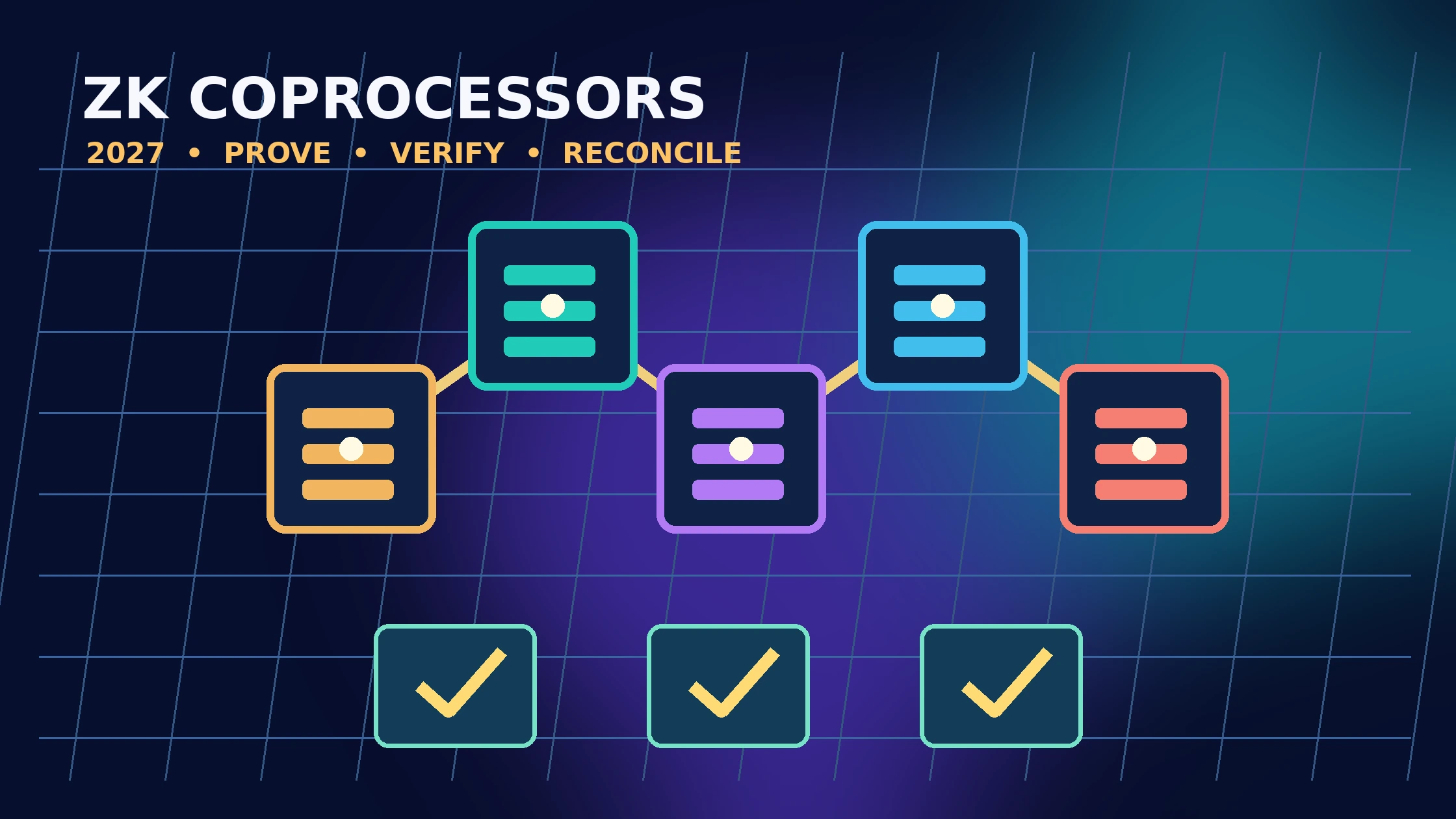
Short answer: Cryptographic coprocessors move expensive blockchain calculations offchain and return proofs that smart contracts can verify. That does not imply all five products in older comparisons are operating or suitable for AI inference: RISC Zero and Succinct SP1 are general zkVM stacks; Brevis and Lagrange emphasize provable historical-data queries; Axiom V2 is included here only as an archived reference.
The signal: verifiable computation is not verified truth
A proof can establish that a named program ran correctly over committed inputs. It does not by itself prove that an external data provider was honest, an AI model was unbiased, or a financial trade would settle profitably. Verify the source of every input, the exact executable or circuit, the chain and verifier contract, and the economic costs of producing the proof.
Four developer stacks and one historical reference
| Stack | Primary task | Proof boundary | What remains unproven | Editorial status |
|---|---|---|---|---|
| RISC Zero zkVM | General-purpose Rust guest execution, verifiable receipt and Ethereum integration | Program identity, zkVM receipt, verifier contract | Application code and inputs still need independent audit | Documented developer stack, not DN bench-tested |
| Succinct SP1 | RISC-V zkVM for Rust/LLVM programs and onchain verification | Proof system and onchain verification contracts | Compare verifier versions, network dependency and proof cost | Maintained public developer source; check release before using |
| Lagrange ZK Coprocessor | Provable SQL-like computation over indexed historical storage data | Verified database, state commitments and aggregated proofs | Source chain coverage, indexing completeness, query latency | Architecture described by vendor; no independent DN performance ranking |
| Brevis zkCoprocessor | Historical state, transaction and receipt data with provable application logic | Application circuit, data access proof, onchain callback | Pure-ZK vs optimistic coChain assumptions; public-alpha limits may differ | Production suitability requires version- and network-specific testing |
| Axiom V2 (legacy reference) | Historic Ethereum state access and ZK-computation callbacks | Core historical block commitment and query verifier | Official core-contract repository archived June 2025 | Historical comparison only; not presented as an active recommendation |
What choosing a coprocessor actually involves
For an agentic-finance or DeFi application, first identify whether the product needs a proof of computation, a historical blockchain query, an external sensor statement, or a proof of user credentials. These are different evidence problems. Generic zkVM frameworks are flexible but require your own input commitments and program design. A historical coprocessor may simplify indexing and state proofs but constrain the chains, data types or historical span you can query.
DN Coprocessor Fit Gate
Score the documented requirements before considering a vendor. This is an editorial integration checklist, not a network availability or benchmark test.
Three use cases worth separating
Historical DeFi fee entitlement
A protocol wants to calculate a fee discount from a user’s past volume. It needs verifiable transaction history and exact event definitions; a specialized historical coprocessor may be a fit, but the data-indexing boundary matters.
Proof of a constrained risk calculation
A treasury agent proposes an allocation and a deterministic program tests position, jurisdiction and counterparty limits. A zkVM may prove execution of the limit program. It does not verify the correctness of offchain prices or the authority to move funds.
Offchain AI inference
A provider claims that a particular model produced a result. Proving the actual inference depends on architecture, model representation, floating-point behavior, inputs, and proof economics. Do not infer production-ready proof of LLM alignment from a zkVM demonstration.
Related DN research: ZKML for Agentic Finance 2027 covers AI use cases; this comparison separates five underlying proof architecture and status models.
Operational status and performance limitations
Brevis publishes the distinction between its pure-ZK and optimistic modes, and documents public-alpha resource limits; these are the vendor’s statements, not independently measured comparative results. RISC Zero documents receipt verification, program identity and Ethereum contracts; SP1 publishes a maintained open-source zkVM repository. Lagrange describes indexing and provable queries. Axiom V2’s core contracts repository states that it was archived on 19 June 2025. We have not independently stress-tested any of these systems.
Primary sources and methods
- RISC Zero: blockchain verifier architecture.
- Succinct SP1 official source repository and documentation.
- Lagrange coprocessor and verifiable database overview.
- Brevis zkCoprocessor introduction.
- Brevis: pure-ZK versus optimistic model.
- Axiom V2 archived contract repository.
Method: We grouped five named architectures by their documented computational and trust boundaries, not by token returns or vendor-reported speed. Reviewed 22 November 2026; compatibility, costs and support can change. No unverified live deployment, pricing or performance ranking is claimed.
Disclosure: Providers are included for explanatory value, not affiliate compensation. This is educational technical research, not investment advice.
Frequently asked questions
Is a ZK coprocessor an AI model?
No. It is an off-chain verifiable computation or historical-data access mechanism. AI model inference may be an application on top but correctness and suitability remain separate.
Does a valid proof mean the input was true?
No. Proofs check a defined computation or commitment. Bad input sourcing, flawed programs and wrong assumptions may still produce valid proofs.
Which of these is the fastest?
DN has not conducted a same-hardware, same-workload benchmark, so no speed ranking is claimed.
Is Axiom V2 currently a recommended live product?
No. Its core contract repository is archived and is included as a historical architectural reference.
Are RISC Zero and SP1 identical to historical-data coprocessors?
No. They are general-purpose zkVM systems. Historical data aggregation is a more specialized architecture.
Can ZK reduce all onchain gas costs to zero?
No. Proving, verification, storage, bandwidth and integration all have costs.
Is private inference automatically available?
No. Privacy and proof integrity depend on exact circuit, public inputs, disclosures and proving setup.
What should developers compare first?
Define the exact output to prove, chain and data range, program, latency budget, onchain verification costs, failure recovery and source-code licence.
About the Author