What Matters
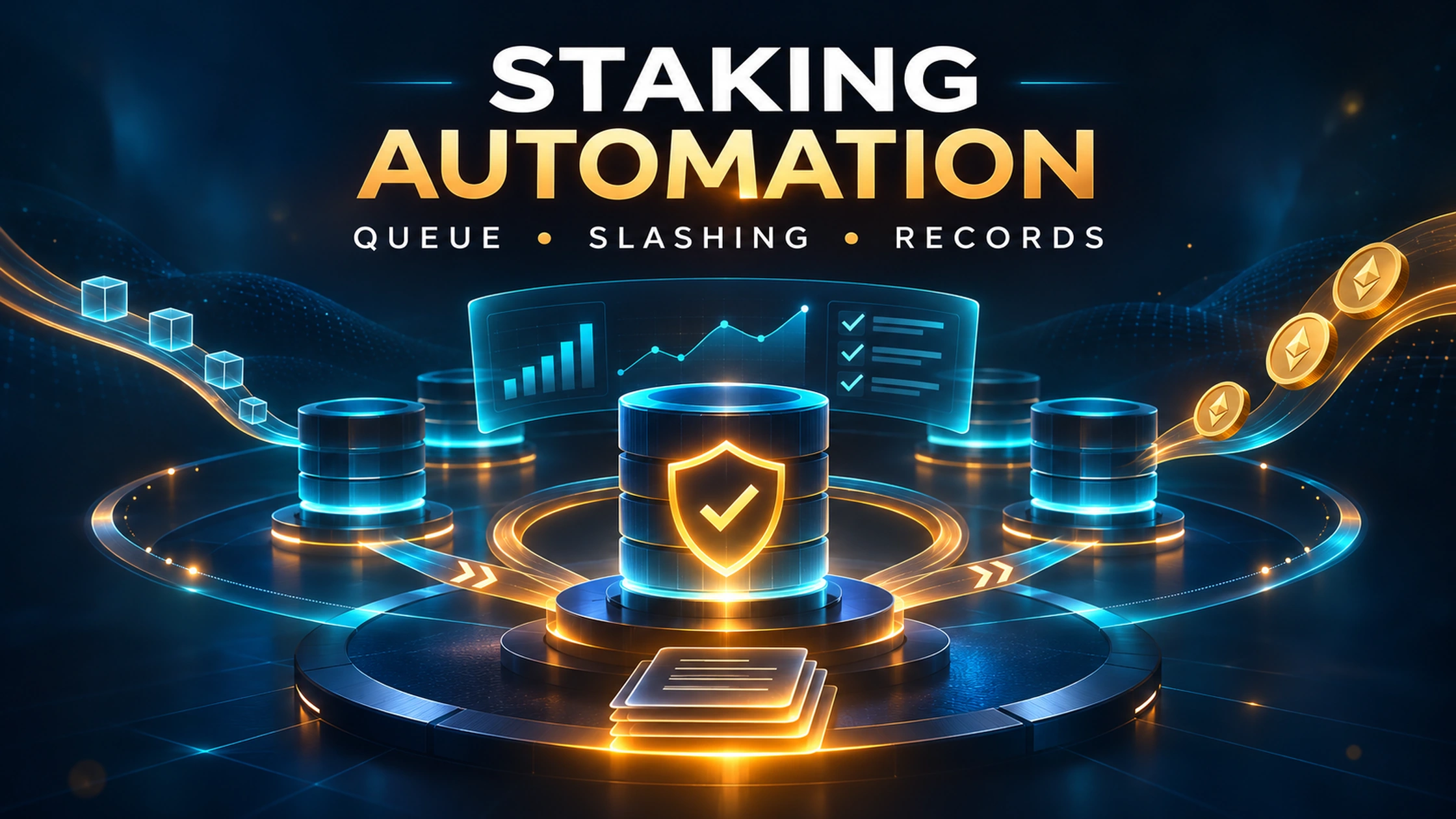
Staking automation is most valuable for monitoring, recordkeeping and bounded operations. It should not conceal who controls the validator keys, where withdrawals go, how long exits take, or what can be slashed. An agent can watch uptime, rewards, queues, protocol changes and token exposure. It cannot turn staking into a risk-free savings account.
DN Evidence Block
Reviewed: 17 November 2026. Primary evidence: Ethereum staking, withdrawal, reward and penalty documentation; Lido withdrawal and slashing-prevention documentation; Rocket Pool operator guidance; and current staking-provider materials.
Boundary: reward rates, validator queues, protocol parameters and liquid-staking discounts change. This article does not rank staking returns or recommend a validator, pool or token.
Six Workflows That Actually Benefit From Automation
| Workflow | Agent role | External control | Primary risk |
|---|---|---|---|
| 1. Validator health monitor | Track attestations, proposals, client status and peer health | Alert and incident playbook | Outage, client bug or duplicate key use |
| 2. Withdrawal and exit tracker | Track queue, eligibility and settlement destination | Withdrawal credentials and approved address | Turning off too early or misreading queue status |
| 3. Reward reconciliation | Match consensus, execution and provider rewards to records | Read-only addresses and accounting policy | Missing, duplicated or misclassified income |
| 4. Liquid-staking exposure monitor | Track token discount, liquidity and withdrawal queue | Maximum exposure and approved venues | Smart-contract, liquidity or depeg risk |
| 5. Restaking and slashing gate | Map additional duties and penalty conditions | Allowlist and maximum at-risk balance | Correlated slashing or unclear delegation |
| 6. Tax and audit record builder | Preserve rewards, fees, swaps and withdrawals | Source-of-truth ledger and exception review | Incomplete basis or jurisdiction mismatch |
1. Validator Health Monitoring
Ethereum validators earn rewards for correct participation and incur penalties for missed duties. Slashing is different from ordinary downtime: it applies to provably conflicting behavior such as double voting or signing conflicting proposals. The common operational danger is running the same signing key on two machines at once during a failover or migration.
A staking agent should therefore monitor more than uptime. It should track validator client version, consensus and execution client health, peer count, clock drift, disk, memory, missed duties and whether the same key appears active in more than one environment. It should never automatically copy signing keys between hosts.
Safer automation pattern
- Use a monitoring key or public validator index, not the signing key.
- Alert on missed attestations, low peer count, time drift and client disagreement.
- Require a human runbook for failover.
- Preserve and import slashing-protection data during migrations.
- Use minority-client guidance where appropriate to reduce correlated client risk.
2. Withdrawal and Exit Tracking
Ethereum exits are not instant. A validator remains responsible for duties while waiting for its exit epoch, and the full withdrawal follows additional processing and sweep mechanics. Queue duration varies with network demand. An agent should present the stages separately: exit request accepted, exit epoch assigned, validator no longer active, withdrawable epoch reached and funds swept to the withdrawal address.
Liquid-staking systems add another queue. Lido withdrawals involve a request, validator-exit and oracle process, then a claim step represented by a withdrawal NFT. The requested amount cannot simply be treated as immediately liquid ETH.
DN Rule
Never let an agent turn off a validator merely because an exit request was broadcast. It must confirm that the validator has reached the exit epoch and is no longer required to perform duties.
3. Reward Reconciliation
Staking returns can include consensus rewards, execution-layer priority fees, MEV-related proceeds, provider distributions, liquid-staking-token appreciation and incentive tokens. These are not interchangeable accounting events. An agent can collect data, but the organization must define how each item is valued and classified.
A robust record contains:
- validator or wallet identifier;
- reward source and timestamp;
- asset and amount;
- fair-value source at receipt where required;
- provider fee or commission;
- subsequent swap, wrapper or withdrawal transaction;
- exception notes for missing or reversed records.
DN has affiliate relationships with Koinly and CoinLedger. Tax software can import records, but it cannot resolve every staking, restaking or wrapper event without review.
4. Liquid-Staking Exposure Monitoring
Liquid-staking tokens make a staked position transferable, but introduce token, contract, liquidity and market-price layers. The agent should monitor the token’s exchange rate, secondary-market discount, withdrawal queue, underlying validator exposure, protocol changes and concentration in DeFi positions.
A discount can reflect temporary liquidity stress or a deeper loss expectation. Automation should not blindly buy every discount or redeem every deviation. It should compare the protocol redemption path, queue, gas, market depth and resulting tax record.
5. Restaking and Additional Duties
Restaking can attach additional services and penalty conditions to staked capital. The agent must map who can impose a penalty, which software must run, how delegation can be changed, how withdrawals work, and whether several services create correlated failure. A headline yield cannot substitute for a complete duty and slashing map.
Safe policy limits include:
- a maximum percentage of total stake exposed to restaking;
- an allowlist of services and operators;
- no automatic acceptance of new slashing terms;
- a delay between governance or contract changes and new deposits;
- an emergency exit plan that accounts for queues and liquidity.
6. Tax and Audit Records
High-frequency compounding and wrapper transactions can create a dense record trail. The agent should import source data regularly, reconcile wallet balances to provider records, preserve transaction hashes and flag unmatched events. Do not wait until year end to discover that an exchange export or protocol endpoint omits a critical field.
DN Staking Automation Risk Gate
Score one proposed automation. Lower is better.
Worked Scenario
A treasury holds solo-staked ETH and a smaller liquid-staking allocation. The monitoring agent has no validator key. It reads public validator data, records rewards, alerts on missed duties, and tracks the liquid token’s secondary-market discount and withdrawal queue. A human approves any exit or reallocation. The wallet used for claims has a daily amount cap and cannot alter validator signing infrastructure.
This design gains speed and record quality without giving a language model the keys that can create a slashable event.
What Automation Cannot Solve
- Protocol or client bugs.
- Correlated validator failures.
- Withdrawal queues during market stress.
- Smart-contract loss in liquid or restaking protocols.
- Token-price volatility and market discounts.
- Jurisdiction-specific tax treatment.
- Governance changes that alter future risk.
Who This Is For
- Validator operators who need better monitoring and records.
- Treasuries with multiple staking exposures.
- Liquid-staking users who understand the extra token layer.
- Developers building read-only tools before adding transaction authority.
Who Should Avoid It
- Anyone expecting fixed or guaranteed yield.
- Users who cannot secure validator and withdrawal credentials separately.
- Teams without a tested migration and slashing-protection process.
- Users who need instant liquidity but rely on queued withdrawals.
Methodology and Limitations
DN evaluated each workflow by key access, action authority, liquidity, slashing exposure, record completeness and concentration. We relied on official documentation and did not compare live annualized returns. Staking mechanics and provider terms can change after publication.
Frequently Asked Questions
Can being offline slash an Ethereum validator?
Ordinary downtime creates missed-reward penalties, not slashing by itself. Slashing applies to conflicting or provably destructive signing behavior.
Can an agent safely fail over a validator?
Only with a carefully designed process that prevents the same signing key from operating in two places and preserves slashing-protection data.
Are liquid-staking tokens the same as ETH?
No. They represent a claim or protocol position and add smart-contract, liquidity, queue and market-price risks.
Are staking withdrawals instant?
No. Solo-validator exits and protocol withdrawals can involve queues, eligibility stages and settlement delays.
Should rewards automatically compound?
Only when the user has defined liquidity needs, concentration limits, tax treatment and protocol risk. Automatic compounding is not automatically optimal.
Primary Sources
- Ethereum.org: Staking Withdrawals
- Ethereum.org: Rewards and Penalties
- Ethereum.org: Solo Staking
- Ethereum Launchpad: Withdrawals
- Lido: Token and Withdrawal Integration
- Lido: Slashing Prevention
- Rocket Pool: Node Operator Responsibilities
Commercial disclosure: this article contains affiliate links to Koinly and CoinLedger. DN may earn compensation if a reader subscribes. They did not pay for inclusion.
About the Author