DN wallet security guide · Verified 20 November 2026
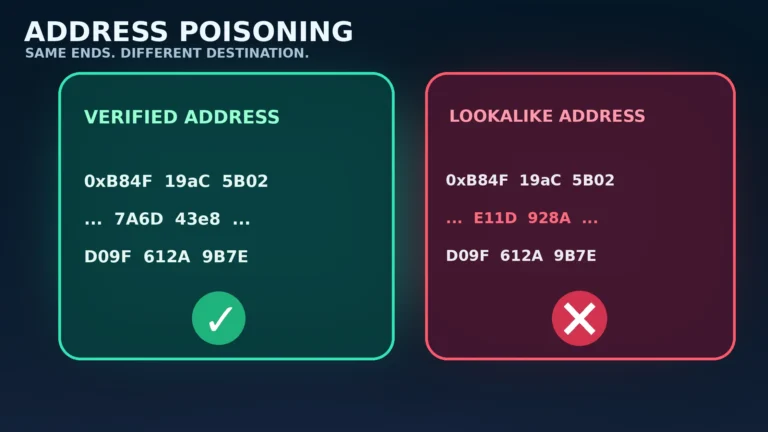
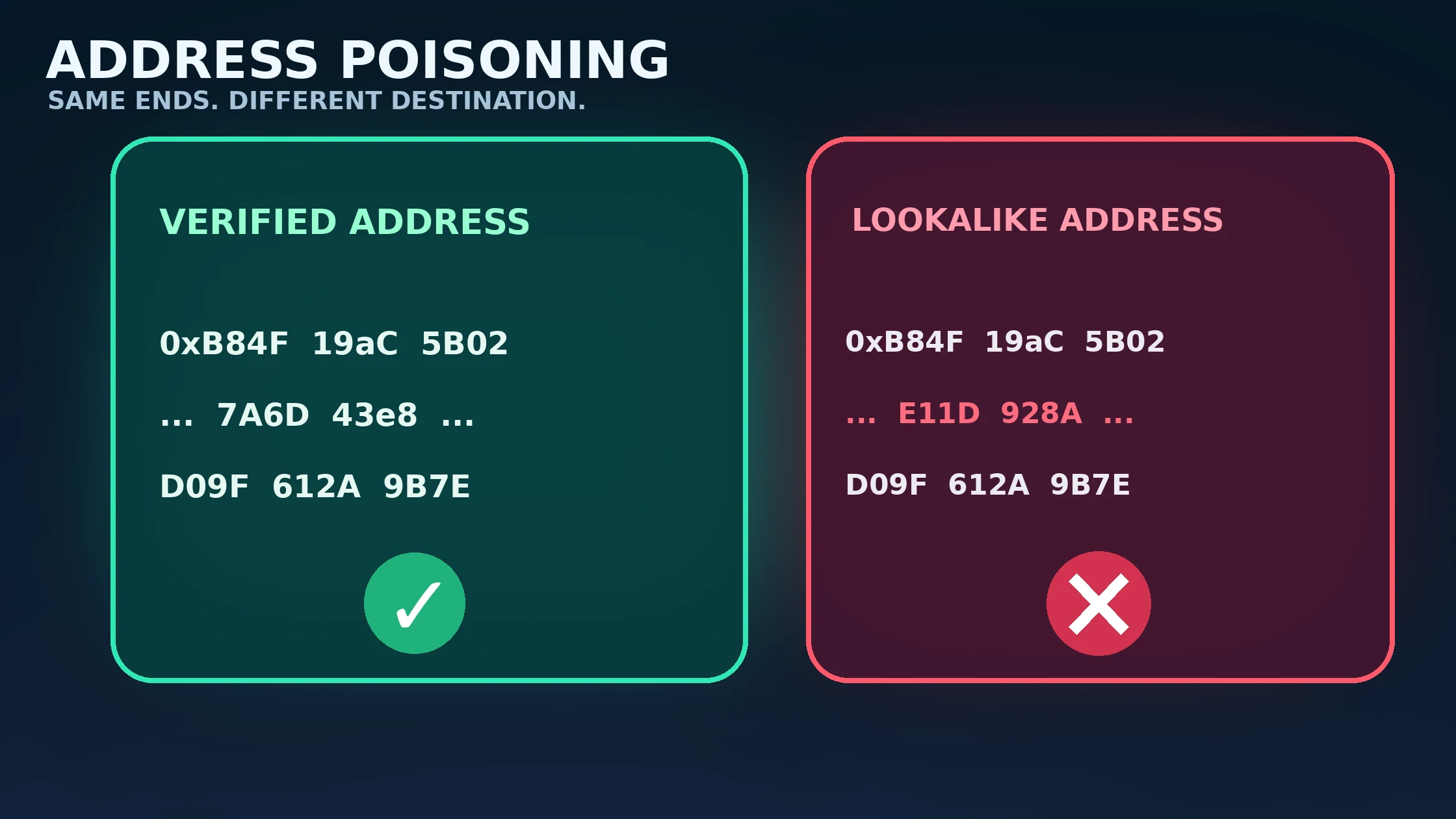
Short answer: Address poisoning puts lookalike destinations into a wallet’s visible transaction history. The scam succeeds when a user trusts a familiar-looking prefix and suffix and sends to the wrong address. The defense is to retrieve the recipient’s address from an independently verified source, compare it in full, and confirm it on the signing device before sending.
How the scam works
- An attacker observes public transfers to a frequently used recipient address.
- They generate a different wallet whose visible beginning and ending resemble the intended destination.
- They make a tiny or zero-value transfer so the lookalike appears in recent activity.
- Someone copies the wrong entry from history and signs a new payment to the attacker.
The poisoning transaction is often not a wallet compromise by itself. The eventual misdirected outgoing transfer is the loss mechanism. This is distinct from clipboard malware, which alters copied text, and from a malicious token approval, which may authorize later spending.
Eight defenses at the moment of payment
- Never use the latest transaction-history entry as your sole source of a destination.
- Obtain the address from the recipient’s trusted independent communication channel.
- Compare the full address, including the middle characters and letter case where applicable.
- Verify the chain and asset contract, not just the address.
- Use a preverified contact book for recurring recipients and review changes separately.
- Inspect warnings from the wallet; do not click through them automatically.
- For high-value or unfamiliar destinations, consider a small test transaction, while remembering that tests cost fees and do not prove later recipient integrity.
- Confirm the full destination on a hardware device where the product supports it, and independently verify the recipient before approval.
DN Local Address Comparator
Paste two public addresses only. This tool never asks for private keys or recovery phrases and makes no external request. It checks textual identity only, not whether a destination is trustworthy. For privacy, do not paste information you do not want displayed in this browser.
If you suspect an attempted theft or have sent to the wrong address
Do not resend from the history. Save the transaction hash, suspicious address, timestamp and any messages that directed you to the address. Report malicious addresses through official wallet support and explorer mechanisms where offered. Transfers on public blockchains generally cannot be unilaterally recalled. Beware anyone requesting upfront fees or a seed phrase to recover lost assets.
Primary sources and limitations
- MetaMask Help: Address poisoning scams, mechanism and safeguards.
- MetaMask: Address poisoning detection now live, product scope and warning descriptions.
- MetaMask: Report a scam, evidence preservation and reporting.
Method: This guide uses provider security documentation and an original browser-side string comparison. The tool does not independently detect scam campaigns, cryptographically verify recipient identity or assess an address's transaction history. Security controls change by wallet and version.
Disclosure: No wallet recommendations are ranked by affiliate payments. This is educational security guidance, not a recovery service or investment advice.
Frequently asked questions
What is address poisoning?
An attacker places a lookalike wallet address into your transaction history, hoping you copy it later as a destination.
Can a zero-value transfer empty my wallet?
Typically the suspicious transfer itself does not grant signing authority. The risk occurs if you later send assets to the fraudulent lookalike address.
Are the first and last six characters sufficient?
No. Lookalike addresses can match a prefix and suffix while differing in the middle. Verify the full trusted destination.
Does a hardware wallet automatically stop this?
No. It can provide an independent display for verifying the full destination, but a user can still approve an incorrect address.
Can an address book prevent all poisoning?
It helps reduce copying from transaction history when entries were originally verified, but address books can still be misconfigured or compromised.
Does MetaMask detect poisoning?
MetaMask reports detection for lookalike destination addresses on supported EVM networks, plus first-time-address warnings. Detection is not a guarantee.
What if I already transferred assets to an impostor?
Stop further transfers, preserve transaction evidence, report the incident via official wallet/platform support and law enforcement as appropriate, and avoid recovery scams.
Is this address comparison tool an on-chain scam detector?
No. It compares two text strings locally in the browser. It does not connect to a wallet, validate address ownership or scan the blockchain.
About the Author