The AI Trade Beyond Models: Who Builds the Memory, Power, Cooling and Compute
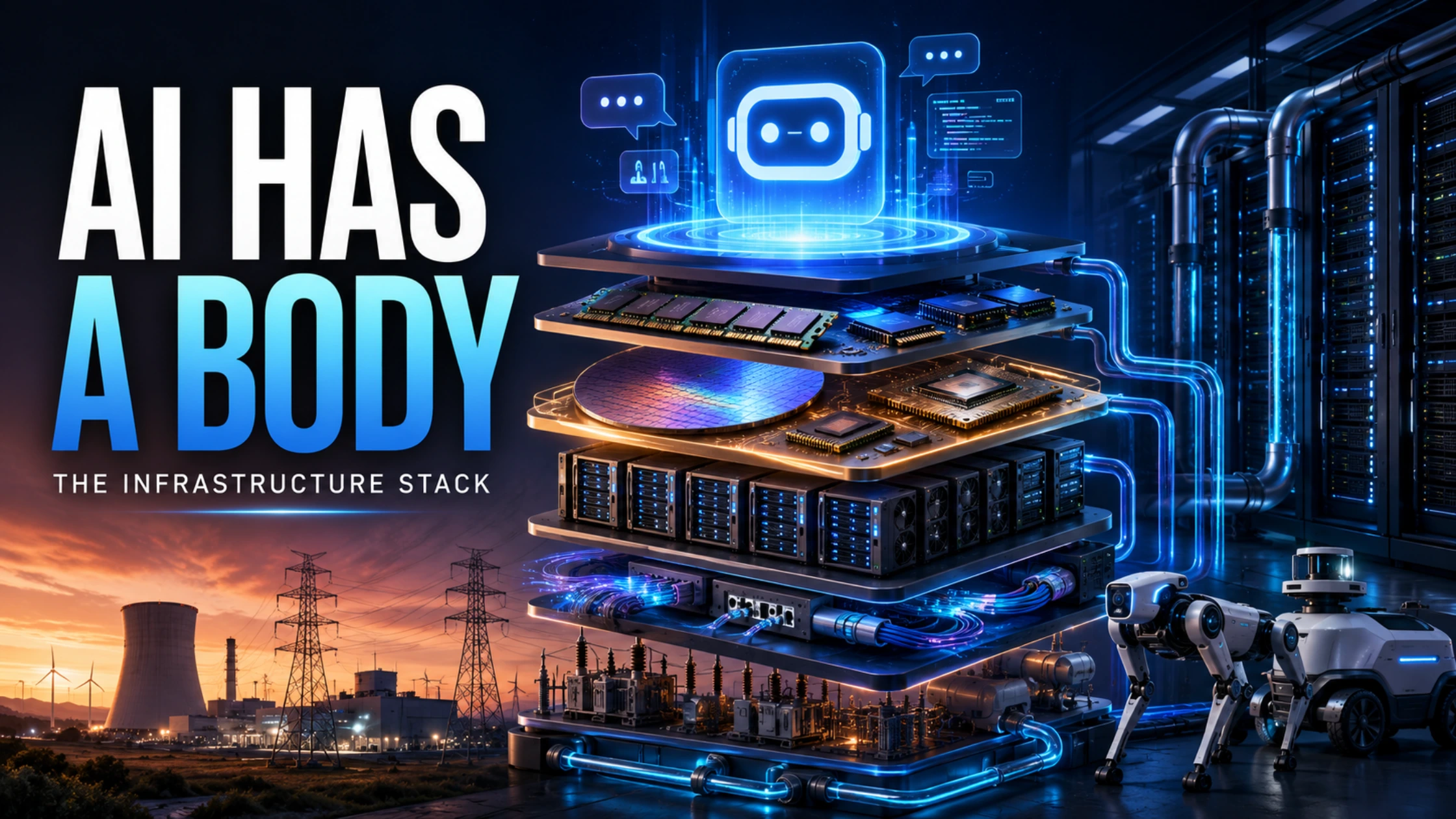
The physical anatomy of AI in 2026: mapping the eight companies building the body behind the chatbot
- Every AI answer depends on a physical stack most investors never see: memory (Micron), foundry manufacturing (Intel), specialized inference silicon (Etched), compute rental (CoreWeave), optical networking (Nokia), on-site power generation (Bloom Energy), power distribution and cooling (Vertiv), and safety-certified edge software (BlackBerry QNX).
- Micron's market capitalisation reached roughly $1.16 trillion after fiscal Q3 2026 revenue of $41.46 billion, with HBM3E and HBM4 fully booked through calendar 2027 and demand stretching into 2028.
- CoreWeave's contracted backlog hit $99.4 billion by the end of Q1 2026, against roughly $24.9 billion in debt and a Q1 net loss of $740 million, with Microsoft historically accounting for around 67 percent of revenue.
- Bloom Energy's roughly $20 billion backlog includes about 43 percent tied to Brookfield joint ventures that did not exist before August 2025, a concentration flagged by short-seller research even as Oracle's own Project Jupiter pipeline faced a second permit rejection in July 2026.
- Vertiv's book-to-bill ratio hit 2.9x with backlog reaching $15 billion, while the stock trades near 46 times forward earnings against peers in the mid-20s to low-30s range.
- Intel's stock returned roughly 330 percent from the US government's $8.9 billion, 10 percent equity stake in August 2025 through May 2026, alongside separate $5 billion and $2 billion investments from Nvidia and SoftBank.
- A recurring pattern connects nearly every company in this stack: a headline backlog or contract figure many multiples larger than trailing realized revenue, a small number of counterparties responsible for most of that backlog, and a valuation multiple analysts openly describe as "priced for perfection."
- The DN Perfection Premium Ledger, embedded below, lets you test that exact pattern, valuation premium over peers, backlog cover in years, and customer concentration, against any company in this stack or elsewhere.
Ask an AI model a question and the popular imagination pictures something close to magic: words in, words out, somewhere in "the cloud." What actually happens is closer to a factory floor than a thought. A trillion-parameter model has to be fed from memory chips stacked like skyscrapers next to a GPU that would otherwise starve. That GPU has to be manufactured at a yield high enough to be economical, on a process node only a handful of companies on earth can execute. The rack it sits in has to be fed enough electricity to power a small town, and that electricity has to arrive faster than the four-to-seven-year queue the US electrical grid currently imposes on anyone trying to plug in. The heat that rack throws off has to be carried away by liquid before the chips damage themselves. And if that intelligence needs to reach a car, a warehouse robot, or a factory floor rather than a browser tab, it has to run on software that is legally certified never to crash.
None of the companies behind any single layer of that stack make the model itself. None of them are Nvidia, OpenAI, or Anthropic. And in 2026, several of them have become some of the best-performing, most argued-about stocks on the market specifically because investors have started to realize that the physical stack beneath the chatbot might be a better, more durable bet than the chatbot's makers themselves. This is a company-by-company map of that stack, and of the single pattern that connects nearly every name in it.
Layer one: memory, or why the GPU is only as fast as its shelf
A GPU does not contain the intelligence it runs. It has to constantly fetch it: model parameters, context, the conversation so far, all pulled from memory chips sitting physically beside the processor. If that memory is too slow or too far away, an extremely expensive chip sits idle waiting for data, which is the entire reason high bandwidth memory, HBM, has become one of the tightest bottlenecks in the AI economy. HBM stacks memory dies vertically and connects them with microscopic through-silicon vias, placing far more bandwidth in far less space than conventional flat memory, at a manufacturing difficulty only three companies on earth have mastered: SK Hynix, Samsung, and Micron, the only one of the three headquartered in the United States.
Micron's fiscal third-quarter 2026 results, reported June 24, 2026, made the scarcity concrete: revenue of $41.46 billion against a $35.69 billion forecast, a 16 percent beat, alongside record free cash flow and gross margins guided above 80 percent. Management confirmed HBM3E and HBM4 are fully booked through calendar 2027, with demand extending into 2028, a level of forward visibility almost unheard of in a historically brutal, cyclical commodity business. The market has responded accordingly: Micron's stock is up roughly 700 percent over the past year, pushing its market capitalisation to approximately $1.16 trillion, second only to Nvidia in projected 2026 and 2027 net income across the entire PHLX Semiconductor Index by some analyst counts. Micron also sits in DRAM, a server's working memory, and NAND flash for SSD storage, giving it exposure across three of the four memory layers an AI server needs, missing only hard-disk archival storage, which remains the province of Seagate and Western Digital.
Layer two: the foundry, or who actually manufactures the chip
Every AI chip, however brilliantly designed, has to be physically manufactured, and for most of the past decade that has meant one company: Taiwan Semiconductor Manufacturing Co. Intel used to make its own chips too, as an integrated device manufacturer, but a series of delays to its 10-nanometer process in the mid-2010s let TSMC pull decisively ahead, turning Intel's greatest historical advantage, owning its own factories, into a liability it could not easily shed.
Intel's comeback bet, under CEO Lip-Bu Tan, rests on a manufacturing process called 18A, combining gate-all-around transistors and backside power delivery to compete at the leading edge again, and on convincing outside customers to actually use it. The financial backing behind that bet has been extraordinary: the US government took a 10 percent equity stake worth roughly $8.9 billion in August 2025, tied to CHIPS Act funding, alongside a $5 billion investment from Nvidia and $2 billion from SoftBank. Intel's stock has returned as much as 330 percent from the government stake through May 2026, helped along by reports of Apple entering foundry talks and Elon Musk building a $25 billion facility around Intel's process node. Intel's Q1 2026 revenue of $13.6 billion beat consensus by more than a billion dollars, sending the stock up 24 percent in a single session. The unresolved question is the one that matters most: 18A has so far been used primarily to make Intel's own products, and the marquee outside customer commitments that would prove the foundry business works remain the piece still missing.
Layer three: the specialists betting the future looks like today
Not every company in this stack is betting on generality. Etched, a San Jose-based startup founded in 2022, is making the opposite wager: that the transformer architecture underlying nearly every major AI model is now stable and important enough to hard-wire directly into silicon, rather than run flexibly on a general-purpose GPU. Its chip, Sohu, manufactured on TSMC's 4nm N4P process, dedicates its entire circuit to the transformer's attention and feed-forward operations, claiming roughly 90 percent useful FLOP utilisation against an estimated 30 to 40 percent for a general-purpose GPU running the same workload through software. Etched exited stealth on June 30, 2026 with $800 million raised and more than $1 billion in signed customer contracts, backed by Sequoia, Jane Street, and a TSMC-linked venture arm among others. Less than a month later, on July 23, 2026, the company closed a further $300 million Series C led by Sequoia at a $10.3 billion valuation, roughly double the figure investors had been discussing weeks earlier, Sequoia's highest-ever Series C valuation.
The bet is elegant and fragile in equal measure. A specialized chip wins decisively for as long as the workload it was built for stays dominant. Nvidia's GPUs can adapt to a new model architecture through a software update; Etched's fixed-function silicon cannot. If transformers remain the standard architecture for high-volume inference, Etched has built one of the most efficient machines on earth for running them. If the field moves on, the company's entire advantage is stranded in silicon that cannot follow.
Layer four: renting the compute itself
Once the chips exist, someone has to operate them at scale on behalf of the labs that need them but cannot or will not build their own data centres fast enough. That is the neocloud business, and CoreWeave is its largest independent example, a company that began in 2017 as an Ethereum mining operation called Atlantic Crypto and pivoted its GPU inventory to AI compute rental just before demand exploded. CoreWeave's contracted backlog reached $99.4 billion by the end of Q1 2026, nearly four times its year-earlier level, built substantially on long-term, take-or-pay contracts with Microsoft, OpenAI, Meta and Anthropic. Roughly 36 percent of that backlog is expected to convert to revenue within 24 months.
The company's financial structure looks less like software and more like leveraged real estate development. CoreWeave borrows against signed contracts to buy GPUs and lease data centre space, largely from landlords including Core Scientific, whose shareholders twice rejected a CoreWeave acquisition offer that would have converted the company from tenant to owner. Total debt stood near $24.9 billion by mid-2026, with quarterly interest expense of roughly $536 million eating deeply into an adjusted EBITDA margin that looks impressive in isolation but obscures a business burning billions in free cash flow, negative $4.7 billion in one recent quarter, while capital expenditure guidance for 2026 runs $30 to 35 billion. Microsoft's customer concentration, historically as high as 67 percent, has been the central bear argument for years. That argument gained new force on July 1, 2026, when Bloomberg reported Meta, a $21 billion CoreWeave commitment signed in March, was developing its own internal cloud business, Meta Compute, to resell excess AI capacity. CoreWeave shares fell sharply on the news, and the incident crystallised the structural risk running through this entire layer of the stack: the same hyperscalers renting capacity today have every incentive and increasingly the means to become tomorrow's competitor.
Layer five: the highways between buildings
A single data centre cannot hold unlimited GPUs. Power, cooling and physical space all run out eventually, which means the industry increasingly spreads AI compute across multiple buildings and campuses that must function as one coordinated system, exchanging enormous volumes of machine-to-machine data continuously. Copper cabling works over short distances inside a rack, but signal degradation, heat and power draw make it impractical over the distances between buildings, which is where optical fiber, and Nokia, come in.
Nokia's optical networking revenue grew 20 percent year over year in Q1 2026, while its combined AI and cloud revenue grew 49 percent, driven by hyperscalers upgrading toward 800G and eventually 1.6 terabit optical transport systems. The more consequential development arrived on October 28, 2025, when Nvidia invested $1 billion in Nokia at $6.01 per share for a roughly 2.9 percent stake, sending Nokia shares up nearly 21 percent that day, to pursue a joint initiative called AI-RAN: running part of the radio access network, the equipment connecting phones to cell towers, on Nvidia GPUs rather than specialized telecom chips. The logic is that the same GPU infrastructure could simultaneously run the mobile network and perform AI inference physically closer to the user, cutting latency from hundreds of milliseconds toward single digits for applications like autonomous vehicles, drones and AI glasses that cannot tolerate a round trip to a distant data centre. T-Mobile began field trials in 2026, with commercial deployment not expected before 2027, meaning AI-RAN remains a real option rather than a current revenue driver. Optical networking, not AI-RAN, is what is actually moving Nokia's numbers today.
Layer six: generating power where the grid cannot reach in time
Every layer above this one assumes electricity simply arrives. Increasingly, it does not, at least not on the timeline AI companies need. The wait to connect a large new electrical load to the US grid, the interconnection queue, has stretched past four years nationally and toward seven years in Northern Virginia, the world's data centre capital, driven by permitting delays and multi-year backlogs for transformers and transmission equipment. That gap is Bloom Energy's entire business: solid oxide fuel cells, boxes that convert natural gas directly into electricity through a chemical reaction rather than combustion, achieving 54 to 60 percent fuel efficiency against roughly 35 to 40 percent for a conventional gas turbine, deployable on-site in around 90 days rather than years.
Bloom's numbers through mid-2026 have been extraordinary by any standard: Q1 2026 revenue of $751.1 million, up 130 percent year over year, full-year guidance raised to $3.4 to $3.8 billion, and a total backlog exceeding $20 billion anchored by an up-to-2.8-gigawatt master agreement with Oracle's Project Jupiter campus and a Brookfield Asset Management financing partnership expanded from $5 billion to $25 billion in 2026. But two developments complicate the picture considerably. First, investigative research published in mid-2026 highlighted that roughly 43 percent of Bloom's revenue now flows from Brookfield-affiliated joint ventures that did not exist before August 2025, a concentration Deloitte flagged as a critical audit matter, alongside a wide divergence between Bloom's GAAP remaining performance obligations, roughly $492 million, and its far larger headline backlog figure. Second, the New Mexico Public Lands Commissioner rejected, for a second time, the natural gas pipeline underpinning Oracle's Project Jupiter campus in July 2026, pushing Oracle's original August 15 in-service target past its deadline and construction potentially into 2027. Bloom's stock has traded with extraordinary volatility through 2026 as a result, up as much as 247 percent in the first half of the year before a sharp pullback tied to both the pipeline setback and short-seller scrutiny.
Layer seven: moving the power and the heat inside the building
Once electricity reaches the site, it still has to be distributed safely and the resulting heat removed continuously, at a scale that has transformed data centre infrastructure from a mature, unglamorous business into one of the tightest supply constraints in the entire AI stack. A single modern Nvidia AI rack draws 120 to 130 kilowatts, more than ten times a traditional server rack, a density at which air cooling physically stops working and liquid cooling, cold plates and coolant distribution units pumping fluid directly across each chip, becomes mandatory rather than optional.
Vertiv, spun out of Emerson Electric and listed on the NYSE in 2020, sells precisely that stack: uninterruptible power supplies, switchgear and busway for power distribution, and the full range of thermal management from precision air conditioning to liquid cooling systems, backed by more than 5,000 field service engineers. The order data through 2026 has been remarkable: a book-to-bill ratio of 2.9x, meaning nearly three dollars of new orders booked for every dollar of product shipped, and backlog reaching $15 billion, more than double the prior year. Vertiv's Q1 2026 revenue of $2.65 billion grew 30 percent year over year, with adjusted earnings per share up 83 percent as operating leverage kicked in, pushing full-year guidance to $13.5 to $14 billion in revenue. The stock has rallied more than 300 percent over twelve months and joined the S&P 500 in March 2026. That performance carries a valuation cost: Vertiv trades near 46 times forward earnings against diversified industrial peers like Schneider Electric and Eaton in the mid-20s to low-30s range, and close to half of all planned US data centre builds have already experienced delays, primarily from power infrastructure shortages rather than falling demand, a dynamic that could extend Vertiv's own revenue recognition timeline even without any softening in underlying orders.
Layer eight: the safety-certified software running AI in the physical world
The final layer of this stack is the one least connected, on the surface, to any of the others: BlackBerry, the smartphone company most people assumed died around 2010. What survived was QNX, a real-time operating system BlackBerry acquired in 2010 for roughly $200 million, originally intended to power its ill-fated BlackBerry 10 phones. QNX uses a microkernel architecture, keeping every driver and service isolated in its own sealed process rather than sharing memory the way Windows, Android and Linux do, so that a single crashed component fails alone instead of taking down the entire system, and can be recertified far more easily against the automotive industry's strictest safety standard, ASIL D, than a monolithic operating system with tens of millions of lines of code.
That architecture has quietly become the default nervous system for safety-critical software: QNX now runs in more than 275 million vehicles, and roughly 24 of the world's 25 largest EV makers build on it. QNX segment revenue reached $268 million annualised in Q1 fiscal 2027, up 26 percent year over year, against an 84 percent gross margin, backed by a royalty backlog near $950 million to $1 billion representing devices and vehicles already contracted or shipping. The layer now extending fastest is not automotive but physical AI: an expanded partnership with Nvidia integrates QNX with the IGX Thor platform and Halos Safety Stack for robotics, surgical systems and industrial automation, positioning BlackBerry as the certified safety layer beneath the same wave of humanoid robots and physical AI systems every other company in this stack is ultimately built to power. BlackBerry's non-automotive QNX revenue, now around 20 percent of the segment and growing, is the number that will determine whether this becomes a second engine or stays a promising side bet.
DN Perfection Premium Ledger
Every AI infrastructure stock in 2026 gets called "priced for perfection." Test what that actually means for any of them.
The pattern underneath all eight companies
Read individually, these are eight unrelated turnaround and momentum stories: a memory maker, a chipmaker trying to rebuild a foundry, a stealth silicon startup, a crypto-miner-turned-cloud-provider, a legacy telecom equipment maker, a fuel cell company, an industrial cooling specialist, and a smartphone company's forgotten acquisition. Read together, a single structural pattern repeats across nearly every one of them.
| Company | Layer | Headline backlog or commitment | Top customer concentration | Valuation signal |
|---|---|---|---|---|
| Micron | Memory (HBM/DRAM) | HBM booked through 2027, into 2028 | Diversified across hyperscalers | ~$1.16T market cap, single-digit forward P/E on FY27 estimates |
| Intel | Foundry manufacturing | 18A capacity, limited external commitments | Primarily internal (own products) | Up ~330% on government/Nvidia/SoftBank backing; foundry losses ongoing |
| Etched | Specialized inference silicon | $1B+ signed contracts, unshipped | Concentrated, early customer base | $10.3B valuation, pre-revenue at scale |
| CoreWeave | Compute rental (neocloud) | $99.4B contracted backlog | Microsoft historically ~67% | ~7.7x EV/revenue; $24.9B debt; quarterly net losses |
| Nokia | Optical networking | Hyperscaler-driven 20% optical growth | Diversified across telecom and cloud | Up ~140% YTD on Nvidia stake and AI/cloud growth |
| Bloom Energy | On-site power generation | ~$20B total backlog | ~43% from Brookfield-affiliated JVs | ~22x sales; GAAP RPO far below headline backlog |
| Vertiv | Power distribution & cooling | $15B backlog, 2.9x book-to-bill | Hyperscalers, concentrated | ~46x forward earnings vs. ~25-30x peers |
| BlackBerry QNX | Safety-certified edge software | ~$950M-$1B royalty backlog | Automotive OEMs, diversifying to robotics | Up double digits on backlog growth and Nvidia tie-in |
Three things are true across almost every row of that table. First, the headline number investors are trading on, backlog, contracted RPO, or a strategic partnership, is a multi-year promise, not a receipt, and every one of these companies discloses a GAAP-recognized figure that converts far more slowly than the headline suggests. Second, a disproportionate share of that promise traces back to a small number of counterparties: Microsoft for CoreWeave, Brookfield-linked entities for Bloom Energy, a handful of hyperscalers for Vertiv, automotive OEMs for BlackBerry, which means any single customer's changed plans has an outsized effect on the whole story. Third, and most consistently, analyst notes across nearly every one of these names use the identical phrase: priced for perfection. The market is not simply betting the AI buildout continues. It is underwriting, at today's multiples, a specific and demanding sequence: backlog converting on schedule, customer concentration resolving itself through diversification rather than departure, and execution risk that has sunk comparable buildouts before, resolving cleanly this time.
What this means for how you read the next headline in this space
The honest takeaway from mapping this entire stack is not that any of these eight companies are frauds, or that the AI infrastructure buildout is fake. Micron's HBM is genuinely sold out years in advance. Vertiv's book-to-bill ratio is a real, audited number. CoreWeave's Microsoft contract is a real, binding commitment. The takeaway is narrower and more useful: a backlog figure, a strategic partnership announcement, or a chip-maker's equity stake in its own customer tells you demand exists, but it tells you almost nothing about whether that demand converts into cash on the timeline the current stock price requires. The gap between those two things, backlog and realized revenue, concentrated customer and diversified customer, peer multiple and premium multiple, is where nearly all of the real risk in this trade actually lives, and it is the same gap DN's Neocloud Collateral Ledger and Reserve Income Stress Ledger were built to interrogate in the compute and stablecoin layers of this same broader AI economy.
For DN's readers positioning around the decentralised and tokenized end of this same infrastructure buildout, the logic transfers directly: a DePIN network's headline node count or partnership announcement deserves the same scrutiny as a neocloud's backlog figure. For readers looking to gain exposure to AI infrastructure and DePIN tokens directly, spot and derivatives markets are available through most major exchanges, including Bybit, OKX and MEXC. As always, this is not financial advice. The physical stack behind AI is real and measurable. Which companies convert their piece of it into durable, non-concentrated cash flow is the judgment call that deserves independent due diligence.
Frequently asked questions
What are the main physical layers behind AI infrastructure?
Beyond the GPU itself, AI infrastructure depends on high bandwidth memory to feed the chip, foundry manufacturing to produce it, compute rental companies to operate it at scale, optical networking to connect data centres, on-site power generation where the grid cannot connect fast enough, power distribution and liquid cooling inside the building, and safety-certified software where AI needs to run in cars, robots or industrial equipment.
Why does Micron matter so much to the AI trade?
Micron is one of only three companies worldwide, alongside SK Hynix and Samsung, that manufacture high bandwidth memory at scale, and the only one headquartered in the United States. Its HBM3E and HBM4 products were fully booked through calendar 2027 as of its fiscal Q3 2026 results, with demand extending into 2028, giving it exceptional pricing power and margins above 80 percent.
What is CoreWeave's backlog and how much of it is realized revenue?
CoreWeave's contracted backlog reached $99.4 billion at the end of Q1 2026, but this figure represents remaining performance obligations and estimated future revenue under committed contracts, not cash already received. Roughly 36 percent of that backlog was expected to convert to revenue within 24 months as of the same disclosure.
Why is Bloom Energy's backlog controversial?
Investigative research published in mid-2026 highlighted that approximately 43 percent of Bloom Energy's revenue now comes from joint ventures affiliated with Brookfield Asset Management that did not exist before August 2025, and that Bloom's GAAP remaining performance obligations figure is dramatically smaller than its headline $20 billion backlog figure, raising questions about how much of that backlog represents firm, near-term commitments.
What is Intel's 18A process and why does it matter?
18A is Intel's most advanced manufacturing process, combining gate-all-around transistors and backside power delivery, and represents Intel's attempt to regain competitiveness with TSMC and rebuild a foundry business serving external customers. Its success is considered the key test of whether Intel's broader turnaround, backed by investments from the US government, Nvidia and SoftBank, is durable.
What does Etched's Sohu chip do differently from Nvidia's GPUs?
Sohu is an application-specific chip that hard-wires the transformer architecture directly into silicon rather than running it flexibly through software on a general-purpose processor, which Etched claims allows roughly 90 percent useful FLOP utilization versus an estimated 30 to 40 percent for a general-purpose GPU. The tradeoff is that Sohu cannot adapt if a future AI architecture moves away from transformers, unlike a GPU, which can be reprogrammed through software.
Why did Nvidia invest in Nokia?
Nvidia invested $1 billion in Nokia on October 28, 2025 for a roughly 2.9 percent equity stake to jointly develop AI-RAN, technology that would let telecom radio access networks run partly on Nvidia GPUs, enabling AI inference to happen closer to end users and devices rather than in distant data centres, reducing latency for applications like autonomous vehicles and AI-native devices.
Why does BlackBerry's QNX matter to physical AI and robotics?
QNX is a real-time, microkernel operating system certified to the strictest automotive safety standards, already running in more than 275 million vehicles. Its architecture isolates each software component so a single failure cannot crash the whole system, which is exactly the property required for AI to safely control physical equipment like robots, industrial machinery and surgical devices, an application BlackBerry is expanding into through a partnership with Nvidia.
What does "priced for perfection" mean and why does it apply across this whole sector?
It describes a stock whose valuation multiple already assumes a company executes its growth plan almost flawlessly, converting backlog on schedule, retaining concentrated customers, and avoiding the delays common in large infrastructure buildouts. Nearly every company across the AI infrastructure stack, from CoreWeave to Vertiv to Bloom Energy, trades at a significant premium to historical peers, meaning any single disappointment tends to produce an outsized stock reaction.
About the Author