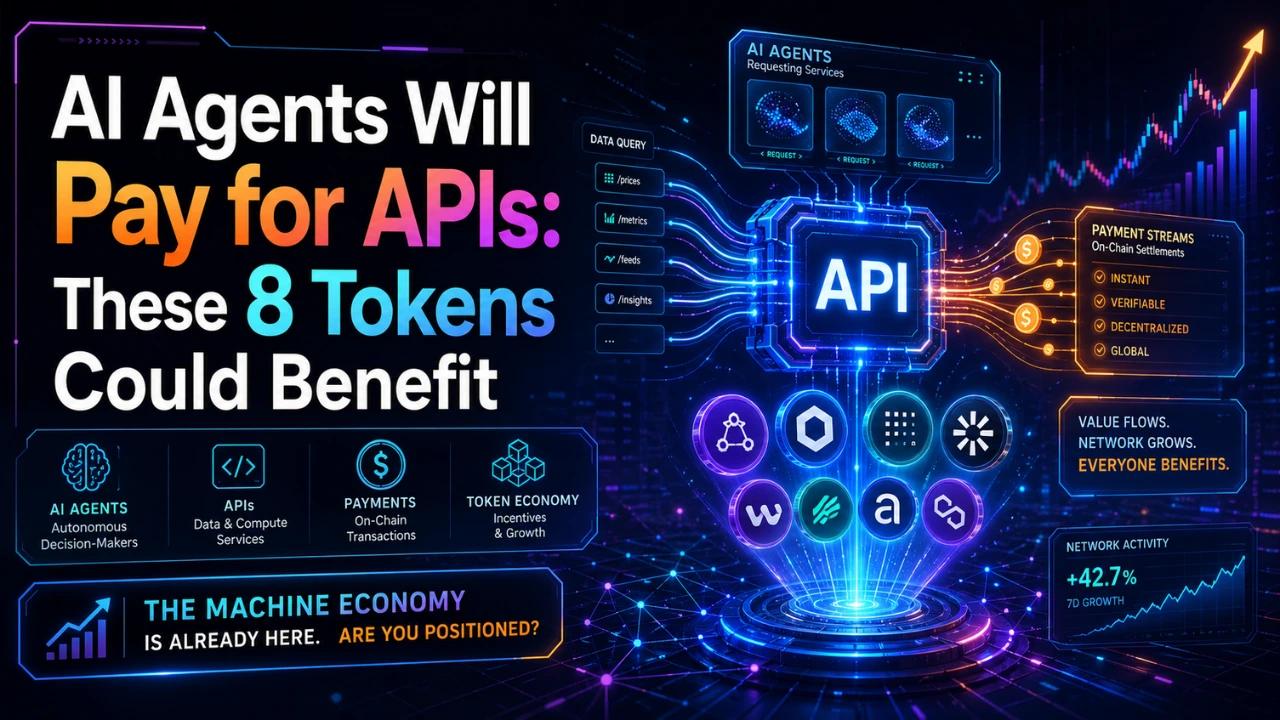
The Next AI Crypto Trade Is Not Just About Agents. It Is About What Agents Pay For.
Most investors are still looking at AI crypto through the wrong lens.
They are asking:
Which AI agent token will go viral?
The better question is:
Which protocols will AI agents actually pay to use?
That is the real shift.
The internet was built around humans clicking, subscribing, logging in, and managing accounts. AI agents do not work like that. They operate continuously. They need to request data, rent compute, call APIs, execute transactions, and settle payments instantly.
That makes the old SaaS model awkward.
Monthly subscriptions do not fit autonomous software. Prepaid credits can run out mid-task. API keys create friction. Human checkout flows break automation.
The next phase of AI monetization is likely to look very different:
pay-per-call, pay-per-query, pay-per-inference, pay-per-execution.
That is why protocols connected to data, compute, privacy, indexing, and machine-readable information could become some of the biggest beneficiaries of the agent economy.
This is not just an AI-token narrative.
It is a usage model.
And usage is where the serious value starts.

Why Pay-Per-Use APIs Matter for Crypto
Pay-per-use APIs allow software agents to pay only when they consume a service.
That could mean:
- an agent pays for one market-data query
- an agent pays for one private inference request
- an agent pays for one compute job
- an agent pays for one data feed
- an agent pays to execute one workflow
The x402 payment model has accelerated this conversation because it revives the HTTP 402 “Payment Required” concept for internet-native payments. The core idea is simple: instead of requiring accounts, subscriptions, or platform credits, a service can request payment directly at the point of access. Coinbase’s developer ecosystem has positioned x402 around agent payments and API monetization, while CoinGecko has also highlighted x402-style data/API monetization in its own coverage.
For AI agents, this matters because it turns crypto rails into something more than speculation.
It turns them into machine-commerce infrastructure.

How Pay-Per-Use Changes Token Design
In the old model, many tokens were valued around governance, staking, and vague “ecosystem utility.”
In the pay-per-use model, the best tokens may have clearer usage logic.
The strongest designs will usually have at least one of these characteristics:
- Consumption demand
The token is needed, burned, staked, or routed through usage. - Fee capture
The protocol earns from queries, compute, data access, inference, or execution. - Infrastructure dependency
Other applications rely on the protocol to function. - Agent compatibility
The service can be called programmatically by autonomous agents. - Payment composability
The project can plug into stablecoin rails, x402-style flows, smart wallets, or API marketplaces.
That is the lens behind this list.
This is not “best AI memes.”
This is which infrastructure tokens could matter if agents become real economic users.
Best AI Agent Pay-Per-Use Token Plays
Rank | Token | Category | Why It Fits Pay-Per-Use APIs | Best Affiliate Trading Access |
1 | GRT | Data queries | Agents need structured blockchain data | Binance, Bybit, Kraken |
2 | TAO | Intelligence / inference | Intelligence markets can price model output | Binance, KuCoin, Kraken |
3 | RENDER | GPU compute | Agents need GPU jobs and inference capacity | Binance, Bybit, Gate, Kraken |
4 | AKT | Decentralized cloud | Agents need on-demand compute deployment | Kraken, Gate, KuCoin |
5 | RLC | Secure off-chain compute | Enterprise agents need trusted computation | MEXC, Binance, Kraken |
6 | PHA | Confidential AI execution | Agents handling sensitive data need privacy | Binance, OKX, MEXC |
7 | RSS3 | Open information layer | Agents need structured open data feeds | Gate, MEXC |
8 | FET | Agent infrastructure | Agent networks need coordination and services | Binance, KuCoin, Kraken |
Listings change by region and over time. Always check the exchange’s live market page before depositing funds.

1. The Graph (GRT): The Pay-Per-Query Data Layer
The Graph is one of the clearest AI-agent infrastructure plays because it sits directly in the data-query layer.
AI agents need structured blockchain data. They need to know what happened on-chain, where liquidity moved, which wallets acted, and which contracts are relevant. The Graph already provides indexing infrastructure for Web3 and uses GRT to coordinate indexers, delegators, and curators. CoinGecko describes GRT as the native token used to coordinate work across The Graph’s network, including indexers processing queries and curators signaling useful subgraphs.
In a pay-per-use world, The Graph becomes more interesting because queries can become a direct consumption unit.
If agents are constantly asking questions like:
- “Which wallet bought this token first?”
• “Where did liquidity move?”
• “Which protocol generated revenue today?”
• “What happened across this smart contract cluster?”
then data-query infrastructure becomes essential.
Why GRT could benefit
The agent economy increases demand for machine-readable blockchain data. If more applications and agents rely on indexed queries, The Graph sits in the middle of that demand.
Where GRT is traded
GRT is listed on major exchanges. CoinGecko identifies Binance as a popular venue for GRT, with Bybit also listed among popular options. Kraken also has a live GRT market page.
2026 price scenario
GRT is not a guaranteed “moonshot.” It is a mature infrastructure token that has already been through multiple cycles.
A realistic scenario framework:
Bear case: weak AI-agent adoption, low query growth, continued token underperformance.
Base case: AI data demand improves and GRT rerates as a core Web3 indexing asset.
Bull case: agent-driven query demand turns The Graph into a critical machine-data layer, allowing a stronger multiple expansion from depressed levels.

2. Bittensor (TAO): Intelligence as a Market
Bittensor is not just an AI token. It is an attempt to create a decentralized market for machine intelligence.
That makes it highly relevant to pay-per-use economics.
If agents begin selecting models, inference providers, subnets, and specialized intelligence services dynamically, then intelligence itself becomes something priced per task or per output.
TAO is traded on centralized exchanges and Coinbase Exchange is a leading venue, with KuCoin and Binance also listed as popular options. Binance also maintains a “how to buy Bittensor” page confirming TAO availability on Binance.
Why TAO could benefit
TAO benefits if intelligence production becomes a marketplace rather than a closed corporate API.
Agents may not use one model forever. They may route tasks to specialized systems depending on cost, speed, quality, or domain expertise.
That fits the Bittensor thesis.
Where TAO is traded
For Decentralised News readers:
2026 price scenario
TAO is already one of the most recognized decentralized AI assets, which means upside may be tied to whether Bittensor can move from narrative dominance to subnet-level commercial adoption.
Bear case: subnet complexity limits mainstream adoption.
Base case: TAO remains the premium decentralized AI benchmark asset.
Bull case: subnets become real machine-intelligence markets and TAO captures base-layer value.

3. Render (RENDER): GPU Compute for the Agent Economy
Render is a major decentralized GPU infrastructure token.
That matters because AI agents do not run on vibes. They need compute.
They may need:
- inference capacity
- rendering jobs
- model-related workloads
- GPU-backed execution environments
Render is traded on Binance as a major venue, with Gate and Bybit also listed as popular options. Kraken also provides a Render buying guide.
Why RENDER could benefit
If agent demand increases, GPU workloads increase.
Render is not a pure AI-agent token, but it is a compute infrastructure token. That may make it more durable than many front-end AI narratives.
In the pay-per-use model, GPU jobs become metered economic activity.
Where RENDER is traded
For Decentralised News readers:
2026 price scenario
RENDER has higher liquidity and stronger market recognition than many AI infrastructure tokens.
Bear case: GPU-demand narrative cools and centralized providers dominate.
Base case: RENDER remains a leading decentralized GPU exposure asset.
Bull case: agent workloads create more on-demand compute demand and RENDER becomes a core AI infrastructure proxy.

4. Akash Network (AKT): Decentralized Cloud for On-Demand Agents
Akash is a decentralized cloud marketplace.
For AI agents, this is important because agents may need to deploy workloads dynamically rather than rely on fixed centralized cloud contracts.
CoinGecko states that AKT is traded on centralized exchanges and identifies Kraken as a popular venue, with Coinbase Exchange and Gate also listed. Kraken and KuCoin both provide Akash buying guides.
Why AKT could benefit
Pay-per-use compute is a natural fit for agent systems.
An agent may need to spin up a task, run a job, pay for it, and shut it down.
That is much closer to marketplace cloud infrastructure than traditional SaaS billing.
Where AKT is traded
2026 price scenario
AKT is a strong “picks-and-shovels” AI asset because it does not need one specific agent app to win.
Bear case: decentralized cloud remains niche.
Base case: AI compute demand keeps AKT relevant as a decentralized cloud asset.
Bull case: agent infrastructure increases demand for on-demand, lower-cost, programmable compute.
5. iExec RLC (RLC): Secure Off-Chain Compute for Serious AI Workloads
iExec RLC sits in the secure off-chain compute category.
That matters because not every AI-agent task should happen in public or in a centralized black box.
Some agents will need:
- private computation
- secure data processing
- enterprise-grade execution
- verifiable off-chain workflows
MEXC as a popular exchange for RLC, with HTX and Binance also listed as options. Binance confirms RLC availability on its own “how to buy” page, and Kraken also has an iExec RLC buying page.
Why RLC could benefit
If pay-per-use compute moves beyond simple APIs into enterprise workflows, secure compute becomes important.
RLC is not the flashiest AI token. That may be the point.
In agent infrastructure, boring can be valuable.
Where RLC is traded
For Decentralised News readers:
2026 price scenario
RLC is a higher-risk, lower-market-attention infrastructure bet.
Bear case: secure compute demand remains too niche.
Base case: RLC benefits from renewed interest in enterprise AI compute.
Bull case: privacy-preserving and secure compute becomes a required layer for financial agents.
6. Phala Network (PHA): Confidential Compute for Private Agents
Phala is one of the clearest privacy and confidential-compute names in the AI crypto stack.
As AI agents handle more sensitive tasks, privacy becomes a serious issue.
Financial agents cannot safely route everything through public infrastructure.
They may need:
- private inference
- confidential computation
- secure execution environment
- verifiable off-chain workflows
PHA is traded on centralized exchanges and identifies Binance as a leading venue, with OKX and MEXC also listed. Binance also confirms PHA availability for trade and purchase, and MEXC provides a dedicated guide for buying PHA.
Why PHA could benefit
Agents that manage capital, personal data, or proprietary research will need privacy.
That makes confidential compute one of the most underappreciated layers in the agent economy.
Where PHA is traded
For Decentralised News readers:
2026 price scenario
PHA is a high-conviction infrastructure theme but still a volatile asset.
Bear case: privacy remains under-monetized.
Base case: PHA follows broader AI infrastructure cycles.
Bull case: confidential AI becomes a core requirement for enterprise and financial agents.

7. RSS3: The Open Information Layer for Agent Data
RSS3 is an information-layer play.
This matters because agents need more than raw market data. They need structured internet and Web3 information.
They need to understand:
- social signals
- content flows
- protocol activity
- information relationships
- identity-linked context
RSS3 is traded across centralized exchanges and notes that Gate and MEXC are among the most active venues by trading volume and Trust Score.
Why RSS3 could benefit
If AI agents become major consumers of structured information feeds, open information layers become more important.
RSS3 is a higher-risk play, but the thematic fit is strong.
Where RSS3 is traded
2026 price scenario
RSS3 has more asymmetric upside but also more liquidity and adoption risk.
Bear case: information-layer demand stays fragmented.
Base case: RSS3 benefits from InfoFi and AI-agent data narratives.
Bull case: structured open information becomes a core input layer for agent workflows.
8. Artificial Superintelligence Alliance (FET): Agent Infrastructure and Coordination
FET remains one of the most important AI crypto assets because it is tied to the broader Artificial Superintelligence Alliance and the long-running Fetch.ai agent infrastructure thesis.
There is important history here.
The ASI Alliance initially consolidated Fetch.ai, SingularityNET, and Ocean Protocol into FET as part of a staged merger plan. CoinGecko still describes FET as the trading token for the Artificial Superintelligence Alliance.
Ocean later created complications by exiting the ASI Alliance in 2025, which is why this article treats FET as the cleaner trading proxy for the alliance/agent-infrastructure side, while Ocean remains a separate data-market watchlist asset rather than a primary affiliate funnel item.
Why FET could benefit
FET is relevant because pay-per-use APIs need agent coordination.
It is not just about agents paying for one API call. It is about agents discovering services, negotiating tasks, and executing workflows across networks.
That is the Fetch.ai thesis.
Where FET is traded
FET is broadly available on major exchanges. CoinGecko confirms the Artificial Superintelligence Alliance trades under FET.
2026 price scenario
FET is one of the more liquid AI-agent infrastructure tokens, which makes it attractive for readers who want broader exposure.
Bear case: alliance complexity and competition weaken the thesis.
Base case: FET remains a liquid AI-agent benchmark asset.
Bull case: agent networks and service markets expand, making FET a core coordination-layer token.

Best Overall AI Token Access
Binance
Best for larger, more liquid names such as GRT, TAO, RENDER, RLC, PHA and FET.
Best for Early and Mid-Cap AI Infrastructure
MEXC
Useful for tokens like RLC, PHA and RSS3, and often strong for smaller AI narratives.
Best for Broad Altcoin Access
Gate
Useful for RENDER, AKT and RSS3 coverage.

Best for Selected AI Majors and Long-Term Holders
Kraken
Useful for GRT, TAO, AKT, RENDER and RLC, depending on region.

Best for Selected AI Majors and Active Traders
Bybit
Useful for GRT and RENDER exposure, plus active trading workflows.
Best for Selected AI and Altcoin Access
KuCoin
Useful for TAO, AKT and RENDER. Note that KuCoin says RSS3 is not currently supported, so use Gate or MEXC for RSS3 instead.

Best Tools for Tracking These Tokens
If you want to trade or research this sector properly, do not rely on social media alone.
TradingView
Use TradingView for charting, alerts, relative strength, trend structure, and sector watchlists.
Coinigy
Use Coinigy for multi-exchange tracking and portfolio monitoring.
Ledger
If tokens are being held long term, move assets off exchanges where supported and secure them with a hardware wallet.

Which Models Can Actually Scale?
The most scalable pay-per-use AI-token models have three traits.
1. They Sell Inputs Agents Need Repeatedly
Data queries, compute jobs, inference calls, and execution services are recurring needs.
That is stronger than one-time token speculation.
2. They Are Easy for Agents to Access
Agents need programmatic interfaces.
Closed dashboards are weak.
APIs, smart contracts, stablecoin rails, and wallet-native payments are strong.
3. They Have Clear Economic Capture
A project should answer:
Where does the fee go?
If that answer is vague, the token thesis is weak.
What Could Fail?
This category is promising, but not every AI infrastructure token will win.
The main failure points are:
Weak token capture
A protocol may get used, but the token may not benefit.
Centralized competition
OpenAI, Anthropic, Google, AWS, and Microsoft can still dominate many AI service markets.
Low agent adoption
If agents remain mostly demos, pay-per-use demand will underperform.
Liquidity fragmentation
Smaller tokens may be harder to enter and exit safely.
Regulatory pressure
AI, data, privacy and tokenized service markets could face stricter oversight.

Final Takeaway
The next AI crypto wave will not only be about which agent goes viral.
It will be about what those agents consume.
They will consume:
- data
- compute
- inference
- privacy
- indexing
- information
- coordination
That is why the strongest AI-token strategy in 2026 is not just chasing front-end agent apps.
It is tracking the infrastructure agents will pay to use.
In an agent economy:
usage becomes demand.
payments become proof.
infrastructure captures value.
That is the thesis.
Disclaimer
This article is for educational and informational purposes only. It is not financial advice, investment advice, or a recommendation to buy or sell any asset. Crypto assets are volatile and may not be suitable for all readers. Always check live exchange listings, regional restrictions, fees, custody options and local regulations before using any platform.
Recommended reading:
AI Agents Need App Stores — These 8 Crypto Marketplaces Are Building Them
AI Agents Can’t Win Without Execution — 8 Cross-Chain Projects Leading the Shift
Why AI Agents Prefer Crypto: The Inevitable Integration of LLMs and Decentralized Finance (DeFi)
The DeFi Protocols AI Agents Can’t Live Without (And Neither Should You)
Decentralized AI Agents: The True Path to AI Autonomy (and Your New Digital Best Friend)
How AI Agents Are Dominating Bitcoin Trades (While You Sleep)
Top 10 AI Agents Crypto Tokens to Watch in 2026
About the Author