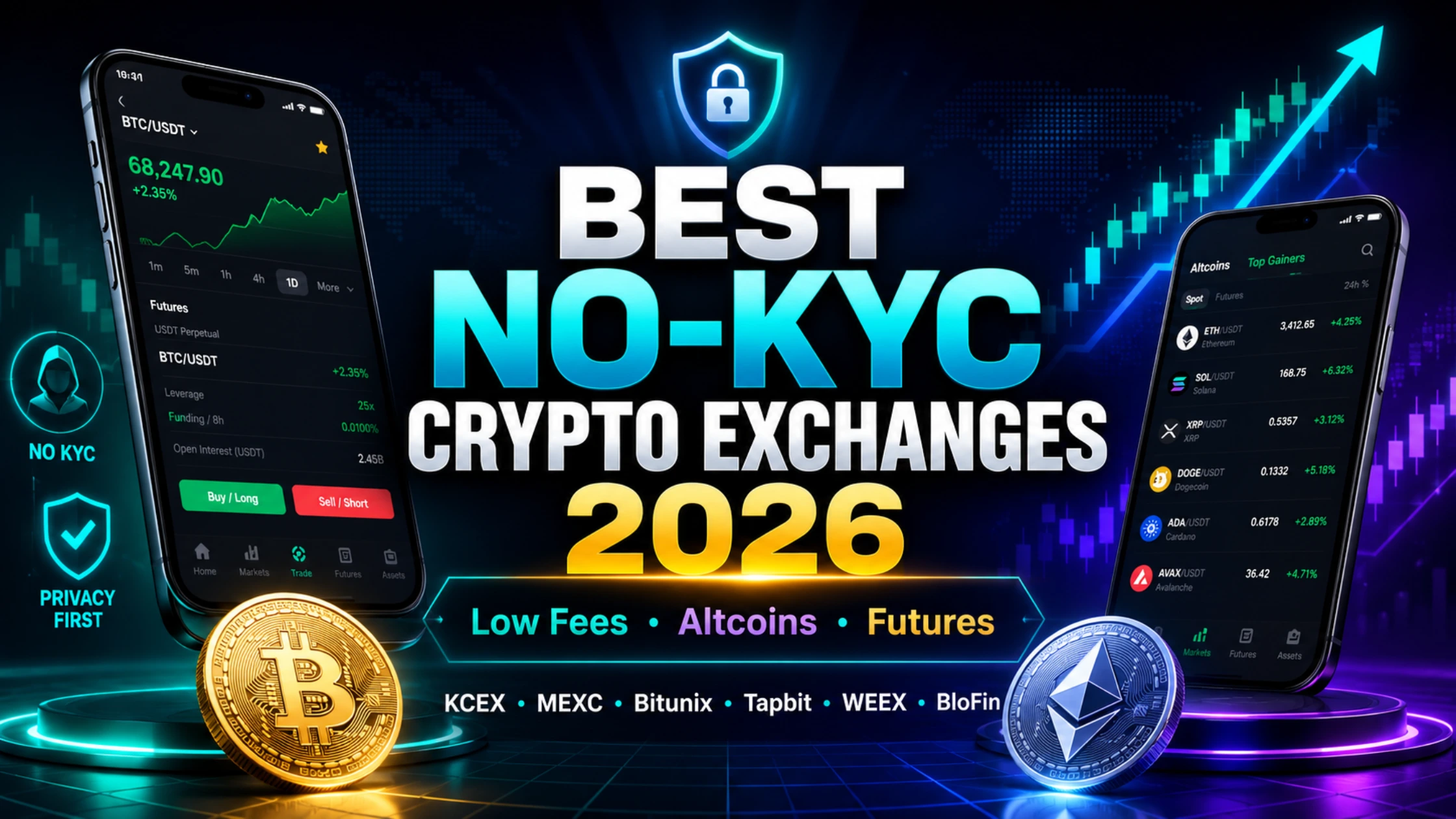
Compare the best no-KYC style crypto exchanges in 2027 for privacy-conscious traders, altcoin hunters and futures users. Review KCEX, MEXC, Bitunix, Tapbit, WEEX and BloFin by fees, withdrawal limits, spot trading, futures access and account risk.
Summary
The best no-KYC style crypto exchanges in 2026 are not “anonymous forever” platforms.
They are lower-friction crypto exchanges that may allow users to deposit, trade or withdraw within certain limits before full identity verification is required.
The best options for privacy-conscious traders are:
KCEX for ultra-low fees and futures trading.
MEXC for altcoin variety and early token discovery.
Bitunix for a balanced spot and futures trading experience.
Tapbit for higher no-ID withdrawal limits and derivatives access.
WEEX for simple crypto deposits, trading and smaller no-KYC withdrawals.
BloFin for futures traders who want a polished derivatives-focused platform with verification-based limits.
The most important rule is simple: no-KYC style access can change. Exchanges may request identity verification because of withdrawal size, regional rules, suspicious activity, compliance updates or internal risk checks.
Do not use any exchange to evade tax, sanctions, fraud checks or local law. Use privacy responsibly.
Quick Answer: Best No-KYC Style Crypto Exchanges in 2027
Best overall no-KYC style exchange for low fees:
KCEX
Best no-KYC style exchange for altcoins:
MEXC
Best balanced exchange for spot and futures:
Bitunix
Best for higher no-ID withdrawal flexibility:
Tapbit
Best for smaller privacy-conscious traders:
WEEX
Best derivatives-focused alternative:
BloFin
Best beginner approach:
Use small test deposits, trade only what you can afford to risk, complete KYC if your strategy requires higher withdrawal limits, and never keep your entire portfolio on any one exchange.
What “No KYC” Really Means in 2027
KYC means “Know Your Customer.”
It is the identity verification process exchanges use to confirm who a user is. This usually involves a government ID, facial verification, proof of address or additional checks.
In 2027, “no-KYC exchange” rarely means completely anonymous, unlimited and permanent access.
It usually means one of four things:
You can create an account with email or phone only.
You can deposit crypto without full verification.
You can trade spot or futures within platform limits.
You can withdraw up to a certain daily amount before verification is required.
That is very different from “no rules.”
Most exchanges still monitor transactions, enforce restricted-country rules, apply risk controls, comply with law enforcement requests where applicable, and reserve the right to ask for identity verification.
This matters because many users misunderstand no-KYC trading.
They think it means unlimited privacy.
It does not.
It means lower-friction access under platform-specific limits.
The best way to think about no-KYC style exchanges is:
Useful for privacy-conscious crypto traders.
Useful for users who do not need fiat banking.
Useful for small to medium trading balances.
Useful for altcoin and futures access.
Not ideal for storing large long-term portfolios.
Not a substitute for legal compliance.
Not a guarantee against account reviews.
Not a way to avoid tax or financial laws.
Privacy is reasonable.
Recklessness is not.
Why Privacy-Conscious Traders Use No-KYC Style Exchanges
There are legitimate reasons some crypto users prefer lower-friction exchanges.
They may not want to upload sensitive identity documents to every platform they test.
They may trade only with crypto deposits and withdrawals.
They may want access to altcoins not listed on heavily regulated local exchanges.
They may want faster account setup.
They may want to reduce the number of companies storing their personal documents.
They may live in countries where local fiat on-ramps are weak.
They may be active traders who need multiple venues for liquidity and pricing.
These are real use cases.
But privacy does not remove risk.
No-KYC style exchanges can still have:
Withdrawal limits
Regional restrictions
Sudden verification requests
Thin liquidity on smaller pairs
Higher custody risk
Futures liquidation risk
Bonus restrictions
Network withdrawal issues
Limited fiat access
Support delays during market volatility
The smarter approach is not to ask, “Which exchange lets me avoid KYC?”
The smarter question is:
“Which platform lets me trade responsibly within clear limits while protecting my capital?”
Best No-KYC Style Platforms for Privacy-Conscious Traders
1. KCEX

KCEX is one of the strongest no-KYC style exchanges for fee-sensitive traders.
Its main selling point is fees.
KCEX’s official fee page states 0% maker and taker fees for spot trading, plus 0% maker and 0.01% taker fees for futures trading. That makes KCEX one of the most aggressive low-fee platforms for active traders.
KCEX is especially attractive for:
Futures traders
Scalpers
Low-fee spot traders
USDT-based traders
Privacy-conscious users
Traders who want a simple crypto-first platform
KCEX’s identity verification guide says completing KYC unlocks higher withdrawal limits and lists a daily withdrawal limit of 30 BTC for basic verification.
That means users should still check account rules before depositing larger amounts.
KCEX is best used as a low-fee trading venue, not as a permanent vault.
Best for:
Low fees, futures trading, active traders and crypto-only users.
Use KCEX here:
Open a KCEX account and use referral code 0MPMVM.
2. MEXC

MEXC is one of the best-known exchanges for altcoin hunters.
Its strength is token access.
MEXC is popular with traders looking for new listings, meme coins, AI tokens, gaming tokens, DeFi coins and smaller-cap markets before they reach the biggest mainstream platforms.
MEXC’s deposit and withdrawal guide says withdrawal capacity depends on verification level, with Primary KYC increasing daily withdrawal capacity to 80 BTC equivalent and Advanced KYC increasing it to 200 BTC daily.
That makes the KYC point clear.
MEXC may feel lower-friction for many crypto traders, but verification level still matters for withdrawal capacity and account access.
MEXC is best for traders who want:
Altcoin variety
Fast listings
Meme coin access
Spot and futures markets
Crypto deposits
Narrative trading
Early token discovery
The risk is quality control.
More coins means more opportunity.
It also means more low-quality assets.
A token listed on MEXC is not automatically safe. Always check liquidity, tokenomics, unlocks, volume, market cap and whether you are buying into hype after the move has already happened.
Best for:
Altcoins, meme coins, new listings and narrative traders.
Use MEXC here:
Open a MEXC account and use referral code 16yJL.
3. Bitunix
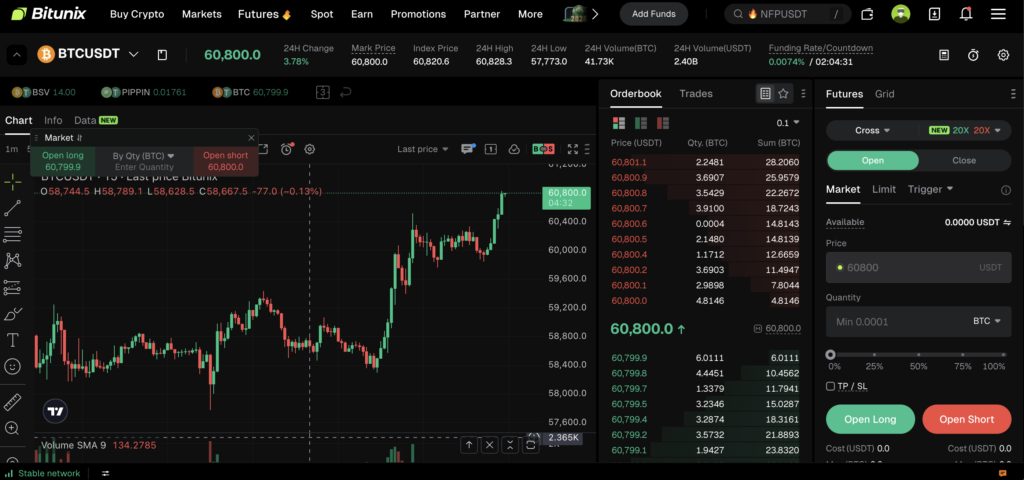
Bitunix is a strong middle-ground platform for traders who want both spot and futures access without the complexity of the largest exchanges.
Bitunix’s official fee page lists VIP 0 spot trading fees at 0.0800% maker and 0.1000% taker, with futures trading fees at 0.0200% maker and 0.0600% taker.
Bitunix also publishes Proof of Reserves information and says it uses Merkle trees to let users verify that account assets are held 1:1.
For withdrawal access, Bitunix explains that withdrawal limits depend on security level and KYC level. Its withdrawal FAQ says accounts with only one security item have a daily withdrawal limit of $10,000 equivalent, and that limits can increase by adding security items or completing KYC.
Bitunix is useful for:
Futures traders
Users who want a clean exchange interface
Traders who want transparent fee tiers
Crypto-only deposits
Users who care about Proof of Reserves
Intermediate traders testing a second venue
The main caution is leverage.
Bitunix is futures-friendly, and futures are dangerous for beginners.
If you use Bitunix, start with spot markets or very small futures positions until you understand liquidation, margin, funding rates and stop losses.
Best for:
Balanced spot and futures trading, transparent fee tiers and intermediate traders.
Use Bitunix here:
Open a Bitunix account and use referral code 17hy.
4. Tapbit
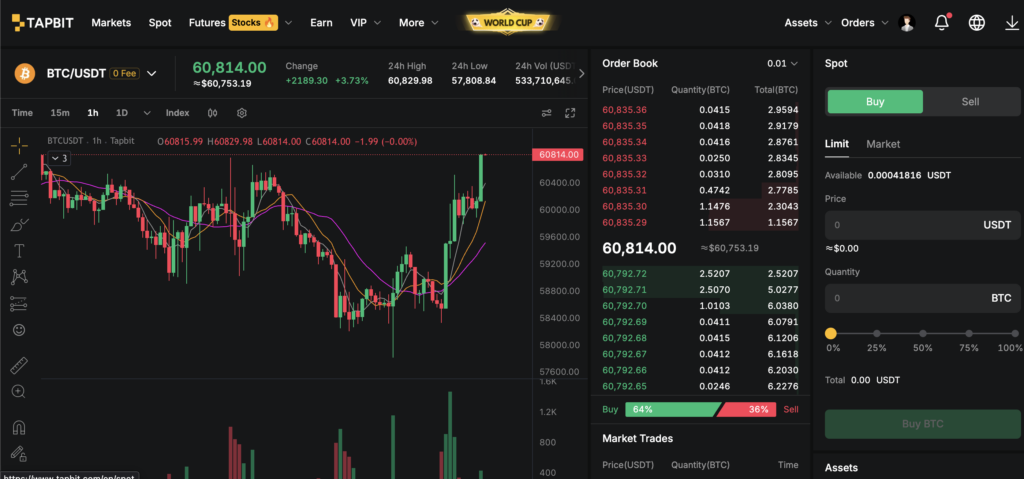
Tapbit is another privacy-conscious trading option with spot and derivatives access.
Tapbit’s exchange homepage describes it as a platform for spot and futures trading and says users can trade 700+ cryptocurrencies.
Tapbit’s deposit and withdrawal FAQ says users who have not completed ID verification have a 10 BTC withdrawal limit within 24 hours, while users who have completed ID verification have a 60 BTC withdrawal limit within 24 hours.
Tapbit’s withdrawal fee page says deposits are free and withdrawal fees fluctuate based on blockchain congestion, with users advised to check the latest withdrawal page for current fees.
This makes Tapbit appealing for users who want:
Crypto-first trading
Spot and futures access
Higher no-ID withdrawal flexibility
A broad list of crypto assets
A derivatives-focused platform
The key caution is regional and compliance risk.
Tapbit’s own content notes that users should pay attention to identity verification requirements, supported networks, withdrawal limits, regional availability and risk notices when moving funds.
Tapbit may suit more experienced users who understand exchange risk, network selection and withdrawal testing.
Best for:
Higher no-ID withdrawal flexibility, derivatives and users who want a crypto-first exchange.
Use Tapbit here:
Open a Tapbit account and use referral code decentralise.
5. WEEX 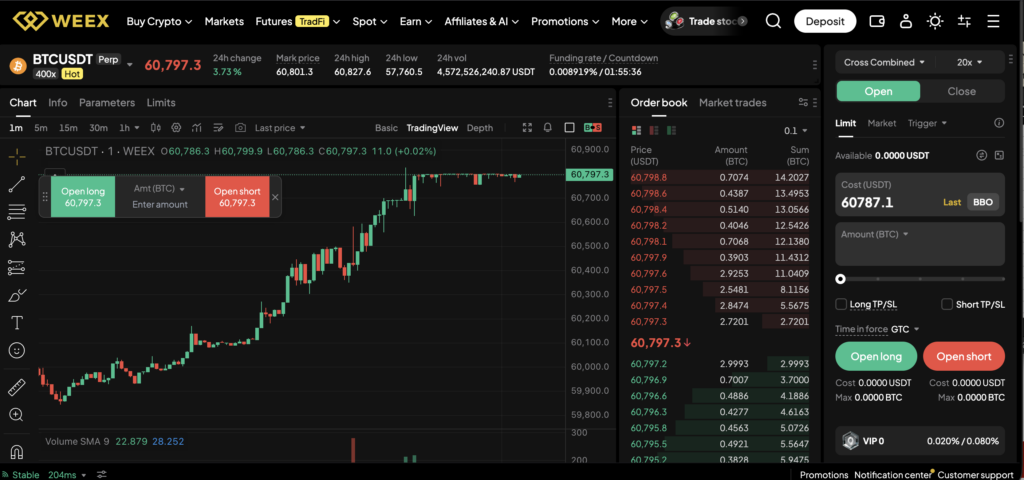
WEEX is a lower-friction option for users who want basic crypto deposits, spot trading, futures trading and smaller no-KYC withdrawals.
WEEX’s own learning page says users can withdraw crypto without KYC up to a daily limit of 10,000 USDT, while larger withdrawals require identity verification.
Another WEEX help page says users without KYC have a maximum single withdrawal amount of 50,000 USDT, 10 withdrawals per day and a daily withdrawal limit of 500,000 USDT, while KYC users receive higher limits.
Those two WEEX sources appear to present different withdrawal-limit framing, which is exactly why users should always check the live withdrawal screen inside their own account before depositing larger funds.
WEEX is best used by smaller traders who want:
Quick account setup
Crypto deposits
Spot trading
Futures trading
Lower-friction withdrawals
A second or third exchange venue
WEEX is not the best choice for users who want the widest altcoin selection or the deepest institutional-style infrastructure.
Its strength is simplicity and access.
Best for:
Smaller privacy-conscious users, simple trading and crypto-only exchange access.
Use WEEX here:
Open a WEEX account and use referral code 3whse.
6. BloFin

BloFin is a polished derivatives-focused platform that appeals to futures traders, copy traders and users who want a more structured trading environment.
BloFin’s fee page states that users can access different trading fee rates through VIP tiers based on asset balance or 30-day trading volume.
BloFin’s own fee guide says its spot market uses a flat 0.1000% fee on both sides of the trade.
For withdrawals, BloFin’s support page says withdrawal limits depend on KYC level, with Basic KYC having a 20,000 USDT 24-hour cumulative limit, Personal Verification up to 1,000,000 USDT and Address Verification up to 2,000,000 USDT.
That makes BloFin less of a pure no-KYC narrative and more of a verification-tier platform.
It still belongs in this article because privacy-conscious traders often compare BloFin with other derivatives exchanges, but users should understand that withdrawal limits and verification level are closely connected.
BloFin is best for:
Futures traders
Copy trading users
Derivatives-focused users
Traders who want a polished interface
Users who may be comfortable completing verification for higher limits
BloFin is not the best pick if your only priority is avoiding KYC.
It is better framed as a futures-focused exchange with verification-based account limits.
Best for:
Futures, copy trading, derivatives and users comfortable with verification tiers.
Use BloFin here:
Open a BloFin account and use referral code Decentralised.
Withdrawal Limits and Account Risk
Withdrawal limits are the most important part of no-KYC style exchange selection.
A trader may be able to deposit and trade quickly, but withdrawals are where friction usually appears.
Before using any platform, ask:
What is the daily withdrawal limit without KYC?
What is the daily withdrawal limit with basic KYC?
What is the withdrawal limit after advanced KYC?
Are withdrawal limits based on BTC, USDT or USD equivalent?
Can limits change after risk review?
Are there restricted countries?
Does the platform require KYC for bonuses?
Can the platform freeze withdrawals during investigations?
Are certain networks disabled during congestion?
Does the exchange support the exact chain you plan to use?
This is why the safest process is always:
Create account.
Enable security.
Deposit a small test amount.
Trade a small amount.
Withdraw a small test amount.
Only then consider using larger balances.
Never discover withdrawal restrictions after depositing serious money.
Spot Trading Options
Spot trading is the safest starting point for most users.
Spot means you buy and sell the actual crypto asset on the exchange.
For no-KYC style traders, spot markets are useful because they allow simple crypto-to-crypto trading without leverage.
Best spot trading options in this list:
KCEX if your priority is low spot fees.
MEXC if your priority is altcoin variety.
Bitunix if you want a balanced spot and futures platform.
Tapbit if you want broad crypto access and higher no-ID withdrawal flexibility.
WEEX if you want a simple lower-friction platform.
BloFin if you want a derivatives-first platform that also supports spot markets.
Beginners should start with spot.
Do not start with futures.
Spot trading can still lose money, but it does not liquidate you the way leveraged futures can.
Futures Trading Options
Futures trading is where many no-KYC style exchanges attract active traders.
Futures allow users to trade long or short with leverage.
That can be useful for experienced traders.
It can be devastating for beginners.
Best futures options in this list:
KCEX for low futures fees.
Bitunix for clear futures fee tiers and a balanced trading platform.
BloFin for derivatives-focused trading.
MEXC for altcoin futures and broader market access.
Tapbit for derivatives access and flexible crypto trading.
WEEX for simple futures access.
If you trade futures, follow these rules:
Use isolated margin.
Start with low leverage.
Set stop losses.
Do not trade with your full balance.
Avoid revenge trading.
Understand funding rates.
Do not hold high-leverage positions through major news events.
Never use leverage because you are trying to recover a loss.
The exchange gives you tools.
It does not give you discipline.
When KYC May Still Be Required
Even if an exchange is described as no-KYC style, KYC may still be required.
Common triggers include:
Higher withdrawal limits
Fiat deposits or card purchases
Suspicious login activity
Large withdrawals
Bonus claims
VIP benefits
Launchpad access
Copy trading features
Compliance reviews
Regional restrictions
Law enforcement requests
Travel Rule requirements
Account recovery
Security disputes
Internal risk controls
This is normal for centralized exchanges.
If you cannot complete KYC on a platform, do not keep large funds there.
If you are not comfortable with possible verification requests, use smaller balances and test withdrawals often.
If you need guaranteed control, self-custody matters more than exchange selection.
Best Beginner Route
If you are new to no-KYC style crypto exchanges, do not rush.
Use this simple route:
Start with a small amount of USDT, BTC or ETH.
Choose one exchange only.
Set up app-based 2FA.
Deposit a small test amount.
Place one small spot trade.
Withdraw a small test amount.
Confirm withdrawal speed and fees.
Only then scale carefully.
For most beginners, KCEX is attractive because fees are simple.
MEXC is attractive if your goal is altcoins.
WEEX is attractive if you want smaller no-KYC style withdrawals.
Do not begin with 50x futures.
Do not chase meme coins on day one.
Do not deposit your full portfolio.
Do not ignore tax records.
Best Advanced Trader Route
Advanced traders may use multiple platforms.
A practical setup:
Use MEXC for altcoin discovery.
Use KCEX for low-fee spot and futures execution.
Use Bitunix or BloFin as a secondary futures venue.
Use Tapbit or WEEX for additional market access if suitable.
Keep long-term holdings in self-custody.
Track all deposits, trades and withdrawals.
This creates exchange diversification.
But it also creates operational complexity.
More platforms means more passwords, more withdrawal addresses, more tax records and more places where mistakes can happen.
Use only what you can manage.
Safety Checklist Before Using a No-KYC Exchange
1. Check restricted countries
Do not assume every exchange is available in your country.
Read the platform’s terms and restricted-region pages.
2. Check withdrawal limits first
Do this before depositing.
Not after.
3. Test deposits and withdrawals
Send a small amount first.
Withdraw a small amount next.
Only then use more capital.
4. Use app-based 2FA
Do not rely only on SMS.
Use an authenticator app.
5. Use unique passwords
Never reuse your email password or another exchange password.
6. Enable withdrawal protection
Use withdrawal address whitelists if available.
7. Avoid fake apps and phishing links
Use official websites only.
Bookmark the correct exchange page.
8. Do not keep your whole portfolio on one exchange
Exchange custody is convenient, but not risk-free.
9. Avoid extreme leverage
Low fees do not save high-leverage gambling.
10. Keep tax records
No-KYC style trading does not erase tax obligations.
11. Watch network selection
USDT on Tron is not the same as USDT on Ethereum, Solana, Arbitrum or BNB Chain.
12. Read bonus terms
Trading bonuses often have restrictions.
Do not assume they are free withdrawable money.
Final Verdict
The best no-KYC style crypto exchange in 2026 depends on the trader.
Choose KCEX if you want ultra-low fees and futures trading.
Choose MEXC if you want altcoin variety and early listings.
Choose Bitunix if you want a balanced spot and futures exchange.
Choose Tapbit if you want flexible crypto trading and higher no-ID withdrawal limits.
Choose WEEX if you want simple no-KYC style access for smaller trading activity.
Choose BloFin if you want a futures-focused trading platform and are comfortable with verification-based limits.
The best privacy strategy is not avoiding every rule.
It is using the right platform, limiting exchange exposure, protecting your accounts, testing withdrawals and keeping long-term funds under your own custody.
No-KYC style exchanges can be useful.
They are not magic.
Use them like tools, not vaults.
FAQ
What is the best no-KYC crypto exchange in 2027?
KCEX is one of the strongest no-KYC style choices for low fees and futures trading. MEXC is stronger for altcoin variety and early listings.
Is no-KYC crypto trading legal?
It depends on your country and how you use the platform. No-KYC style access does not remove tax obligations, sanctions rules, anti-money-laundering laws or local financial regulations. Always follow your local laws.
Can I trade crypto without KYC?
Some exchanges may allow limited crypto deposits, trading and withdrawals without full identity verification, but limits and access rules vary. Exchanges can request KYC at any time based on risk, region, withdrawal size or compliance requirements.
Which no-KYC exchange has the lowest fees?
KCEX has one of the strongest low-fee structures, with its official page listing 0% spot maker and taker fees plus 0% futures maker and 0.01% futures taker fees.
Which no-KYC style exchange is best for altcoins?
MEXC is one of the best choices for altcoin traders because it is widely used for new listings, meme coins and smaller-cap tokens.
Which no-KYC style exchange is best for futures?
KCEX, Bitunix, BloFin, MEXC, Tapbit and WEEX all offer futures-style trading access, but users should compare fees, liquidity, leverage limits and withdrawal rules before trading.
Can exchanges ask for KYC later?
Yes. Any centralized exchange may request KYC later. This can happen because of higher withdrawals, suspicious activity, account recovery, regional rules, compliance reviews or bonus claims.
Is KCEX really no-KYC?
KCEX has lower-friction crypto trading appeal, but its own identity verification guide says KYC unlocks higher withdrawal limits. Users should always check current account rules before depositing.
Is MEXC no-KYC?
MEXC should be treated as a lower-friction exchange with verification-based withdrawal levels, not as permanently no-KYC. Its own guide describes Primary and Advanced KYC withdrawal capacities.
Is Tapbit no-KYC?
Tapbit’s FAQ says users who have not completed ID verification have a 10 BTC withdrawal limit within 24 hours, while verified users have a higher limit. Users should still check current rules and regional availability before trading.
Is WEEX no-KYC?
WEEX says users can withdraw crypto without KYC up to a stated daily limit, although users should check their live account page because limits and rules can change.
Is BloFin no-KYC?
BloFin is better described as a derivatives exchange with verification-based withdrawal tiers. Its support page says withdrawal limits depend on KYC level.
Should I keep long-term crypto on a no-KYC exchange?
No. Keep only active trading funds on exchanges. Long-term holdings are usually better kept in self-custody, ideally with strong wallet security and proper backup procedures.
18+ Educational Disclaimer
This article is for educational purposes only and does not constitute financial advice, legal advice, tax advice, investment advice or a recommendation to use any exchange, product or trading strategy. Crypto assets are volatile and you can lose money. Futures, margin and leverage trading are high-risk and can lead to rapid losses. No-KYC style exchange access does not remove your obligation to follow local laws, tax rules, sanctions rules or platform terms. Exchange rules, KYC requirements, fees, withdrawal limits and regional availability can change at any time. Always do your own research, check live platform terms, use strong security, test withdrawals and speak to a qualified professional if you need financial, legal or tax guidance. Crypto trading and investing are intended for adults aged 18 and over.
About the Author