Binance, Bybit, OKX and Kraken: The Withdrawal Disclosure Test
Exchange Infrastructure | Counterparty Risk | June 2026
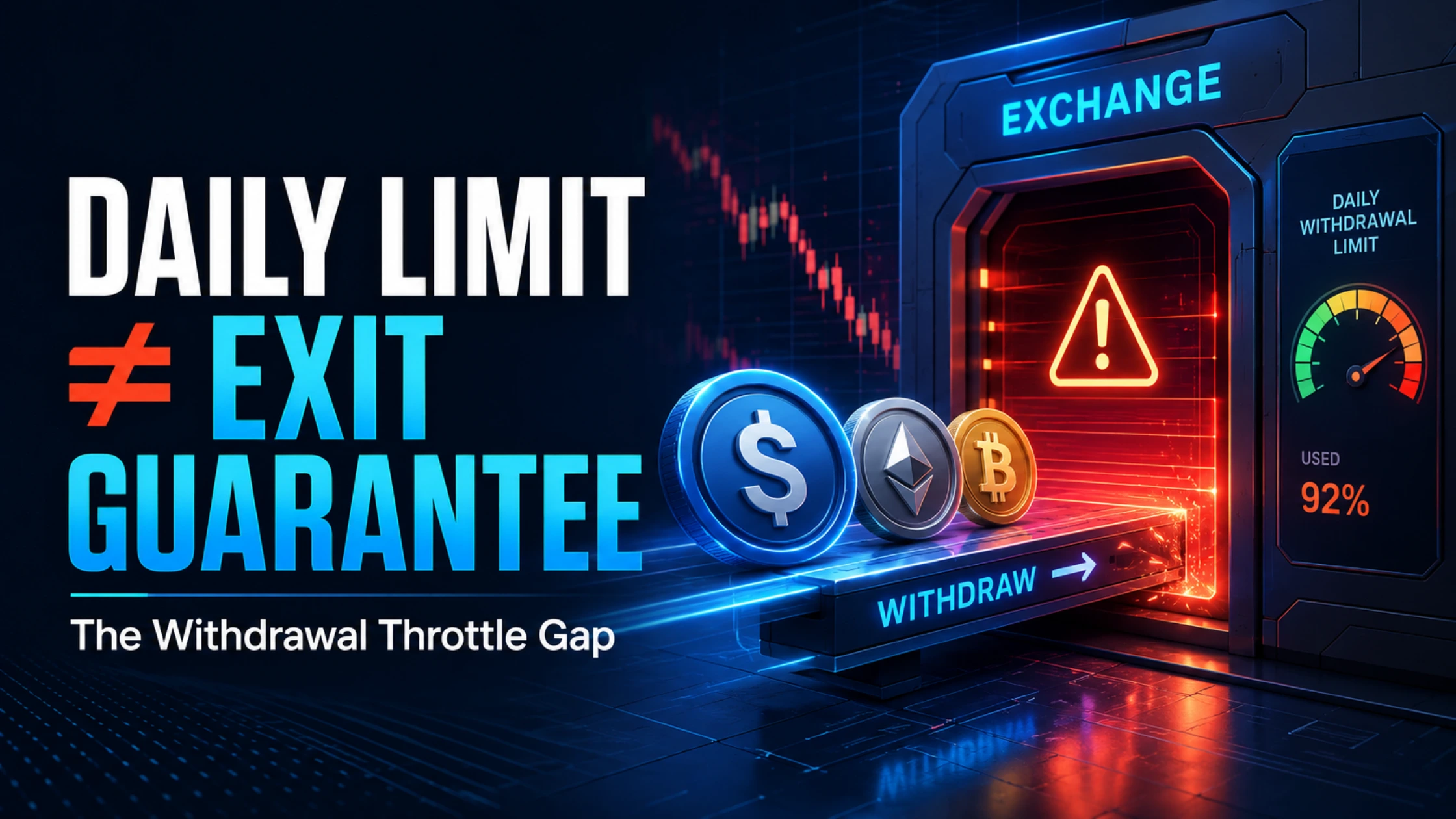
The Withdrawal Throttle Gap: Every Major Exchange Publishes Its Daily Limit. Almost None Discloses What Happens When That Limit Stops Applying.
Exchange withdrawal limit disclosures contain a structural gap that almost no comparison content currently names: every major centralized exchange publishes its daily withdrawal cap by KYC tier, and those figures are genuinely disclosed, tiered, and in some cases generous. What almost none of them discloses is the second, more consequential layer: the conditions under which those published limits stop applying, specifically when a large withdrawal gets flagged for manual review, when platform systems override normal limits during stress, and how long any of those secondary processes actually take. These are the mechanisms that determined whether users could actually exit their positions during the October 10, 2025 crypto crash, in which over $19 billion in leveraged positions were liquidated and reports of API lockouts, system overloads, and allegations of intentional withdrawal throttling surfaced across multiple venues. Among verified published disclosures, Binance states that withdrawals may be restricted during abnormal activity and system updates without specifying what constitutes either. Bybit reserves the right to request KYC at any time, especially for withdrawal approvals, without disclosing the threshold that triggers such a request. OKX shows some improvement by providing proactive notifications for holds, and Kraken distinguishes itself in this comparison by documenting the specific categories of conditions, deposit method, funding flow, and security flag, that trigger holds, even if the numeric thresholds within those categories are not published. The distinction this article draws is between the published daily limit, which is the number comparison content always cites, and the actual exit reliability under stress, which is the number no comparison content currently measures.
Every exchange comparison article that covers withdrawal mechanics eventually arrives at the same table: KYC tier, daily limit in BTC or USDT equivalent, processing time under normal conditions. Binance gives KYC-verified users 100 BTC daily; VIP 9 accounts reach 96 million BUSD. Bybit lets unverified accounts withdraw up to 20,000 USDT per day, with verified accounts reaching 100 BTC. OKX's highest tier reaches up to $40 million per 24 hours per reviewed reporting. Kraken publishes $500,000 per day for Intermediate accounts and more than $10 million for Pro. These numbers are real, disclosed, and, in isolation, appear to answer the question of whether a user can exit their position when they need to.
They do not, and the gap between what those numbers answer and what a user in a genuine stress event actually needs to know was made concrete on October 10, 2025. Over roughly fourteen hours, more than $19 billion in leveraged positions were forcibly closed in what independent analysts have described as the largest deleveraging event in crypto market history. During the worst of it, capital could not flow between venues to arbitrage price gaps, because inter-exchange transfers were, in the words of one subsequent analysis, effectively frozen by the combination of human risk aversion and system overloads. Users reported API lockouts, order execution failures, and, in allegations the same source notes lacked hard corroboration, what appeared to be intentional withdrawal throttling to protect exchange positions. The $600 million in compensation Binance subsequently offered its users confirmed at scale that something had broken between the published daily limit and the actual exit experience, without specifying exactly what that something was.
"A venue that costs 1bp less per trade but holds your funds for 24 hours during a market move is not actually cheaper."
— EdgeLedger, Binance vs Bybit vs OKX comparison, 2026.The Two-Layer Disclosure Problem: What Is Published and What Is Not
The structural gap this article is built around is not in the daily limit figures themselves, which are genuinely published, but in the second layer of withdrawal logic that sits beneath those figures and is almost never disclosed with comparable specificity. That second layer has three components.
The first is the large-withdrawal manual-review threshold: the undisclosed point at which a withdrawal of a specific size, at a specific account age, from a specific geographic location, or under a specific set of market conditions, gets routed to a human review queue rather than processing automatically. Every major exchange runs such a queue; none of them publishes the numeric threshold that triggers it. A user whose daily limit is 100 BTC and who submits a 50 BTC withdrawal on a calm Tuesday will almost certainly receive it within the normal processing window. The same user submitting the same withdrawal the moment a major market moves against their position may encounter a review process lasting hours, at precisely the moment the withdrawal matters most. The published limit describes the first scenario. It says nothing about the second.
The second component is the stress-condition policy: what the exchange explicitly commits to doing, or reserves the right to do, when its own systems or the broader market are under acute pressure. Binance's published documentation, per Coin Bureau's analysis of the platform's own support pages, states that withdrawals may be restricted during abnormal activity and system updates, without defining what constitutes either term in a way that lets a user assess in advance whether a given market condition might trigger the clause. Bybit's own published language reserves the right to request KYC at any time, especially for withdrawal approvals, without specifying what size or pattern of withdrawal is most likely to trigger that request. These are not concealed terms of service buried in footnotes; they are the exchanges' own disclosed language, and they explicitly preserve discretion over the conditions that matter most, without quantifying when that discretion will be exercised.
The third component is independent verifiability: whether a user can cross-reference an exchange's published withdrawal commitments against any external, independently maintained source, the way a proof-of-reserves attestation at least makes the existence of assets theoretically verifiable even if it does not verify the liability side. Withdrawal throttle conditions, by their nature, are not on-chain. They are entirely at the discretion of a centralized exchange's risk systems, and those systems are neither independently audited nor published in a form that permits comparison.
What October 10, 2025 Revealed About the Gap Between Published and Actual
The October 10, 2025 crash is the most important natural experiment available for understanding what the second layer of withdrawal logic actually looks like under real stress, because it is the most thoroughly documented stress event in crypto market history and because several of its consequences are directly attributable to withdrawal and transfer mechanics rather than to the underlying price movements alone. The total liquidation figure, $19.16 billion across roughly 1.6 million trader accounts wiped out in under 24 hours, was roughly nine times larger than any previous single-day total. The triggering mechanism was a geopolitical shock, a tariff announcement, but the cascading severity was structural: unified cross-asset margin systems tied portfolios to their weakest positions, single-venue oracle pricing for certain collateral assets produced prices that diverged wildly from multi-venue markets, and the combination of system load and risk-aversion among liquidity providers made inter-venue capital movement nearly impossible during the worst of the cascade.
The withdrawal-specific consequences of the event remain partly documented and partly contested. What is verified: Binance's own internal oracle priced USDe stablecoin at materially different levels from other venues during the crash, deepening liquidations for accounts using it as collateral. Users reported API lockouts preventing risk-reducing orders, independently documented in academic analysis of the event. Crypto.com's CEO publicly called on regulators to investigate whether some exchanges had slowed down to a halt, effectively not allowing people to trade, a framing that directly implicates withdrawal and transfer mechanics rather than order execution alone. Binance subsequently offered $600 million in compensation, acknowledging at scale that the user experience diverged from what normal operations would imply. What remains unverified: allegations that specific exchanges intentionally froze withdrawals to limit their own exposure during the crash rather than as a protective measure for users; independent analysts covering the event note that plausible explanations range from genuine system overload to intentional throttling, and that the absence of published stress-condition policies makes it impossible to distinguish between the two from the outside. That last point is precisely the gap this article is measuring.
The Withdrawal Throttle Disclosure Snapshot, June 2026
| Exchange | Published Daily Limit | Stress-Condition Policy | Manual-Review Threshold Disclosed |
|---|---|---|---|
| Binance | 100 BTC (KYC); 96M BUSD (VIP 9) | Vague: "may be restricted during abnormal activity and system updates" | Not disclosed |
| Bybit | 20,000 USDT/day (no KYC); 100 BTC (KYC) | Reserves right to request KYC "at any time, especially for withdrawal approvals" | Not disclosed |
| OKX | Up to ~$40M/24hr (highest tier) | Provides proactive notifications for holds; review process partially documented | Not disclosed |
| Kraken | $500K/day (Intermediate); $10M+/day (Pro) | Documents categories: deposit method, funding flow, security conditions | Categories partially disclosed; thresholds not |
Read across that table and the pattern is consistent: daily limit figures are disclosed across the board. Stress-condition policies range from vague to partially documented. Manual-review thresholds, the specific figures that determine when normal limits stop applying, are not published by any of the four exchanges named. The structured gap exists in the same form at every venue, just with different degrees of acknowledging that the second layer exists at all.
Score = sum of four answers (0–2 each, max 8) × 12.5. A high score means withdrawal mechanics including stress-condition policies and review triggers are genuinely disclosed, not just the daily limit under calm conditions. This is a structural evaluation aid, not a guarantee of exit speed or a recommendation to use any named exchange.
Note that all four exchanges scored 2/2 on daily limit disclosure (those figures are published); the gaps appear entirely in stress-condition policy and manual-review threshold disclosure, where no exchange scores 2/2. Kraken scores best (75) primarily because it names specific categories of conditions that trigger holds, even without publishing the numeric thresholds within those categories. No exchange in this comparison fully discloses all four dimensions. Re-verify against current documentation before relying on any single score.
Events sourced from TheStreet Crypto, insights4vc, FTI Consulting, and academic analysis of the October 2025 crash. The October 10 withdrawal-freeze allegations are included specifically because they are unverified — the inability to verify or refute them from published disclosure is itself the central finding of this index.
The Practical Implication: What a User Can and Cannot Do With This Information
The disclosure gap documented in this article has a direct, actionable reading for anyone currently holding material balances on a centralized exchange: the published daily limit tells you the ceiling under calm conditions, not the ceiling under the conditions that will determine whether you can actually exit a position when you most need to. This is not an argument against using any specific exchange, and this article is not making one. It is an argument for treating the published daily limit as one of at least two numbers that matter, the second being whatever the exchange's own published language implies about what happens when that limit's normal operation is suspended.
For users in the DN affiliate exchange set specifically, the structural complement to this disclosure gap has always been self-custody: moving core long-term holdings off exchange entirely eliminates the withdrawal throttle problem at the expense of taking on full responsibility for key management. Bybit's track record during its own February 2025 crisis, maintaining withdrawals and covering losses from its own reserves, is a genuine data point in favor of its exit reliability, even if its pre-crisis stress-condition disclosure remains limited. For active traders requiring exchange exposure, the practical workaround for the disclosure gap is diversification across venues rather than relying on any single exchange's undisclosed stress-condition policy as if it were reliable. See DN's Attestation Gap Clock for the complementary proof-of-reserves disclosure gap that this index is the structural counterpart to.
What This Index Does Not Claim
A high disclosure score is not a guarantee of exit speed. An exchange could publish its stress-condition withdrawal policy fully and still have that policy be restrictive; disclosure quality and policy generosity are related but distinct dimensions. This index measures the former.
The Kraken disclosure is partial, not complete. Kraken receives the highest score in this comparison because it names specific categories of hold triggers, which is meaningfully more than the other three exchanges provide. It does not publish the specific numeric thresholds within those categories, and its score (75) reflects this partial rather than full disclosure.
This is not trading or investment advice. Exchange selection involves many factors beyond withdrawal disclosure, including fees, liquidity, asset coverage, regulatory standing, and security history. This index addresses one specific structural dimension and should be read alongside DN's other exchange evaluation frameworks.
The Bottom Line: The Daily Limit Is Not the Exit Guarantee
Proof of reserves tells you the assets exist. Withdrawal throttle disclosure tells you whether you can actually access your share of them when you need to. The first has become a recognized, regularly audited, institutionally demanded disclosure standard. The second has not, and the October 10, 2025 crash is the most documented illustration available of what that gap costs when a genuine stress event tests it. Every major exchange in this comparison publishes its daily limit by KYC tier, and those figures are real. None of them publishes the conditions under which those limits stop applying with comparable specificity. That is the gap this article names, and the gap that the DN Withdrawal Throttle Disclosure Index is built to measure.
Frequently Asked Questions
A published daily withdrawal limit is the amount an exchange states a user can withdraw under normal operating conditions within a 24-hour period. Actual exit reliability describes whether a user can access that limit during a stress event, when exchanges may activate manual reviews, route withdrawals to slower queues, restrict processing due to system load, or invoke broadly worded terms-of-service provisions about abnormal activity. The published limit answers the calm-conditions question. Exit reliability under stress is almost never disclosed in equivalent detail.
During the October 10-11, 2025 crash, in which over $19 billion in leveraged positions were liquidated, inter-exchange capital transfers were effectively frozen by a combination of human risk aversion and system overloads. Users reported API lockouts that prevented risk-reducing orders. Crypto.com's CEO publicly called for regulatory investigation into whether exchanges had slowed to a halt, effectively not allowing people to trade. Binance subsequently offered $600 million in compensation to affected users and businesses. Allegations of intentional withdrawal throttling surfaced but lacked hard corroborating evidence, a distinction made impossible to resolve precisely because no exchange had published its stress-condition withdrawal policy in advance.
Binance's published documentation, per analysis of its support pages, states that withdrawals may be restricted during abnormal activity and system updates, without defining what constitutes either term in a way that lets a user assess in advance whether a specific market condition would trigger the clause. Binance separately publishes its daily withdrawal limits by KYC tier in full detail, so the limit under normal conditions is disclosed; the conditions under which that limit may not apply are not.
Kraken's published documentation, per Coin Bureau's analysis of its support pages, names specific categories of conditions that trigger holds on withdrawals, including deposit method, funding flow, and security conditions, rather than relying solely on a broadly worded abnormal activity clause. This is a partial, not full, disclosure, and Kraken does not publish the specific numeric thresholds within those categories. Kraken scores 75 rather than 100 precisely because categories are disclosed but thresholds are not. All four exchanges in this comparison score 2/2 on daily limit disclosure; the gaps emerge entirely in the second and third questions.
They are the structural complement of each other. Proof of reserves attestations tell you whether the assets backing user balances actually exist in the amounts claimed. Withdrawal throttle disclosure tells you whether you can actually access your share of those assets under stress conditions. An exchange with strong proof of reserves but undisclosed withdrawal throttle conditions has confirmed the assets exist, but has not confirmed they are accessible when you need them; the Celsius, Voyager, and BlockFi cases all involved assets that genuinely existed until they did not, with the withdrawal freeze as the first visible symptom of insolvency, not a separate disclosure gap. DN's Attestation Gap Clock covers the proof-of-reserves dimension; this index covers the withdrawal-access dimension.
Bybit maintained withdrawal operations throughout the February 2025 Lazarus Group hack in which approximately $1.5 billion in Ethereum was stolen from its multi-signature wallet system. The exchange covered customer losses from its own reserves rather than passing losses to users or restricting withdrawals, and subsequently restored its insurance fund to full capacity. This is the best available real-world test of Bybit's exit reliability during its own acute financial stress and is a genuine positive data point, even though it does not change the assessment of Bybit's stress-condition withdrawal policy disclosure, which remains limited.
The most direct practical implication is that the published daily limit should be treated as a calm-conditions figure rather than a stress-conditions guarantee. For users holding large balances on centralized exchanges, the structural mitigations include self-custody for core long-term holdings, which eliminates the exchange withdrawal throttle problem entirely at the cost of taking on full key management responsibility, and diversification across multiple venues so that no single exchange's undisclosed stress-condition policy controls the entire exit path.
The index scores four dimensions from an exchange's own published documentation: daily limit disclosure by KYC tier, stress-condition policy disclosure, manual-review threshold disclosure, and independent verifiability of withdrawal claims. Each dimension scores 0 to 2, summing to a 0 to 100 scale, where a higher score means both the standard limit and the conditions under which that limit may not apply are disclosed. An exchange can score 2/2 on daily limit disclosure while scoring 0/2 on all three remaining dimensions, which is the pattern this article's research finds across most major venues.
Embed grant: The DN Withdrawal Throttle Disclosure Index may be reproduced with attribution to decentralised.news.
DN-INTERNAL links to resolve: DN Attestation Gap Clock (V7-1).
Sources: Debut Infotech "Which Crypto Exchanges Give the Most Spending Limit" (2026), Koinly "Best No KYC Crypto Exchanges" (Jun 2026), Coin Bureau "How to Unfreeze Cryptocurrency" (Apr 2026), insights4vc "Inside the $19B Flash Crash" (Feb 2026), FTI Consulting "Crypto Crash Oct 2025: Leverage Meets Liquidity" (Apr 2026), Medium/Jung-Hua Liu "The October 11 2025 Crypto Black Swan Crash: An Academic Analysis," TheStreet Crypto "Another crypto company halts withdrawals as markets slide" (Feb 2026), EdgeLedger "Binance vs Bybit vs OKX 2026" (May 2026), CryptoSlate Bybit Review 2026, Invezz OKX Review US 2026, DayTrading Bybit Review 2026, Bybit Help Center "FAQ — On-Chain Crypto Withdrawals" (Apr 2026).
As of: June 29, 2026. Exchange withdrawal policies, limits, and terms of service are subject to change without notice; verify current published documentation directly before relying on any figure in this article. Not financial, trading, or investment advice.
About the Author