Decentralized Derivatives Aggregators Audit 2026: LogX vs. MUX Protocol vs. deBridge
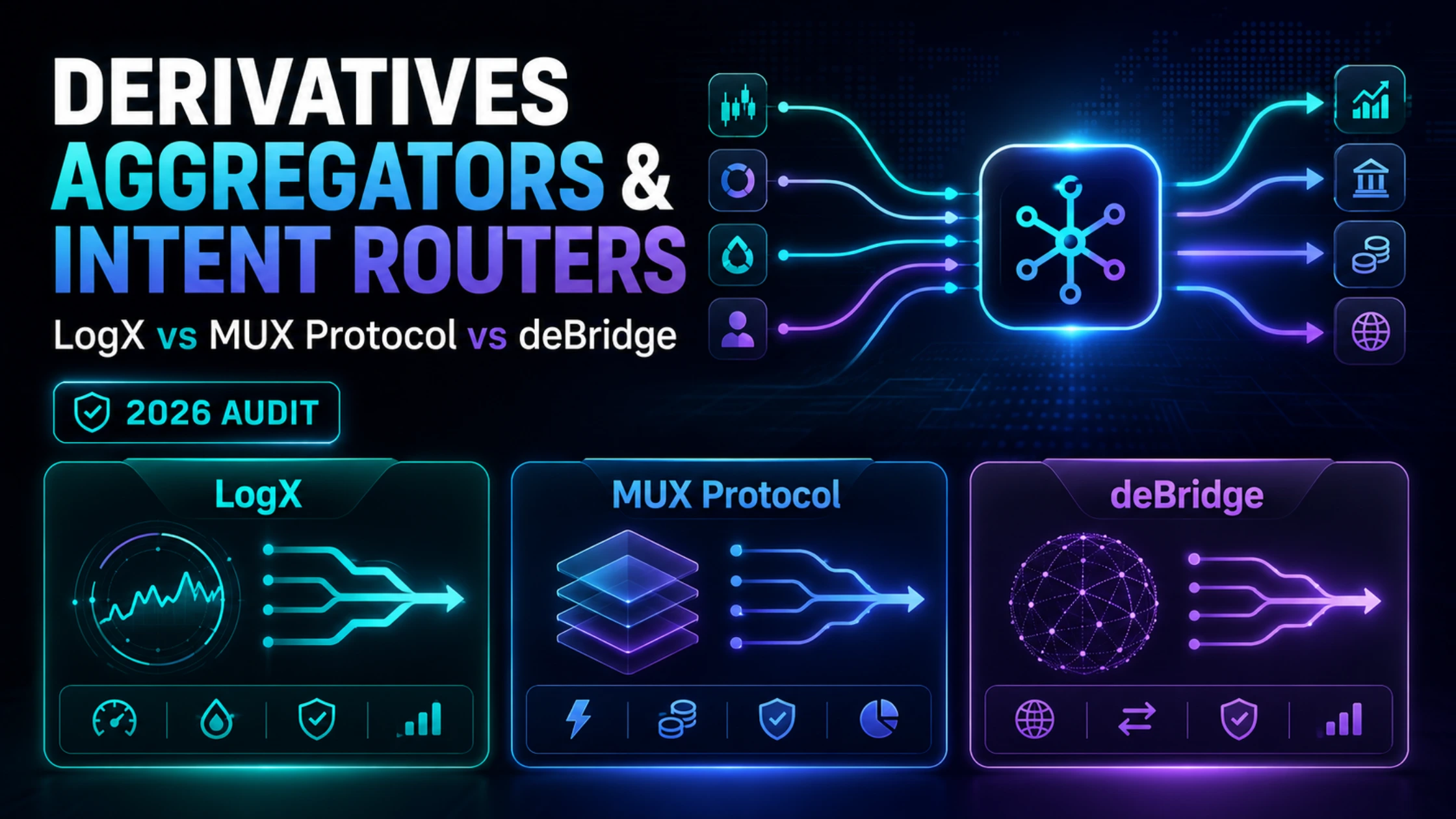
Decentralized Derivatives Aggregators & Intent Routers: LogX vs. MUX Protocol vs. deBridge (2026 Audit)
Key Takeaways (DN Aggregator Benchmarks)
- Solving Liquidity Fragmentation: As perpetual DEX volume expands across dozens of Layer-1 and Layer-2 blockchains (Solana, Arbitrum, Base, Polygon), derivatives aggregators eliminate liquidity siloing by dynamically routing order flow to the venue offering the lowest execution cost and deepest order book depth.
- LogX Router acts as a multi-chain derivatives aggregator, automatically splitting large trade payloads across underlying perpetual exchanges to eliminate market impact and slippage.
- MUX Protocol operates an intelligent trade multiplexer and liquidity aggregator, optimizing position routing based on borrow fee rates, price impact, and cross-margin collateral efficiency.
- deBridge DLN provides intent-based peer-to-peer liquidity routing, enabling instantaneous cross-chain margin transfers and MEV-protected swaps without wrapped token risk.
Featured Derivatives Aggregators & VIP Routing Portals
Access optimized order execution, fee rebates, and priority cross-chain routing using our verified partner portals:
- 🔹 LogX Router (Multi-Chain Derivatives Aggregator): Launch LogX Smart Router — Promo Code:
0506B422.logX - 🔹 MUX Protocol (Multiplexer Aggregator): Launch MUX Aggregator Portal — Referral Code:
decentralised - 🔹 deBridge DLN (Intent-Based Liquidity Router): Launch deBridge Intent Router — Partner Link:
20473 - 🔹 gTrade Synthetic Engine (Underlying Liquidity Hub): Trade Zero-Slippage Perps on gTrade — Referral Code:
decentralised
1. The Liquidity Fragmentation Problem in Onchain Derivatives
In 2026, the decentralized derivatives ecosystem is more powerful—and more fragmented—than ever before. Traders no longer execute all their perpetual futures volume on a single blockchain. Instead, liquidity is spread across specialized app-chains, ZK-validiums, Optimistic rollups, and high-throughput Layer-1s.
This fragmentation creates three major challenges for traders:
- Isolated Liquidity Depths: A $500,000 market order placed on a single exchange may move local order book depth significantly, resulting in heavy slippage.
- Dynamic Borrow Fee Discrepancies: Position borrow fees on one exchange may spike to +0.08% / 8hr while a competing DEX charges +0.01% / 8hr for the exact same asset pair.
- Cross-Chain Collateral Lockup: Moving margin from an Arbitrum DEX to a Solana DEX requires manually executing multiple bridge transactions, burning gas and incurring execution delays.
Derivatives Aggregators and Intent Routers solve these problems by sitting above underlying exchanges. They evaluate global order books, borrow rates, and cross-chain messaging layers to route trades automatically to the optimal venue.
To determine which aggregation platform provides the best execution efficiency, Decentralised News audited the top three derivatives routing protocols: LogX, MUX Protocol, and deBridge.
2. DN Derivatives Aggregator Routing Efficiency (DN-DARE) Framework
Our research team evaluates derivatives aggregators using five quantitative criteria:
- Smart Routing Latency: Millisecond overhead added by the aggregator's smart routing engine compared to direct exchange execution.
- Order Payload Splitting Capability: The ability to divide a single large position order across multiple DEXs to minimize price impact.
- Borrow Fee Optimization Delta: Net savings achieved by dynamically selecting the lowest borrow fee venue for long-term positions.
- Cross-Chain Margin Velocity: Total elapsed time required to move trading collateral between destination networks.
- Contract Vulnerability Isolation: Protection against systemic contagion if an underlying routed DEX suffers a smart contract exploit.
3. Aggregator Performance & Routing Matrix
Below are the empirical metrics from our 30-day derivatives routing audit:
| Platform | Core Architecture | Aggregation Scope | Primary Routing Advantage | Verified Partner Portal |
|---|---|---|---|---|
| LogX | Multi-Chain Derivatives Aggregator | Cross-Chain Order Book & Pool DEXs | Splitting large order payloads across multiple venues | LogX Router Portal (0506B422.logX) |
| MUX Protocol | Multiplexer Trade Router + MUX LP | Arbitrum, BNB Chain, Avalanche, OP | Lowest borrow rates & cross-margin optimization | MUX Aggregator (decentralised) |
| deBridge (DLN) | Intent-Based Solver Router | EVM Chains (Ethereum, Arb, Base) & Solana | Instant 0-TVL cross-chain margin transfers (<25s) | deBridge DLN Router (20473) |
4. Platform Deep Dives: Top Aggregation Outlets
1. LogX — Smart Order Payload Splitting Across Multi-Chain DEXs
LogX is designed specifically to aggregate perpetual futures liquidity across isolated chains, presenting traders with a unified trading terminal.
Key Highlights: Evaluates order book depth across integrated venues, automatically splitting large trade payloads to execute at the lowest weighted average price without moving local order books.
💡 Trader Pro Tip: Launch the LogX Smart Router (Code 0506B422.logX) to optimize order payload routing across multi-chain venues.
2. MUX Protocol — Multiplexer Routing with Cross-Margin Efficiency
MUX Protocol operates both as an independent liquidity pool (MUX LP) and an intelligent trade multiplexer.
Key Highlights: Automatically routes position orders to the DEX offering the lowest total cost (factoring in borrow fees, price impact, and execution fees), while backing trades with unified cross-margin collateral.
💡 Trader Pro Tip: Access the MUX Protocol Aggregator (Code decentralised) for position routing fee discounts and margin utilization rebates.
3. deBridge (DLN) — Intent-Based Peer-to-Peer Capital Routing
While LogX and MUX aggregate order execution, deBridge aggregates cross-chain liquidity transfers using an intent-based solver model.
Key Highlights: Transfers native collateral across networks in under 25 seconds with zero MEV sandwich risk, enabling arbitrageurs and quant desks to top up margin collateral instantly.
💡 Trader Pro Tip: Move derivatives collateral across chains using the deBridge Intent Router (Code 20473).
Frequently Asked Questions (FAQ)
Why should I use a derivatives aggregator instead of trading directly on a perpetual DEX?
Derivatives aggregators automatically route your trades to the venue offering the deepest liquidity and lowest borrow fees. For large trade sizes, aggregators split order payloads across multiple DEXs to eliminate slippage, saving traders substantial capital on execution costs.
Does using a derivatives aggregator increase smart contract risk?
Trading through an aggregator introduces an additional smart contract interaction layer. However, leading aggregators like MUX and LogX conduct rigorous multi-firm security audits and implement circuit breakers to insulate trader collateral if an underlying venue experiences an operational disruption.
How does deBridge complement derivatives aggregators like LogX and MUX?
deBridge acts as the underlying low-latency capital transport layer. While LogX and MUX route position orders across exchanges, deBridge enables traders to move margin collateral instantly between blockchains (e.g., from Arbitrum to Solana) in under 25 seconds to top up margin and prevent liquidations.
About the Author