EVEDEX Review 2027: Can Hybrid Perpetual Trading Combine CEX Speed With DeFi Control?
Our flagship EVEDEX review examines perpetual futures, fees, leverage, cashback, AI bots, Eventum infrastructure, liquidations, security and leading EVEDEX alternatives.
Research Verified: 18 July 2026
Editorial Note: This 2027 edition is based on official platform information available in July 2026. EVEDEX is actively developing its infrastructure and market catalogue. Live specifications should be rechecked before publication or trading.
Executive Summary
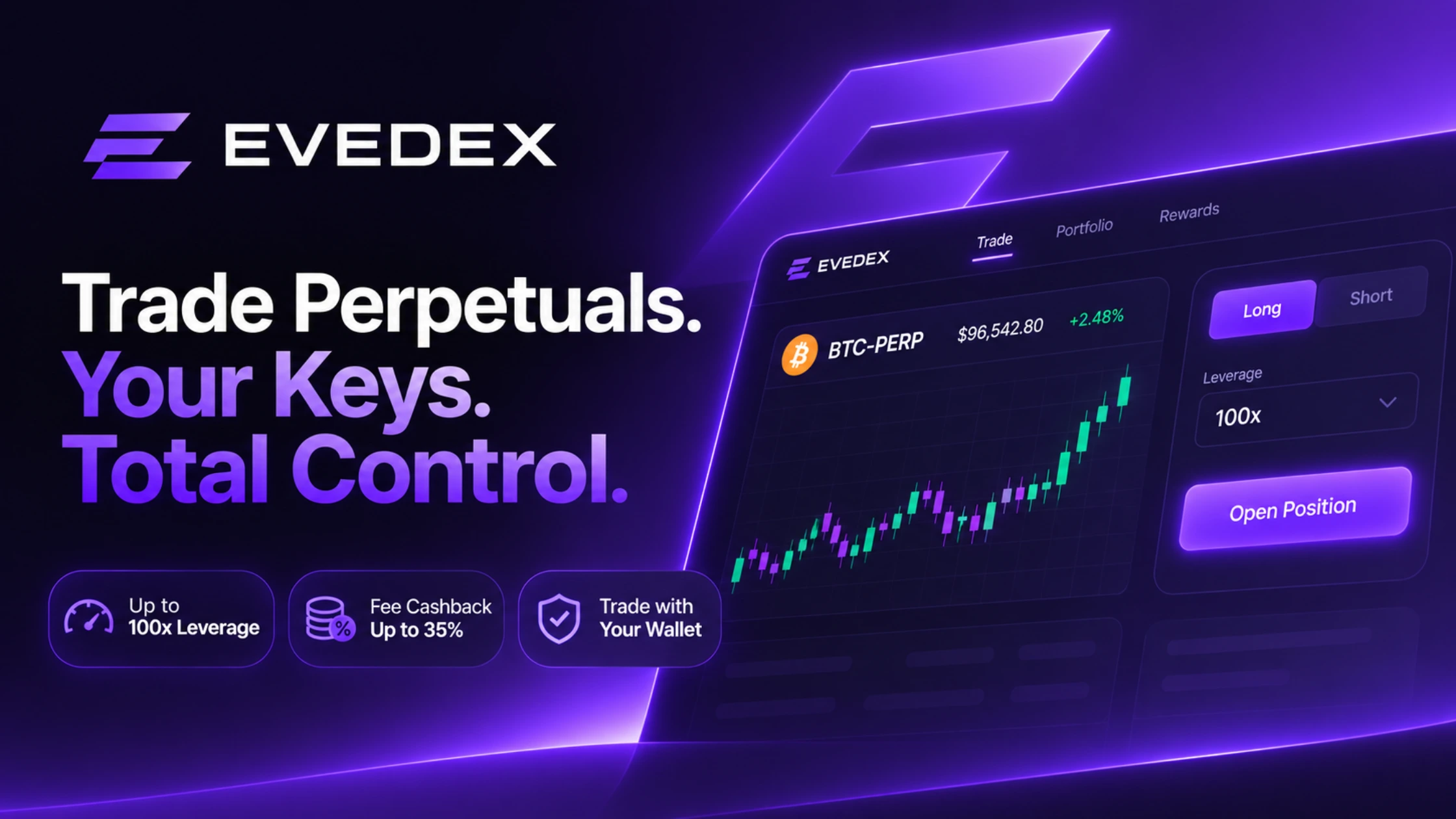
EVEDEX is building a hybrid derivatives exchange around a straightforward thesis: traders should not have to choose between the order-book performance of a centralised exchange and the wallet control associated with DeFi.
Its perpetual futures terminal uses an off-chain matcher for speed, while deposits, smart accounts and settlement infrastructure interact with Eventum, an Arbitrum-based network. Traders can connect wallets, create account-abstraction-based accounts, fund the platform from multiple networks and trade USDT-settled perpetual contracts.
Base fees are 0.015% for makers and 0.045% for takers. The platform’s trader-level, skills and Prime systems can return up to 35% of paid fees as cashback.
EVEDEX also offers AI trading bots, API access, one-click execution, funded trading and selected real-world asset perpetuals.
Flagship verdict: EVEDEX has an appealing product concept, particularly for active traders who value order-book execution and wallet-based access. It is not fully on-chain, and several key technical claims require careful interpretation. High leverage, ADL, bridge dependencies and incomplete audit visibility remain material risks.
Referral code: 9e3mk2nx
EVEDEX at a Glance
Category | EVEDEX |
Platform model | Hybrid non-custodial derivatives exchange |
Primary product | Perpetual futures |
Settlement asset | USDT |
Order matching | Off-chain order book |
Blockchain infrastructure | Arbitrum-based Eventum network |
Account model | Wallets and account-abstraction smart accounts |
Base maker fee | 0.015% |
Base taker fee | 0.045% |
Maximum advertised cashback | 35% |
Pair-level documented leverage | Up to 100x |
Higher marketing claims | 120x, 125x and 200x appear on other official pages |
Funding calculation | Eight-hour rate |
Funding settlement | Hourly, pro-rated |
Liquidation fee | 5% under the documented mechanism |
ADL | Yes |
Main order types | Market, limit and TP/SL |
One-click trading | Available |
AI trading bots | Available through the web platform |
API support | REST, WebSocket and JavaScript or TypeScript SDK |
Deposit minimum | Official pages state either 6 or 7 USDT |
AML screening | Chainalysis screening documented |
U.S. access | Prohibited under global terms |
Best suited to | Active derivatives traders and wallet-based bot users |
Official documentation confirms the off-chain matcher, Eventum infrastructure, fee schedule, funding system, liquidation mechanics and current eligibility terms.
The EVEDEX Investment Thesis
The perpetual DEX market has developed around several architectures.
Pool-based protocols offer simple, on-chain liquidity but can struggle with capital efficiency, skew and price impact.
Fully on-chain order books improve transparency but can be constrained by blockchain throughput, latency and transaction costs.
Centralised exchanges provide fast matching but retain custody and operate internal ledgers.
EVEDEX chooses a fourth path.
It combines:
- Wallet signatures
- Smart accounts
- An off-chain matcher
- Eventum settlement infrastructure
- Multi-network routing
- Traditional order-book controls
- Gamified fee economics
The architecture may provide a familiar experience to CEX traders without requiring a conventional exchange login and custodial account.
The cost of that performance is additional system complexity.
How EVEDEX Actually Processes a Trade
Stage | What Happens | Principal Dependency |
Authentication | User connects a wallet or accesses a smart account | Wallet and account-recovery security |
Order signing | User signs an order request | Signing-key integrity |
Backend checks | Funds, minimum size and signature are verified | EVEDEX backend |
Matching | Off-chain matcher processes and fills the order | Matcher availability and correctness |
Database update | Order status is stored and relayed to the interface | Backend database |
Blockchain interaction | Selected fills and account information interact with Eventum | L3, bridge and settlement implementation |
Withdrawal | Liquidity route sends USDT to the selected network | Bridge and liquidity-provider availability |
The matcher can process orders faster than a public-chain-only order book. EVEDEX’s documentation explicitly compares the off-chain matching principle with centralised exchange systems.
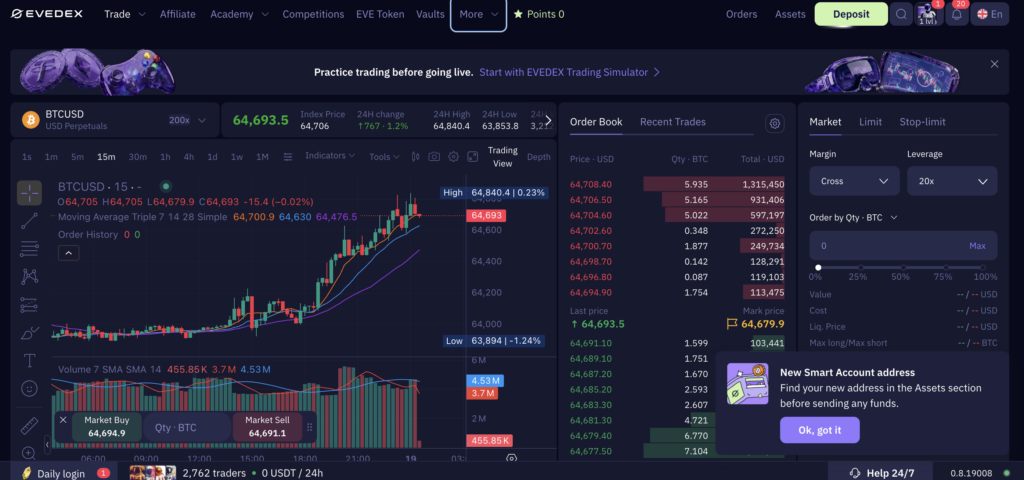
The Settlement Nuance
EVEDEX’s homepage says settlements happen on-chain.
The technical documentation says filled orders may be recorded on the blockchain according to backend demand. It also says periodic position-data recording was under development.
These statements do not necessarily mean the platform lacks blockchain settlement. They do mean the degree and timing of on-chain finality should be verified rather than inferred from a headline claim.
Eventum, Arbitrum and Account Abstraction
Component | Intended Role |
Eventum | EVEDEX’s Arbitrum-based network |
Smart account | Holds and manages the user’s trading balance |
Personal deposit contract | Receives and routes deposits without an ordinary private key |
Paymaster | Allows supported transaction fees to be paid through alternative assets |
Governor multisig | Administrative or governance control |
Vault | Holds or manages protocol assets |
Pyth oracle contracts | Supply external pricing |
Bridge contracts | Transfer assets between networks |
The deployed-contract documentation lists governance, treasury, vault, account-abstraction, oracle and bridge addresses.
The homepage refers to Arbitrum Layer 2, while the whitepaper describes Eventum as an Arbitrum-based Layer 3. This appears to reflect the relationship between the platform’s parent infrastructure and its dedicated execution network, but clearer public terminology would reduce confusion.
Is EVEDEX Really Non-Custodial?
EVEDEX’s terms say the applications are non-custodial and that the company does not possess users’ digital assets.
The website says assets are stored in wallets and smart accounts rather than ordinary exchange hot wallets.
At the same time, users move funds into a trading smart account and depend on EVEDEX’s routing, bridges, matcher and settlement infrastructure to use and withdraw them.
Custody Question | EVEDEX Model |
Does the user sign through a wallet? | Yes |
Does EVEDEX operate a traditional personal hot-wallet account? | The platform says no |
Do funds enter protocol smart accounts? | Yes |
Does order matching occur entirely on-chain? | No |
Are withdrawals dependent on platform infrastructure? | Yes |
Is every position update independently recorded immediately on-chain? | Not clearly established in current documentation |
Is the model identical to self-custody in a personal wallet? | No |
The most accurate description is non-custodial smart-account trading with operational protocol dependencies.
EVEDEX Markets
The documented product set includes cryptocurrencies, meme assets and selected RWA-linked perpetual contracts.
Market Group | Examples Documented in 2026 | Maximum Documented Leverage |
Major crypto | BTC and ETH | Up to 100x |
Large altcoins | SOL, XRP, SUI, NEAR and APT | 30x to 75x, depending on market |
Smaller altcoins | LINK, HYPE, MYX, Aster and others | Generally lower, market-specific |
Meme assets | Pepe, Bonk, Fartcoin, Pengu and others | Market-specific |
Commodities and RWA | Crude oil, silver and tokenized gold-linked instruments | Up to 100x on certain documented contracts |
Equity or index-linked | SPY and stock-perpetual examples | Market-specific |
The current market list and a June 2026 onboarding guide confirm that the platform has expanded beyond crypto-only contracts.
The Maximum-Leverage Problem
EVEDEX’s official pages currently display several different maximums.
Official Source | Maximum Mentioned |
April 2026 supported-pairs article | 100x |
Futures product page | 100x |
Trader-progression material | 120x |
Derivatives product page | 125x |
Main homepage onboarding section | 200x |
This is one of the most important weaknesses in the current public documentation.
The difference between 100x and 200x is not cosmetic. It materially changes initial margin and liquidation proximity.
The live market specification should take precedence over general marketing pages. The April 2026 pair-level list confirms 100x as the highest current leverage within that documented set.
Initial Margin Examples
Position Size | Leverage | Initial Margin Before Fees |
$10,000 | 5x | $2,000 |
$10,000 | 10x | $1,000 |
$10,000 | 25x | $400 |
$10,000 | 50x | $200 |
$10,000 | 100x | $100 |
Higher leverage does not increase the profit or loss generated by a fixed notional position. It reduces the capital supporting that position and brings liquidation closer.
Margin and Portfolio Risk
EVEDEX’s detailed documentation focuses on account-level and cross-margin calculations.
Margin Concept | Function |
Initial margin | Collateral required to open a position |
Maintenance margin | Minimum collateral required to keep it open |
Unrealised PnL | Changes account equity while a position remains open |
Available balance | Capital that is not locked or required for margin |
Account health | Shows proximity to margin call or liquidation |
Cross-margin exposure | Shares available balance across positions |
A larger position may receive stricter margin requirements based on the platform’s risk tables and available liquidity.
Marketing materials reference isolated and cross margin, but the detailed operational examples focus primarily on cross margin. Users should verify whether isolated mode is active for their selected market.
EVEDEX Fee Schedule
Execution Type | Standard Fee |
Maker | 0.015% |
Taker | 0.045% |
Unexecuted order | No trading fee |
Trading gas fee | EVEDEX says no gas fee applies to hybrid position trading |
Liquidation | Separate 5% liquidation charge under the documented process |
The trading fee is charged against executed notional value rather than the user’s initial margin.
Standard Fee Examples
Executed Notional | Maker Fee | Taker Fee |
$1,000 | $0.15 | $0.45 |
$10,000 | $1.50 | $4.50 |
$100,000 | $15.00 | $45.00 |
$1 million | $150.00 | $450.00 |
A complete trade usually includes entry and exit fees.
Cashback as an Effective Fee Discount
EVEDEX does not reduce its published maker and taker rate at each level. It charges the standard fee and then returns a percentage through cashback.
Maximum Cashback | Effective Maker Cost | Effective Taker Cost |
0% | 0.01500% | 0.04500% |
10% | 0.01350% | 0.04050% |
20% | 0.01200% | 0.03600% |
30% | 0.01050% | 0.03150% |
35% | 0.00975% | 0.02925% |
The maximum published 35% consists of gamification benefits and a Prime component. Cashback is generally credited the next day rather than deducted instantly.
What It Takes to Level Up
The platform currently awards 50 XP per $1 spent in trading fees. Tasks, quests and referrals can provide additional progression.
This means the highest effective fee reduction is more relevant to consistently active traders than to a new user making one occasional trade.
Funding Mechanics
Funding Feature | Current Documentation |
Rate calculation window | Eight hours |
Settlement frequency | Hourly |
Hourly amount | One-eighth of the calculated eight-hour rate |
Interest coefficient | 0.01% |
Premium-index band | 0.05% |
Funding-rate cap | 0.375% per eight-hour calculation |
Payment direction | Longs pay shorts when positive, shorts pay longs when negative |
EVEDEX uses order-book impact pricing and an average premium to calculate funding.
Funding Cost Example
An eight-hour funding rate of 0.01% produces the following approximate full-period transfers:
Position Size | Eight-Hour Funding |
$1,000 | $0.10 |
$10,000 | $1.00 |
$100,000 | $10.00 |
$1 million | $100.00 |
Funding can become the largest cost of holding a crowded leveraged trade.
Mark Price and Liquidation
EVEDEX uses a median-based mark-price calculation rather than relying only on the last executed trade.
Its formula incorporates:
- Index price
- Funding adjustment
- Five-minute basis
- Last traded price
This design is intended to reduce unfair liquidation caused by isolated local spikes.
Liquidation Waterfall
Stage | What Happens |
Normal monitoring | Positions are checked periodically |
Risk zone | Account health deteriorates |
Margin call | Trader is encouraged to add funds or reduce exposure |
Restrictions | Certain balance transfers or exposure increases may be blocked |
Forced liquidation | Positions are closed to restore solvency |
Liquidation charge | A 5% fee applies under the documented mechanism |
ADL | Opposing profitable positions may be reduced if necessary |
During a margin call, EVEDEX says the liquidation engine can increase monitoring frequency to once per second.
Auto-Deleveraging Risk
ADL is not merely a risk for the account being liquidated.
It can affect profitable traders on the other side of the market.
Condition | ADL Impact |
Normal market | Positions remain under user control |
Severe liquidation | Exchange attempts to close the losing position |
Insufficient liquidity | Loss cannot be absorbed through normal execution |
Residual deficit | Profitable opposing accounts can be ranked for ADL |
ADL execution | Part or all of an opposing position may be reduced |
Traders using large, profitable and highly leveraged positions may rank more prominently in an ADL queue.
Order Types and Execution
Feature | Purpose |
Market order | Immediate execution against available liquidity |
Limit order | Execution at a chosen price or better |
Take profit | Closes exposure at a target |
Stop loss | Attempts to limit loss |
Order by value | User enters total notional |
Order by margin | User enters allocated collateral |
One-click trading | Immediate submission without another confirmation |
Partial TP/SL | Applies an exit instruction to part of a position |
EVEDEX supports TP/SL at order creation or after the position is open.
One-click trading improves speed but removes a protective review step.
Deposits, Routing and Withdrawals
Deposit Stage | Description |
Select asset and network | User chooses the source route |
Route comparison | Aggregator presents expected amount and time |
Personal deposit contract | Deterministic Arbitrum contract receives assets |
Monitoring | QuickNode Streams monitors USDT movement |
Compliance check | Chainalysis AML screening is applied |
Minimum threshold | Documentation states 7 USDT, newer Help Center says 6 USDT |
Bridge routing | Assets move through an available liquidity provider |
Eventum credit | User’s smart account receives the trading balance |
The deposit contract has no normal private key and is designed to route funds only through predefined destinations.
Withdrawal Process
Withdrawal Stage | Description |
User request | Amount and destination network selected |
Liquidity check | Available provider routes are assessed |
Transfer | USDT is sent to the chosen network |
Potential dependency | Speed depends on available route liquidity |
The platform’s multi-network approach can simplify onboarding but does not remove bridge or route availability risk.
No KYC, Yet Not Compliance-Free
Issue | Current Position |
Conventional registration | Wallet access does not require a traditional account |
Email or social login | Available through smart-account creation |
Standard KYC marketing claim | Homepage says no KYC |
Deposit screening | Chainalysis AML check documented |
United States | Residents prohibited |
United Kingdom | Limited to specified professional, high-net-worth and sophisticated-investor exemptions |
Other jurisdictions | User must ensure local legality |
VPN circumvention | Prohibited by the terms |
EVEDEX may provide lower-friction onboarding than many centralised derivatives exchanges, but users should not interpret this as universal permission to trade.
EVEDEX AI Bots
EVEDEX’s current AI trading product uses a mean-reversion-oriented framework.
Bot Component | Documented Approach |
Market signal | Statistical identification of local extremes |
Volume confirmation | Compares volume with the 50-period average |
Strategy expectation | Price returns towards an estimated mean |
Direction | Can track long and short positions |
Historical review | Seven-day and 365-day results |
Testing | Backtesting provided |
Risk controls | Adjustable settings |
Access | Configured through the web interface |
The product may help users automate a disciplined strategy, but the use of the term “AI” should not be interpreted as evidence of predictive certainty.
API and Professional Trading Tools
Capability | Availability |
REST API | Documented |
WebSockets | Documented |
JavaScript SDK | Available |
TypeScript declarations | Included for many requests |
Market-data streaming | Supported |
Account metrics | Supported |
Order management | Supported |
Wallet-key authentication | Supported |
API-key authentication | Supported |
The SDK creates potential for market-making, systematic trading and account monitoring.
Professional users should still test actual latency, uptime and cancellation performance.
Security Assessment
Positive Security Elements
Control | Intended Benefit |
Wallet-signed orders | Reduces unauthorised order submission |
Smart accounts | Enables programmable security and recovery |
Personal deposit contracts | Avoid ordinary temporary private keys |
Governor multisig | Distributes administrative control |
Published contracts | Improves traceability |
Pyth oracle contracts | External price inputs |
Mark price | Reduces dependence on local last trade |
Arbitrum-based infrastructure | Ethereum-aligned rollup technology |
AML screening | Filters flagged deposit activity |
Account abstraction | Supports 2FA and flexible gas handling |
Transparency Limitations
The official website says the platform is audited, and the deposit documentation says its personal deposit-contract code is audited.
However, the reviewed documentation did not provide a clearly indexed report explaining the scope and findings of a full current-system audit.
The publicly available contract-address list is valuable, but addresses alone do not explain:
- Upgradeability
- Multisig thresholds
- Auditor findings
- Bridge assumptions
- Emergency controls
- Matcher security
- Backend protections
- Whether deployed bytecode matches audited code
EVEDEX Risk Matrix
Risk | Why It Matters | Possible Mitigation |
High leverage | Small moves can erase margin | Use materially less than the maximum |
Cross-margin contagion | One loss can affect all positions | Separate strategies where possible |
Liquidation | Position can be closed automatically | Maintain excess collateral |
ADL | Profitable positions may be reduced | Monitor ADL exposure |
Matcher outage | Orders or cancellations may be delayed | Avoid excessive leverage |
Backend risk | Orders depend on exchange infrastructure | Keep balances limited |
Smart-account risk | Contract or recovery flaw could affect access | Secure all authentication methods |
Bridge risk | Deposits and withdrawals depend on routes | Test transfers with small amounts |
Oracle failure | Mark and liquidation calculations can be affected | Maintain a large margin buffer |
Sequencer risk | Eventum availability may be disrupted | Monitor platform status |
AI bot losses | Strategy may fail in a new regime | Use strict capital limits |
Cashback changes | Effective costs can increase | Evaluate standard fees first |
Documentation inconsistency | Users may rely on incorrect settings | Confirm every value in the terminal |
Regulatory restriction | Access can be blocked | Verify eligibility before depositing |
EVEDEX Pros and Cons
Advantages | Disadvantages |
Wallet-based access | Off-chain matcher dependency |
Smart-account functionality | Not every position update is clearly immediate on-chain |
Central-limit-order-book experience | Technical implementation remains complex |
Maker fee of 0.015% | Standard taker fee is 0.045% |
Up to 35% cashback | Maximum benefit requires progression and Prime |
Broadening perpetual catalogue | Liquidity can vary by market |
Selected RWA markets | Not a substitute for owning the underlying asset |
AI bots | Automated losses remain possible |
One-click trading | Accidental-order risk |
API and SDK support | Credential and automation risk |
Multi-network funding | Bridge and routing dependencies |
Account abstraction | Recovery architecture must be understood |
Published contract addresses | Full-system audit reporting is unclear |
No routine KYC claim | AML and geographic controls still apply |
Funded trading access | Separate programme rules and risks |
Strong gamification | Can encourage excessive turnover |
Best EVEDEX Alternatives for 2027
Affiliate relationships do not alter the need to compare architecture, liquidity, security and legal eligibility.
On-Chain and Hybrid Alternatives
Platform | Primary Comparison Point | Access |
MYX | Alternative perpetual liquidity model | |
Aster | Multi-market perpetual trading | |
Lighter | Order-book-focused on-chain execution | |
edgeX | Professional perpetual order book | |
Paradex | Advanced derivatives environment | |
Aevo | Perpetuals and options | |
GMX | Pool-based EVM perpetual trading | |
gTrade | Crypto, forex and commodity exposure | |
Helix | Injective-based order-book markets | |
ApeX Omni | Multi-chain perpetual trading and APIs |
Centralised Futures Alternatives
Platform | Primary Comparison Point | Access |
Bybit | Broad derivatives ecosystem | |
MEXC | Extensive altcoin futures | |
Bitget | Futures, bots and copy trading | |
BingX | Social and copy-trading tools | |
BloFin | Futures-focused interface | |
Bitunix | Streamlined perpetual trading | |
KCEX | Fee-conscious futures access | |
Deribit | Specialist options and derivatives |
Which Platform Should Each Trader Research?
Trader Priority | Platform to Research |
EVEDEX cashback and gamification | EVEDEX |
Wallet access with an order book | EVEDEX, Lighter, edgeX or Paradex |
Pool-based perpetual liquidity | GMX or MYX |
Forex and commodities | gTrade or selected EVEDEX markets |
Options | Aevo or Deribit |
Copy trading | Bitget or BingX |
Broad altcoin futures | MEXC |
Centralised derivatives depth | Bybit |
API-driven perpetual trading | EVEDEX, ApeX Omni or Deribit |
Lower operational complexity | A mature centralised exchange |
Fully personal-wallet asset storage | Keep long-term holdings outside active trading venues |
EVEDEX vs a Centralised Futures Exchange
Factor | EVEDEX | Centralised Exchange |
Access | Wallet or smart account | Registered exchange account |
KYC | No routine KYC claimed, AML controls remain | Commonly required |
Matching | Off-chain EVEDEX matcher | Centralised matching engine |
Trading balance | Protocol smart account | Exchange internal ledger |
Asset control | Non-custodial model claimed | Exchange custody |
Account recovery | Account-abstraction dependent | Conventional support procedures |
Blockchain transparency | Contracts and selected records | Usually limited |
Smart-contract risk | Yes | Lower direct user exposure |
Bridge risk | Yes | Usually handled internally |
Counterparty risk | Protocol and infrastructure | Company solvency and custody |
Gamified cashback | Central product feature | VIP discounts vary |
Maximum leverage | Market-specific, potentially very high | Market-specific |
Best suited to | Web3-native active traders | Users prioritising liquidity and convenience |
How to Use EVEDEX More Carefully
- Confirm that your country is eligible.
- Enter through the verified referral link.
- Use a dedicated trading wallet or smart account.
- Enable every available security control.
- Deposit a small amount first.
- Confirm the live minimum and selected network.
- Test a withdrawal.
- Treat 100x as a risk warning, not a target.
- Use conservative position sizing.
- Monitor cross-margin account health.
- Check funding before opening a trade.
- Use reduce-only exit instructions where available.
- Disable one-click trading when not needed.
- Limit AI bot capital.
- Protect API and signing credentials.
- Export trade records.
- Evaluate standard fees before counting cashback.
- Keep long-term investments outside the trading account.
Final EVEDEX Review Verdict
EVEDEX is a notable hybrid-exchange experiment.
Its product combines many features traders associate with a centralised venue, including an off-chain order book, fast execution, one-click trading and bots, with wallets, smart accounts and blockchain-connected settlement infrastructure.
The platform’s cashback system is unusually central to its economics. Highly engaged traders can potentially reduce costs below the headline maker and taker rates.
EVEDEX also shows ambition beyond conventional crypto perpetuals. RWA-linked markets, funded trading, AI automation and a wider DeFi roadmap could make it an increasingly broad trading ecosystem.
The platform is not without structural compromises.
The order book depends on a backend matcher. Multi-network funding depends on routing and bridges. Eventum’s implementation descriptions are not perfectly aligned across official pages. Maximum-leverage claims range from 100x to 200x, and a comprehensive audit repository would improve confidence.
EVEDEX may be attractive to experienced, Web3-native traders who understand these trade-offs.
It is not an appropriate platform for someone who interprets “non-custodial” as meaning that no external system can delay an order, affect a withdrawal or liquidate a position.
Start small, use moderate leverage and evaluate actual execution rather than marketing limits.
Referral code: 9e3mk2nx
EVEDEX Review FAQs
Is EVEDEX legitimate?
EVEDEX is an operating derivatives platform with a live trading terminal, published documentation, deployed contract addresses and current trading products. This does not make it risk-free or suitable for every jurisdiction.
Is EVEDEX a DEX?
It is a hybrid exchange. Wallets and smart contracts are used, while order matching occurs off-chain.
Is EVEDEX self-custodial?
The platform and terms describe it as non-custodial. Trading funds are placed in protocol smart accounts and remain dependent on EVEDEX’s contracts, bridges and operational infrastructure.
What is the EVEDEX referral code?
The Decentralised News referral code is 9e3mk2nx.
Join through the EVEDEX referral link.
What are EVEDEX’s fees?
The current standard maker fee is 0.015%, and the standard taker fee is 0.045%.
Can cashback reduce EVEDEX fees?
Yes. EVEDEX advertises cashback of up to 35%, reducing the maximum effective taker cost to approximately 0.02925% under current conditions.
How much leverage is available?
The current pair-level market documentation lists leverage of up to 100x. Other marketing pages show higher numbers, so the live order ticket should be checked.
Does EVEDEX have isolated margin?
A futures marketing page references both cross and isolated margin. Detailed whitepaper examples focus heavily on cross margin. Confirm live availability for the chosen market.
What currencies can be traded?
The platform supports BTC, ETH, SOL and numerous altcoin perpetuals, together with selected commodity, index and stock-linked markets.
Does EVEDEX have spot trading?
Spot trading appears within the 2026 to 2027 roadmap. Users should verify its current live scope rather than assume the perpetual terminal includes a mature spot exchange.
How does EVEDEX funding work?
An eight-hour funding rate is calculated, with one-eighth settled each hour.
What is the liquidation fee?
The documented process includes a 5% liquidation fee.
Can profitable positions be auto-deleveraged?
Yes. EVEDEX uses ADL during extreme liquidation conditions.
Does EVEDEX require KYC?
Its homepage promotes no-KYC onboarding. Deposits undergo AML screening, and geographic restrictions apply.
Can U.S. users trade on EVEDEX?
No. The global terms exclude U.S. residents.
Does EVEDEX have AI bots?
Yes. The platform offers automated trading through its web interface.
Are AI bot profits guaranteed?
No. Automated strategies can lose money and perform differently from backtests.
Does EVEDEX have APIs?
Yes. REST, WebSocket and JavaScript or TypeScript SDK support are documented.
Is EVEDEX audited?
Official pages state that contracts have been audited, but this review did not locate a clearly indexed full-system audit report showing complete scope, findings and remediation.
What are the best EVEDEX alternatives?
Alternatives include MYX, Aster, Lighter, edgeX, Paradex, Aevo, GMX, gTrade, Helix, ApeX Omni, Bybit, MEXC, Bitget, BingX, BloFin, Bitunix, KCEX and Deribit.
Affiliate Disclosure
The EVEDEX referral link and certain alternative-platform links are affiliate links. Decentralised News may receive compensation or platform rewards when eligible users register or trade through them.
Affiliate relationships do not influence our analysis of fees, architecture, security, liquidation risk or suitability.
Educational Disclaimer
This article is for educational and informational purposes only. It does not constitute financial, investment, legal, tax or trading advice.
Perpetual futures and leveraged trading involve substantial risk. Users can lose their entire trading balance. Positions can be liquidated or auto-deleveraged, while smart contracts, bridges, account-abstraction systems, matching engines, APIs, bots, oracles and blockchains can fail or be exploited.
Fees, leverage, cashback rules, markets and regional access can change. Verify all live conditions before depositing. Never trade with money you cannot afford to lose. For adults aged 18 and over.
About the Author