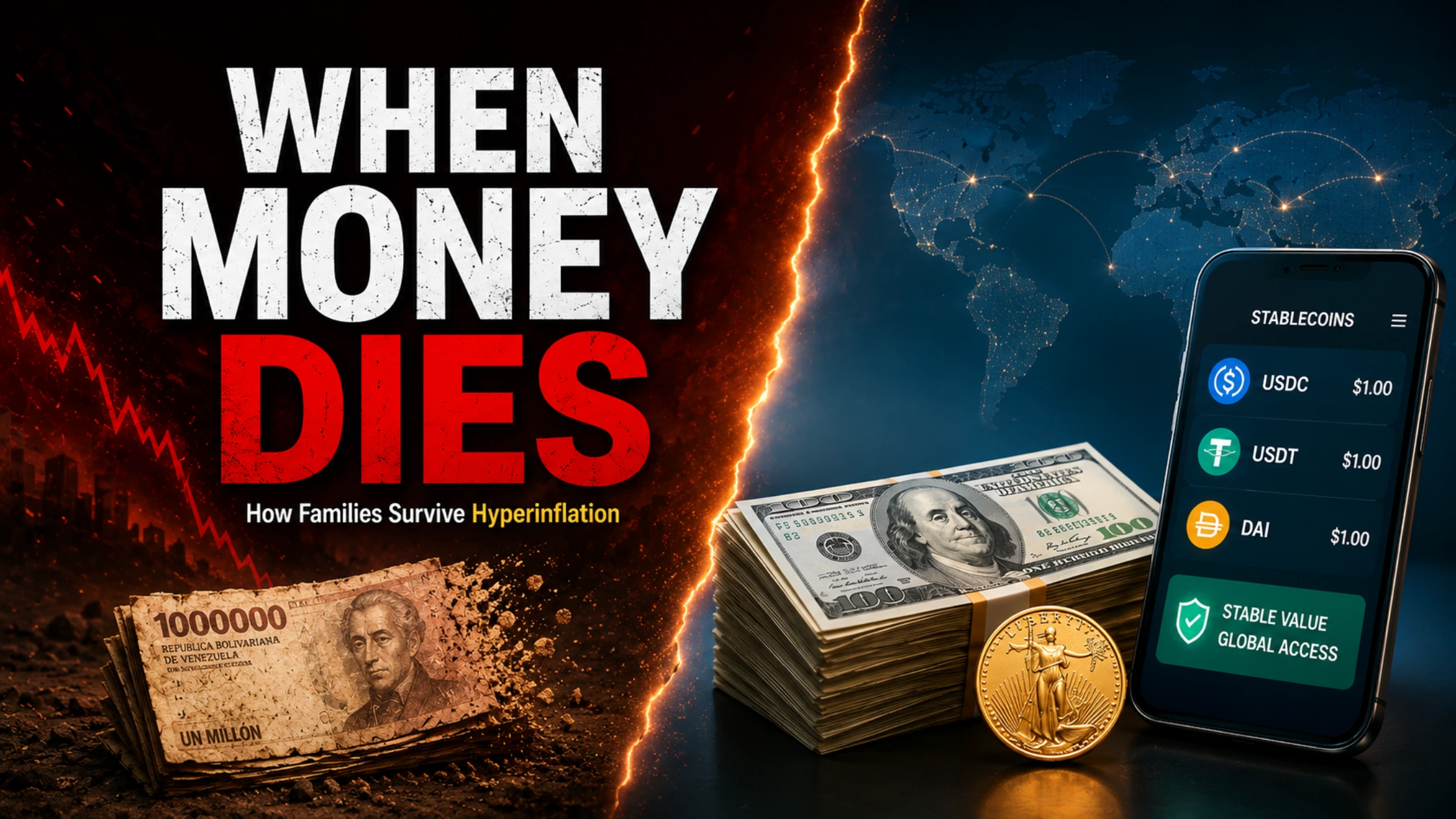
How Families Survive Hyperinflation: Dollars, Gold, Stablecoins and Hard Assets
DN Hyperinflation Survival Files
What Families in Venezuela, Zimbabwe and Argentina Actually Did When Their Money Died
Three real hyperinflations, thirty years apart, and the specific, unglamorous decisions that separated households who kept their purchasing power from households who watched a lifetime of savings become worthless paper. Includes the DN Hyperinflation Survival Simulator, built from the verified math of all three collapses.
DECENTRALISED NEWS · MACRO & MONETARY SURVIVAL SERIES · UPDATED 2026
There is a specific kind of fear that only shows up when a currency is actively dying: the fear of waiting one more hour before you spend it. Not a market downturn. Not a bad quarter. The physical sensation of watching a number on a banknote become a joke between breakfast and lunch. Three countries in the last three decades lived through this in its most extreme form, and in every one of them, some families came out the other side with their wealth intact while their neighbours, often with identical incomes, did not. The difference was rarely luck. It was almost always a handful of concrete decisions, made early, about where value actually lives when a government's promise stops meaning anything.
This piece is not a history lesson for its own sake. It is a forensic account of the mechanics, gathered from three separate collapses, of what protecting a family's purchasing power against runaway inflation actually looks like in practice, stripped of the abstractions that usually surround this topic. It ends with the DN Hyperinflation Survival Simulator, a tool that runs the exact compounding math behind each of these three crises so you can see, in numbers, what a single month of indecision costs.
DN AI Summary
Venezuela (2016–2021), Zimbabwe (2007–2009) and Argentina (2018–2023) each produced hyperinflation severe enough to destroy a national currency's function as a store of value. Households that converted savings into US dollars, gold or, in Argentina's case, dollar-pegged stablecoins early and partially, rather than waiting for a "better exchange rate" or converting everything at once, preserved meaningfully more purchasing power than those who stayed in local currency. The core mechanic is compounding: a monthly inflation rate that sounds survivable, even 25% or 80%, destroys savings on a timeline of weeks once compounded, and the cost of each month of delay grows, not shrinks, as the crisis deepens. All three countries eventually stabilised, Venezuela and Zimbabwe through de facto or formal dollarisation, Zimbabwe more recently through a gold-backed currency reaching single-digit inflation in January 2026, and Argentina through a disinflation program that cut annual inflation from 211% to roughly 31% between 2023 and 2025.
What hyperinflation actually does to a household's money
Economists date the start of hyperinflation to a simple threshold: a month in which prices rise more than 50%, first defined this way by Phillip Cagan in 1956. Below that line, inflation is painful but survivable through normal saving behaviour. Above it, something different happens. Compounding takes over, and a rate that sounds manageable in a headline becomes catastrophic once it runs for even a few months.
The number that matters to a family is not the annual percentage published in a news report. It is the halving time: how long it takes for a unit of savings to lose half its real value. At a monthly rate of 25%, savings halve in real terms in roughly three months. At the rates Venezuela saw at its 2018 peak, the halving time collapses to about five weeks. At the rate Zimbabwe hit in November 2008, it is measured in hours. This is the number the DN Hyperinflation Survival Simulator further down this page calculates directly from whatever monthly rate you enter, because it is the single figure that makes the abstraction of "high inflation" concrete enough to act on.
The decision that actually matters: speed, not size
Across all three crises, the households that preserved wealth were not necessarily the wealthiest or the most financially literate. They were the ones who converted a meaningful share of savings into something outside the collapsing currency early, and kept doing it, rather than waiting for confirmation that things were "really" as bad as they seemed. Waiting for certainty is itself the expensive decision, because by the time a crisis is unambiguous to everyone, the local currency has already lost most of what it is going to lose.
Zimbabwe's collapse is the most extreme hyperinflation the modern world has watched unfold with cameras and the internet recording it in real time. Official statistics broke down in July 2008 at 231 million percent annually, the last figure Zimbabwe's Central Statistical Office published before abandoning the count. Economists Steve Hanke and Alex Kwok later reconstructed the rest from black-market exchange rate data, calculating a peak monthly rate of approximately 79.6 billion percent in mid-November 2008, an annualised figure that runs into the sextillions. At that rate, prices doubled roughly every 24.7 hours. A wage collected in the morning had lost half its value by the following morning.
The Reserve Bank of Zimbabwe's response was to keep adding zeroes: a Z$100 trillion banknote entered circulation on January 16, 2009, the highest denomination any central bank has ever issued for general circulation. By the time it reached hands, it was worth roughly forty US cents at the black-market rate people actually transacted at.
Families who protected themselves did one of a small number of things, usually in combination: they converted salaries to US dollars or South African rand within hours of being paid rather than at the end of the week; they held physical gold, which Zimbabwe produces domestically and which several households used as a savings vehicle precisely because it could not be printed by a central bank; and, for those with land, they held value in livestock and grain, assets whose worth doesn't reprice every few hours. Reporting from the period captured how ordinary this calculation became. One Harare resident, describing her routine to Al Jazeera during an earlier stretch of the crisis when annual inflation was "only" 913.6%, said she had learned to live one day at a time, a habit that intensified rather than eased as the crisis worsened over the following two years.
The formal end came in April 2009, when the government stopped printing Zimbabwean dollars entirely and let citizens transact in whatever foreign currency they held, mostly US dollars. Confidence in a domestic unit of account took over a decade to rebuild. In April 2024, Zimbabwe introduced a new currency, the Zimbabwe Gold, backed at launch by 2.5 tonnes of gold and roughly $100 million in foreign reserves. It struggled initially, losing nearly half its value in its first six months. But by January 2026, with reserves backing the currency grown to $1.2 billion, Zimbabwe recorded annual inflation of 4.1%, its lowest rate since 1997, nearly three decades of monetary chaos ending in a single-digit print. It is, so far, the clearest example in this piece of a country that ran the full cycle from monetary collapse to a working, asset-backed stabilisation.
Zimbabwe's lesson
Hard assets that cannot be printed, whether gold, foreign currency, or productive property, held their function throughout, even while the definition of "the currency" changed six times. The households that struggled longest were the ones still holding paper Zimbabwean dollars when the note that reached their hands couldn't buy a loaf of bread by the time they got to the front of the queue.
Venezuela's hyperinflation was less a single explosive spike than a multi-year grind that eventually became one of the worst sustained episodes in modern history. The Central Bank of Venezuela's own figures put the annual rate at 130,060% in 2018, the peak year, with independent estimates using purchasing power parity methodology putting the year-end run-rate closer to 80,000% and cumulative price increases since the crisis began surpassing 1,000,000%. Unlike Zimbabwe, Venezuela's government never formally abandoned its currency. Instead, the country drifted into what economists call de facto dollarisation: the bolivar remained legal tender on paper while US dollars quietly took over as the actual unit of account for anything that mattered, from rent to groceries.
The families who preserved wealth were disproportionately those with access to a channel into dollars: remittances from relatives abroad, informal exchange houses trading at the black-market rate rather than the official one, or employment with multinational firms that paid partly in foreign currency. Those without such access and without savings already converted before the worst years watched bolivar-denominated deposits, including money held in formal bank accounts, lose more than 50% of their real value annually through the peak years of 2016 to 2019, according to reconstructions of the period. A middle-class family with a decade of bolivar savings built up during an earlier period of relative stability could see that entire cushion evaporate within a single year of the crisis's worst phase.
| Year | Annual inflation (Central Bank of Venezuela) | What was happening on the ground |
|---|---|---|
| 2017 | 652.7% | Price controls deepen shortages; informal dollar economy expands |
| 2018 | 130,060% | Peak year; new banknotes issued; bolivar effectively unusable for savings |
| 2019 | 9,585.5% | Rapid deceleration as monetary expansion is curtailed |
| 2021 | 686.4% | First year back below pre-crisis 2017 levels; de facto dollarisation entrenched |
By 2023, the shift toward foreign currency had gone beyond household behaviour and into state infrastructure. Venezuela's state oil company PDVSA began requiring portions of crude export payments to be settled directly in USDT, the dollar-pegged stablecoin, rather than bolivars, a striking admission from the government itself that stablecoins had become part of the country's functioning financial plumbing. Today, most retail transactions in Venezuela's cities happen in dollars or dollar-equivalents, with the bolivar relegated to small change.
Venezuela's lesson
Access to a channel into hard currency, any channel, mattered more than financial sophistication. Families with a relative sending remittances from Madrid or Miami, or an employer willing to pay a dollar component, weathered a crisis that wiped out households with identical peso, sorry, bolivar-denominated savings but no such channel. The eventual state-level embrace of stablecoin settlement for oil exports simply formalised what households had already worked out for themselves years earlier.
Argentina never crossed into textbook hyperinflation territory the way Zimbabwe or Venezuela did, but it offers the clearest modern case study in a population that responded to chronic, severe inflation with a coordinated, largely informal hedge, and then watched a policy correction actually work. Annual inflation topped 140% ahead of the 2023 presidential election and closed the full year at 211.4%, driving roughly four in ten Argentinians into poverty by some estimates. Newly elected president Javier Milei devalued the peso by 50% in December 2023 as opening "shock therapy," a move that briefly pushed inflation higher before a sustained disinflation program took hold.
What makes Argentina distinct is the scale and speed at which its population turned to stablecoins specifically, not just physical dollars. Argentina's share of transaction volume conducted in stablecoins reached 61.8%, well above the global average of 44.7% and slightly ahead of regional peer Brazil, according to Chainalysis's 2024 Latin America adoption research. Between July 2023 and June 2024, Argentinians transferred an estimated $91.1 billion in crypto, more than any other country in the region. The mechanism is intuitive once you see it: Argentina's decades-old "blue dollar" black market for physical US currency has simply gained a digital, more portable, more divisible sibling. Stablecoins let a family hold dollar-equivalent value without needing to physically source, store and later spend paper bills, a real logistical problem in an economy where formal dollar purchases are still tightly rationed through capital controls.
The policy side of the story is the one worth sitting with, because it is rarer. Argentina's annual inflation fell from 211.4% in 2023 to 117.8% in 2024, and to roughly 31.5% by the end of 2025, the lowest year-end print since 2017, achieved through a fiscal surplus and a sharp cut in government spending rather than through capital controls or a currency board. It remains a bi-monetary economy in practice: pesos for wages and daily transactions, dollars and dollar-stablecoins as the store of value people actually trust, a split that seems likely to persist even as the annual headline number keeps improving.
Speed compounds
Every month spent deciding whether a crisis is "real" is a month of exponential erosion. In Venezuela's peak year, waiting two extra months to convert savings cost roughly 45 percentage points of purchasing power.
Partial beats binary
Families who hedged 50% of savings rather than agonising over an all-or-nothing conversion still preserved most of their purchasing power, without needing to correctly time the worst of the crisis.
Informal markets are a safety valve
Zimbabwe's foreign-currency shops, Venezuela's black-market exchange houses and Argentina's blue dollar market all emerged as functioning substitutes for a broken formal system, often ahead of any government policy response.
Portability is the modern upgrade
What gold and mattress dollars did for Zimbabwean and Venezuelan households, stablecoins now do with far less friction, at the cost of trading currency risk for issuer and custody risk instead.
The tool: running the actual math on your own numbers
Every family in these three stories was, whether they framed it this way or not, running a compounding calculation against a clock. The DN Hyperinflation Survival Simulator below runs that same calculation directly: enter a monthly inflation rate, a share of savings converted to a hard currency or stablecoin at day zero, and a time horizon, and it shows exactly how much purchasing power survives under each path. Load any of the three verified historical scenarios above to see the model reproduce the real halving times, including Zimbabwe's documented 24.7-hour doubling time at its November 2008 peak.
DN Proprietary Instrument
DN Hyperinflation Survival Simulator
Enter a monthly inflation rate to see exactly how fast savings erode, and how much a partial hedge into hard currency or stablecoins preserves.
Any currency unit. The result is shown as a percentage of this starting value.
Above 50%/month is the textbook hyperinflation threshold (Cagan, 1956).
The remainder stays in local currency and inflates away at the rate above. A one-time 1.5% conversion cost is applied to the hedged portion.
Load a verified historical scenario
Local-currency purchasing power at month t is 100 / (1 + r)^t, where r is the monthly rate as a decimal. This is the standard compounding decay used to reconstruct historical hyperinflations, including Hanke & Kwok's 2009 analysis of Zimbabwe.
The hedged blend is hedge% × 100 × (1 − 1.5% fee) + (1 − hedge%) × 100 / (1 + r)^t, treating the converted share as holding its value from day zero (illustrative; a real dollar or stablecoin position still carries its own smaller risks, covered below).
Preset scenarios use figures sourced directly from the article above: Zimbabwe's monthly rate is Hanke & Kwok's directly measured 79.6 billion percent for November 2008; Venezuela's and Argentina's monthly rates are derived from the Central Bank of Venezuela's 130,060% 2018 annual figure and Argentina's 211.4% full-year 2023 print, converted to an equivalent constant monthly rate. Loading the Zimbabwe preset at a one-month horizon reproduces the documented 24.7-hour doubling time exactly.
DN Hyperinflation Survival Simulator is an illustrative educational model, not financial advice. It does not account for taxes, transaction limits, capital controls, or exchange-rate risk on the converted portion. Not a recommendation to convert savings into any specific asset. May be reproduced with attribution to decentralised.news.
Where the model breaks down: risks the tool doesn't price in
The simulator above deliberately simplifies. A real conversion out of a collapsing currency carries costs the model treats as a flat one-time fee: capital controls that ration how much foreign currency a household can legally buy, as Argentina's "cepo" has done for years; black-market spreads that widen precisely when demand for an exit is highest; and, for stablecoins specifically, a different category of risk entirely. A dollar-pegged stablecoin removes currency-collapse risk but replaces it with issuer risk, platform risk and custody risk, the same trade every household made when they stopped trusting a mattress and started trusting a bank, just one layer more digital. None of this changes the core lesson from Zimbabwe, Venezuela and Argentina: the risk of doing nothing during a currency collapse has, in every documented case, been larger than the risk of an imperfect hedge.
Getting practical access to a hedge
For readers across Africa and emerging markets asking the more immediate question, "how do I actually hold dollars or stablecoins if my local currency is under pressure," the mechanics families in Zimbabwe and Venezuela had to improvise informally now exist as regulated infrastructure. VALR, licensed by South Africa's Financial Sector Conduct Authority and now Africa's largest crypto exchange by volume, processed more than $20 billion in stablecoin transactions in the twelve months to mid-2026 and supports direct on-ramps into USDT, USDC and PYUSD from local currency. For readers outside Africa seeking similar dollar-stablecoin access with deep liquidity, Bybit offers comparable stablecoin on and off-ramp infrastructure across a wide range of local payment rails.
Frequently asked questions
DN-internal: This piece connects to the DN Real FX Cost instrument and the DN Denominator Terminal's debasement framework, both of which quantify currency erosion from the opposite direction, official monetary policy rather than lived household crisis.
Sources: MPRA "Hyperinflation in Venezuela: An Analysis"; Central Bank of Venezuela official figures via FocusEconomics and Grokipedia; Cato Institute / Steve Hanke, "Venezuela's Hyperinflation Hits 80,000% Per Year in 2018"; Hanke & Kwok, "On the Measurement of Zimbabwe's Hyperinflation," Cato Journal 2009; Wikipedia, "Hyperinflation in Zimbabwe"; Al Jazeera, "Zimbabwe statistics paint bleak picture" (2006); Bloomberg, "Zimbabwe Inflation in Single Digits for First Time in Decades" (Jan 2026); AllAfrica, "Zimbabwe Hits Single-Digit Inflation Milestone" (Jan 2026); Chainalysis, "2024 LATAM Crypto Adoption: The Rise of Stablecoins"; QuickNode, stablecoin adoption blog; Focus Economics, "Argentina's Economy Outlook Under Milei"; Michigan Journal of Economics, "An Analysis of Issues with the Argentine Economy Following Milei's Inflation Reform"; QuickNode, PDVSA/USDT reporting.
As of: July 2026. Not financial advice. This is high-risk, emerging-market and YMYL content; figures reflect the most recent verified reporting available at time of writing and may have changed. The Hyperinflation Survival Simulator is an illustrative educational model, not a live feed.
About the Author