Our flagship Pacifica review examines perpetual futures, spot markets, fees, unified margin, APIs, AI trading, security, liquidation risks and the best Pacifica alternatives for 2027.
Research Verified: 17 July 2026
Summary
Pacifica is attempting to close the gap between a centralised professional trading venue and a wallet-connected decentralised exchange.
Built around Solana, Pacifica offers an order-book interface, perpetual futures, spot markets, cross and isolated margin, multi-asset collateral, USDC lending, user-managed vaults and institutional-style APIs. Its newest infrastructure also allows compatible AI agents to retrieve market data and manage trades through Model Context Protocol integrations.
The platform’s strongest qualities are its breadth, relatively competitive fee schedule and focus on professional execution. Its main weaknesses are a complicated trust model, incomplete public audit accessibility, liquidation and auto-deleveraging exposure, beta-stage account limits and the possibility that unified margin creates risks users do not fully understand.
Verdict: Pacifica deserves attention as an emerging Solana trading ecosystem. It should be evaluated as a hybrid venue with decentralised settlement elements, not treated as a completely trustless protocol or a risk-free alternative to a centralised exchange.
Pacifica at a Glance
Category | Pacifica |
Platform model | Hybrid decentralised trading exchange |
Primary blockchain | Solana |
Main collateral and settlement asset | USDC |
Products | Perpetual futures, spot, money market, vaults and Swim |
Perpetual leverage | 3x to 50x, depending on market |
Margin modes | Cross and isolated |
Spot margin | Cross only |
Base maker fee | 0.015% |
Base taker fee | 0.040% |
Lowest published maker fee | 0% |
Lowest published taker fee | 0.028% |
Funding interval | Hourly |
Main order types | Market, limit, stop market and stop limit |
Advanced instructions | GTC, IOC, ALO, TOB, TP/SL and batch orders |
API support | REST, WebSocket and MCP |
Wallets identified in documentation | Phantom, Solflare, Backpack, Ledger and WalletConnect |
Current audit listing | BlockSec report listed, but official PDF was inaccessible when checked |
Restricted jurisdictions | Includes the US and several sanctioned or restricted regions |
Best suited to | Active traders, market makers, developers and advanced Solana users |
Pacifica’s official documentation currently contains different market counts. Its About page reports more than 65 perpetual pairs, while its trading overview states more than 35. The live interface should be treated as the authoritative list.
The Pacifica Thesis
Most decentralised perpetual exchanges begin by choosing one of two models.
The first is an automated liquidity pool. This can simplify on-chain execution but may produce price impact, liquidity-provider inventory risk and limited order-book functionality.
The second is a central limit order book supported by an off-chain matching engine and on-chain settlement. This can provide a faster, more familiar interface, but it introduces sequencer, matching-engine and administrative dependencies.
Pacifica belongs closer to the second category.
Its strategy is to combine:
- Solana wallet authentication
- Order-book execution
- Professional APIs
- Unified margin
- Spot collateral
- Lending and borrowing
- Managed pools
- AI-agent connectivity
This gives Pacifica more product depth than a single-purpose perpetual DEX, but each additional layer creates new dependencies and risk interactions.
Who Built Pacifica?
Pacifica says it was founded in January 2025 and launched its mainnet approximately six months later.
The project reports that its team has experience from crypto exchanges, high-frequency trading firms, financial institutions, machine-learning companies and universities. Named backgrounds include Binance, Coinbase, FTX, Jane Street, Fidelity, OpenAI, DeepMind, MIT and Stanford.
Pacifica also says it has remained self-funded and has not raised external capital. These are statements from the project’s own materials and should not be interpreted as independent verification of individual employment histories or financial backing.
The absence of external funding can reduce investor pressure, but it can also mean the platform has fewer publicly disclosed institutional diligence events than venture-backed competitors.
How Pacifica’s Hybrid Architecture Works
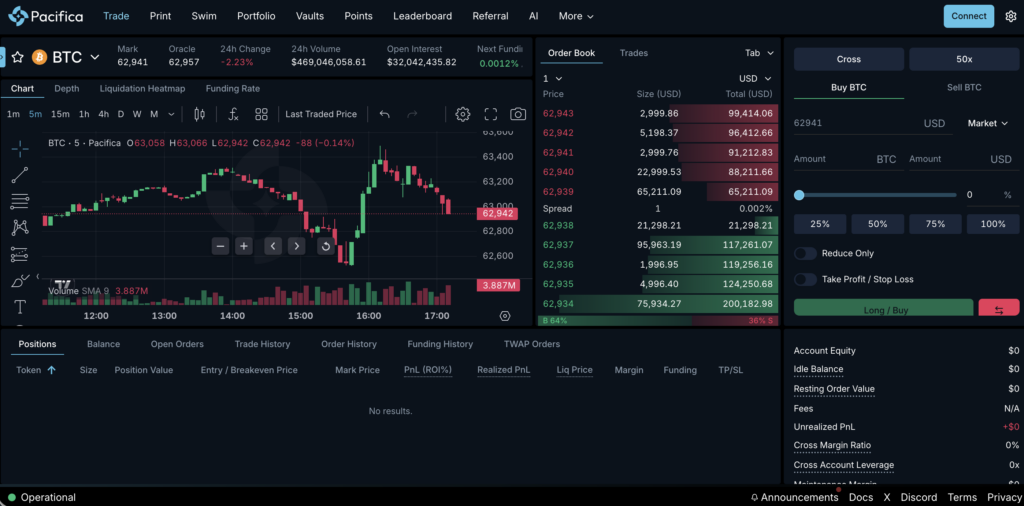
Pacifica’s user experience begins with a Solana-compatible wallet, but trading does not occur solely through wallet-to-contract transactions in the manner of a conventional automated market maker.
The platform relies on a matching engine to coordinate order-book execution and process ordinary withdrawals. Pacifica’s security documentation directly acknowledges that access to withdrawal authority creates an important trust and attack surface.
Pacifica’s Planned Security Separation
Component | Intended Function | Principal Risk |
Operational hot wallet | Process routine withdrawals quickly | Engine-key or infrastructure compromise |
Multi-signature cold vault | Hold most user capital | Governance, signer and implementation risk |
Matching engine | Coordinate orders and normal operations | Outage, delay, incorrect processing or compromise |
Solana programs | Account for balances and enforce rules | Smart-contract or upgrade risk |
Oracle and mark-price system | Price positions and liquidations | Stale, incorrect or manipulated data |
Backstop liquidator | Absorb severely undercollateralised positions | Insufficient capacity during stress |
Auto-deleveraging system | Resolve deficits not covered elsewhere | Forced closure of profitable opposing positions |
Pacifica says its newer design limits the amount accessible to the hot wallet and uses a Squads multi-signature vault with role-based controls and time-locked upgrades for the larger cold balance. Its documentation describes the platform as transitioning to this architecture, so traders should verify the implementation status and deployed contracts before assuming the complete design is operational.
Pacifica Market Coverage
Pacifica has developed beyond crypto-only perpetual futures.
Its market universe has included:
- Major cryptocurrencies
- Smaller crypto assets
- Foreign exchange
- Precious metals
- Energy and commodity-linked instruments
- Equity-related markets
- Pre-market assets
- USDC-quoted spot markets
This makes Pacifica relevant to traders who want to hold collateral and trade several asset classes inside one account.
However, synthetic and real-world markets bring additional complications:
- Traditional markets close while crypto markets continue trading.
- Oracle sources can become less responsive outside conventional trading hours.
- Price gaps can occur when underlying venues reopen.
- Some markets have lower leverage and different liquidation support.
- Certain experimental and real-world markets are excluded from the backstop liquidator.
Market breadth is useful only when liquidity and risk controls remain adequate.
Perpetual Futures and Leverage
Pacifica offers perpetual contracts with maximum leverage ranging from 3x to 50x.
Maximum leverage is set per market. The selected leverage affects the initial margin required to open the trade.
Selected Leverage | Approximate Initial Margin |
2x | 50% |
5x | 20% |
10x | 10% |
20x | 5% |
50x | 2% |
This simplified table does not include fees, funding, collateral discounts or maintenance-margin requirements.
A 50x position has very little tolerance for adverse movement. Even when the theoretical liquidation distance appears sufficient, spread, mark-price changes and funding can reduce the actual margin buffer.
Pacifica allows leverage on an existing position to be increased but not reduced until the position is closed. Traders should therefore choose leverage deliberately before opening.
Cross Margin, Isolated Margin and Unified Collateral
Feature | Cross Margin | Isolated Margin |
Collateral source | Shared account equity | Margin assigned to one position |
Uses eligible spot assets | Yes | No |
Shares unrealised PnL | Yes | No |
Exposure to other positions | High | Limited |
Capital efficiency | Higher | Lower |
Simplicity | More complex | Easier to isolate |
Best suited to | Portfolio traders and hedgers | Controlled single-position risk |
Pacifica’s cross-margin account pools USDC, unrealised perpetual PnL and eligible spot collateral.
Spot assets are discounted through LTV ratios. Pacifica gives typical examples of 90% for BTC and ETH and 80% for other major assets. It can also impose per-user collateral caps.
A trader holding $20,000 of an eligible asset may discover that only a portion contributes towards account equity because of the LTV and collateral ceiling.
This prevents the risk engine from treating a volatile token like cash. It also means account balances and usable collateral can differ materially.
The USDC Money Market
Pacifica’s money market is embedded within unified margin rather than presented only as a separate lending application.
Participant | How the Position Arises | Economic Effect |
Lender | Holds sufficient idle USDC with auto-lending enabled | Earns variable interest |
Borrower | Cross-margin equity excluding spot falls below zero | Pays variable USDC interest |
Spot holder | Uses eligible spot as collateral | Can support positions without immediate borrowing |
Isolated trader | Opens an isolated position against borrowed funds | Borrow may arise when the position opens |
Only USDC is lent or borrowed. Pacifica states that spot collateral is not rehypothecated.
The important risk is that borrowing can become implicit. A trader may not intentionally click “borrow,” but losses can push the account into a negative USDC balance that begins accruing interest.
If utilisation reaches 95%, Pacifica can deleverage borrowers starting with the largest positions until utilisation declines towards 90%.
Pacifica Fee Schedule
Fee levels are based on total executed volume over a rolling 30-day period.
Tier | 30-Day Trading Volume | Maker Fee | Taker Fee |
Tier 1 | $0 to $5 million | 0.015% | 0.040% |
Tier 2 | Above $5 million | 0.012% | 0.038% |
Tier 3 | Above $10 million | 0.009% | 0.036% |
Tier 4 | Above $25 million | 0.006% | 0.034% |
Tier 5 | Above $50 million | 0.003% | 0.032% |
VIP 1 | Above $100 million | 0% | 0.030% |
VIP 2 | Above $250 million | 0% | 0.029% |
VIP 3 | Above $500 million | 0% | 0.028% |
Fee tiers update daily. Subaccounts inherit the master account’s tier, and their trading activity contributes to aggregate volume.
Fee Cost by Position Size
Executed Notional | Base Maker Fee | Base Taker Fee | VIP 3 Taker Fee |
$1,000 | $0.15 | $0.40 | $0.28 |
$10,000 | $1.50 | $4.00 | $2.80 |
$100,000 | $15.00 | $40.00 | $28.00 |
$1 million | $150.00 | $400.00 | $280.00 |
A complete round trip usually includes both entry and exit executions.
These figures exclude funding, spread, slippage, interest and liquidation charges.
Execution Quality and the Randomised Delay
Pacifica supports a central order book with market, limit and conditional orders.
Its time-in-force instructions include:
- Good-Til-Cancelled
- Immediate-or-Cancel
- Add-Liquidity-Only
- Top-of-Book
An unusual feature is the randomised 50 to 100-millisecond delay applied to market, GTC and IOC orders. Pacifica says this protects liquidity providers against adverse selection.
For a discretionary trader, this may be less important than spread and depth.
For a market maker or arbitrage system, it changes the latency model. A proper review of Pacifica for algorithmic trading should measure:
- Time from request to acknowledgement
- Time from acknowledgement to fill
- WebSocket update delay
- Cancel success during volatility
- Slippage by order size
- Frequency of partial fills
- Behaviour during Solana congestion
- Difference between displayed and realised execution
Published interface speed is not a substitute for independent execution testing.
Funding Rates
Pacifica settles funding each hour.
The funding rate is based on an order-book premium and an interest-rate component. The premium measures how Pacifica’s impact prices differ from its oracle.
Funding Condition | Typical Economic Direction |
Positive funding | Longs pay shorts |
Negative funding | Shorts pay longs |
Perpetual trades above spot | Positive funding becomes more likely |
Perpetual trades below spot | Negative funding becomes more likely |
Pacifica samples the expected rate every five seconds and applies the hourly average at the end of the interval.
The published funding cap is plus or minus 4% per hour. This is an extreme boundary rather than a typical rate, but traders should understand that highly imbalanced markets can become very expensive to hold.
Funding payments also alter isolated-position margin and liquidation levels.
Pacifica’s Three-Level Liquidation Waterfall
Stage | Trigger | What Happens |
Market liquidation | Equity below maintenance margin but above backstop threshold | Orders cancelled and positions reduced through IOC marketable orders |
Backstop liquidation | Equity below two-thirds of maintenance margin | Positions and collateral transferred to the backstop liquidator |
Auto-deleveraging | Equity below zero and prior mechanisms insufficient | Profitable opposing positions reduced according to risk priority |
Pacifica can partially liquidate a position if doing so restores sufficient maintenance margin.
The liquidation engine also deducts a charge based on the value liquidated. Large positions can be broken into five chunks submitted at short intervals.
Auto-deleveraging is an important tail risk. A profitable position does not guarantee that the trader will be able to retain its full size during a market deficit.
Spot Markets and Collateral
Pacifica spot markets trade a base asset against USDC through the same broad order-book experience.
Spot holdings can serve three purposes:
- Direct investment or trading
- Unified-margin collateral
- A hedge against perpetual exposure
Pacifica can apply a hedging bonus to part of an eligible spot holding when it offsets a cross-margin short position.
Spot collateral is not free of operational constraints. Selling an asset locks the units in the order and removes their recognised collateral contribution until execution or cancellation.
A trader near liquidation could therefore worsen account health by placing a large unfilled spot sell order.
Deposits, Withdrawals and Beta Limits
Item | Current Published Condition |
Minimum USDC deposit | $10 |
Maximum standard account equity | $250,000 during closed beta |
Minimum USDC withdrawal | $1 |
USDC withdrawal fee | $1 |
Per-account withdrawal cap | $250,000 per 24 hours |
Individual spot-asset deposit cap | Approximately $50,000 daily |
Spot-asset withdrawal cap | Up to $250,000 daily per asset |
Supported wallet examples | Phantom, Solflare, Backpack and Ledger |
Network | Solana |
Pacifica also applies exchange-wide withdrawal limits intended to restrict the amount that can leave during a defined period.
These controls may reduce the consequences of a compromised operational system, but they can also delay withdrawals during periods of unusually high demand.
API, Subaccounts and AI-Agent Trading
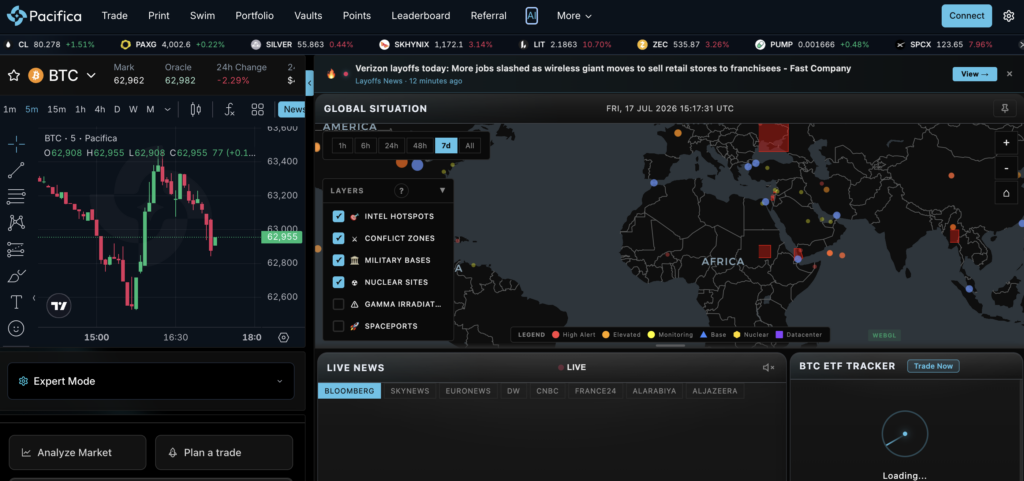
Pacifica’s strongest differentiator may eventually be its developer infrastructure.
It provides:
- REST endpoints
- WebSocket feeds
- Batch orders
- Editable orders
- Stop and TP/SL management
- Account history
- Subaccounts
- Spot operations
- Vault operations
- Agent wallets
- MCP tools
Revocable Agent Keys
A Pacifica agent key can sign trading requests without holding the same withdrawal authority as the principal wallet.
This reduces the damage that can result from exposing an automated trading credential, although any active trading key can still open or close harmful positions.
Model Context Protocol
Pacifica’s open-source MCP server converts exchange functions into tools usable by AI clients.
An AI agent can potentially:
- Read prices and funding
- Inspect balances
- Analyse order books
- Place market and limit orders
- Set stops
- Cancel positions
- Query trade history
Read-only access requires only an account address. Trading requires a private or agent key, with agent-key mode recommended.
This is powerful infrastructure, but storing any secret key in an AI-client configuration creates operational risk. Agent permissions, position limits and emergency revocation procedures should be established before enabling automated execution.
Pacifica Vaults
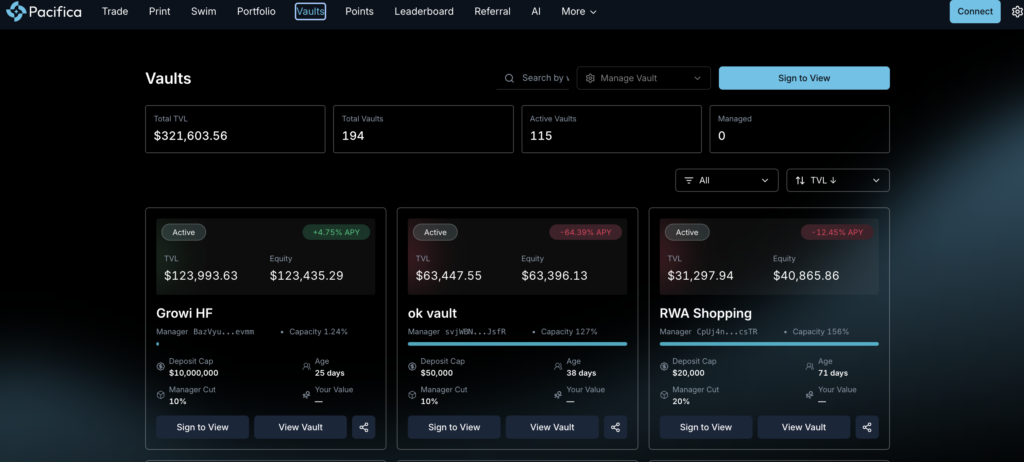
Pacifica’s vault product lets a user create a managed trading pool.
Participant | Role |
Creator | Establishes the vault and initial configuration |
Manager | Trades the pooled capital |
Depositor | Contributes USDC and receives LP shares |
Managers and depositors can hold different share classes.
Vaults can restrict:
- Tradable markets
- Prohibited markets
- Maximum leverage
- Deposit amounts
- Manager capital
- Performance fees
The vault’s profit and loss is distributed according to its configured economics.
Transparent on-platform performance does not eliminate manager risk. A strategy can become more leveraged, more correlated or less liquid than a depositor expects.
Pacifica Security Review
Positive Security Elements
- Multi-signature cold-storage design
- Limited operational wallet concept
- Programmatic spending controls
- Time-locked upgrades
- Role separation
- Solana wallet signatures
- Revocable API keys
- Multi-source price indexing
- Partial-liquidation procedures
- Backstop liquidation
- Bug-bounty programme
Unresolved Questions
- Is the full hot-and-cold architecture currently deployed?
- What percentage of funds remains in the operational wallet?
- Which contract version did BlockSec audit?
- Did the audit include unified margin, spot, money market and vaults?
- What material findings were discovered?
- Were all findings remediated?
- Who currently controls upgrade and emergency-pause permissions?
- What insurance or reserve capital exists beyond the backstop liquidator?
Pacifica’s audit page links to a BlockSec report, but the linked document returned an error when accessed during this review.
This reduces transparency at the point where a prospective user needs to confirm audit scope.
Pacifica Risk Matrix
Risk | Why It Matters | Potential Mitigation |
Smart-contract failure | Could affect balances or withdrawals | Limit deposits and monitor audits |
Matching-engine outage | Orders or cancellations may be delayed | Keep leverage conservative |
Oracle failure | Can distort marks and liquidations | Avoid excessive leverage |
Admin-key compromise | May affect upgrades or controls | Confirm multisig and timelocks |
Hot-wallet compromise | Operational withdrawal funds could be exposed | Verify hot-wallet limits |
Cross-margin contagion | One loss can affect all positions | Use isolated margin or subaccounts |
Borrowing interest | Can accumulate without an explicit manual borrow | Monitor USDC balance and interest |
Funding-rate spikes | Can erode returns rapidly | Check predicted funding before entry |
Backstop failure | May lead to auto-deleveraging | Avoid illiquid and crowded markets |
Withdrawal restrictions | Funds may not leave immediately | Test withdrawals and retain off-platform liquidity |
Vault-manager losses | Depositors cannot control every trade | Assess mandate, leverage and track record |
Regulatory restrictions | Access may be blocked | Verify local eligibility |
Pacifica Pros and Cons
Pros | Cons |
Broad Solana trading ecosystem | Hybrid trust model |
Perpetual and spot order books | Matching-engine dependency |
Cross and isolated margin | Cross-margin complexity |
Multi-asset collateral | Collateral haircuts and caps |
USDC lending and borrowing | Implicit borrowing and interest |
Competitive fee tiers | No maker rebate |
Professional REST and WebSocket APIs | Randomised delay on several order types |
Revocable API agent keys | AI automation creates credential risk |
MCP support for AI agents | Audit PDF inaccessible when reviewed |
Managed vaults | Vault-manager risk |
Real-world and crypto markets | Certain markets lack backstop support |
Partial liquidation | Auto-deleveraging remains possible |
Wallet-based onboarding | Closed-beta limits remain |
Solana transaction efficiency | Solana network dependency |
Best Pacifica Alternatives for 2027
No single platform dominates execution quality, asset coverage, decentralisation, privacy, automation and liquidity simultaneously.
Affiliate relationships do not remove the need to evaluate every venue independently.
Best On-Chain Pacifica Alternatives
Platform | Trading Model | Best For | Why Compare It With Pacifica |
Matching-pool perpetual DEX | Pool-based execution | Uses a different liquidity model from Pacifica’s order book | |
Privacy-focused order-book DEX | Hidden positions and RWA markets | Offers privacy-oriented execution and crypto, equity and commodity markets | |
Ethereum ZK order book | Verifiable low-fee execution | Generates proofs for matching and liquidation operations | |
High-performance order book | Professional perp traders | Targets CEX-style execution with on-chain settlement | |
Private multi-product L2 exchange | Perps, spot and options | Supports several derivatives products in one unified account | |
OP Stack derivatives exchange | Options and pre-launch futures | Combines perpetuals, options and structured strategies | |
Oracle-priced liquidity pools | Pool-backed EVM trading | Avoids a conventional order book and supports several EVM networks | |
Oracle-based synthetic trading | Forex and commodities | Provides broad macro and real-world market exposure | |
Injective order book | Expiry futures and grid bots | Offers perpetual, expiry-futures and automated grid tools | |
Multi-chain order-book exchange | Cross-collateral API users | Supports multiple deposit chains and professional integrations |
MYX’s Matching Pool Mechanism, Lighter’s zero-knowledge infrastructure, Aster’s privacy model, and edgeX’s central order book represent substantially different approaches to decentralised execution.
Paradex and Aevo are stronger comparisons for traders seeking options or multi-instrument margin, while GMX and gTrade use oracle and liquidity-pool models that differ from Pacifica’s order-book architecture.
Best Centralised Pacifica Alternatives
Platform | Best Suited To | Key Reason to Compare |
Broad derivatives traders | Large futures ecosystem, bots and copy trading | |
Altcoin-futures traders | Wide selection of smaller-asset markets | |
Copy traders | Strong copy-trading and derivatives focus | |
Social traders | Social and copy-trading interface | |
Futures-focused traders | Derivatives-centred product suite | |
Straightforward futures trading | Simplified account-based perpetual interface | |
Fee-sensitive traders | Futures markets and competitive fee positioning | |
Options professionals | Specialist crypto options and institutional derivatives |
Centralised exchanges can provide deeper liquidity and easier fiat onboarding but require custody of user assets and may impose identity verification, regional restrictions and withdrawal controls.
Which Pacifica Alternative Fits Each Trader?
Trader Priority | Platform to Research |
Solana-based unified margin | Pacifica |
Matching-pool execution | MYX |
Private perpetual positions | Aster or Paradex |
ZK-verifiable order matching | Lighter |
High-performance decentralised order book | edgeX |
Crypto options | Aevo, Paradex or Deribit |
Pool-backed EVM perpetuals | GMX |
Forex and commodities | gTrade |
Expiry futures and grid automation | Helix |
Multi-chain deposits and cross collateral | ApeX Omni |
Centralised copy trading | Bitget or BingX |
Altcoin perpetuals | MEXC |
Broad centralised derivatives suite | Bybit |
Professional options liquidity | Deribit |
Pacifica vs a Centralised Futures Exchange
Factor | Pacifica | Centralised Futures Exchange |
Login and authentication | Solana wallet signatures | Exchange account |
Asset custody | Protocol-controlled hybrid architecture | Company-controlled custody |
Matching | Pacifica matching engine | Centralised matching engine |
Settlement visibility | Solana-linked accounting | Internal ledger |
Account recovery | Limited by wallet and platform structure | Conventional account recovery may exist |
Smart-contract risk | Yes | Usually limited for ordinary account trading |
Counterparty risk | Protocol and operational infrastructure | Exchange solvency and custody |
Unified spot collateral | Supported | Common on larger venues |
Fiat deposits | Not a core feature | Often available |
Identity checks | Jurisdiction and interface dependent | Commonly required |
Audit transparency | Protocol and contract audits | Corporate and reserve reporting varies |
Withdrawal limits | Beta and exchange-wide caps | Platform-specific controls |
Best for | Wallet-connected advanced traders | Users prioritising liquidity and convenience |
Neither model is automatically safer. The risks are different rather than absent.
How to Use Pacifica More Safely
- Use a dedicated trading wallet.
- Verify the official domain before every connection.
- Start with isolated margin where practical.
- Keep leverage substantially below the platform maximum.
- Understand the LTV applied to every collateral asset.
- Monitor USDC borrowing and accrued interest.
- Check hourly and predicted funding before holding positions.
- Use reduce-only stops.
- Separate unrelated strategies through subaccounts.
- Avoid depending on one vault manager.
- Use revocable agent keys for APIs.
- Never place a main wallet secret key inside an AI-agent configuration.
- Test deposits, trading and withdrawals with a small amount.
- Keep emergency liquidity outside the platform.
- Review updated audit reports and security deployments.
Final Pacifica Review Verdict
Pacifica is one of the more credible attempts to build an integrated Solana trading stack rather than another single-feature perpetual application.
Its order-book interface, spot markets, multi-asset collateral, USDC money market, APIs, subaccounts, managed vaults and AI-agent tools give it a potentially defensible position among professional and technically sophisticated traders.
The fee schedule is competitive without depending on a governance-token discount. Higher-volume traders can reach zero maker fees, while base taker fees remain within the range expected from major derivatives venues.
The risk side deserves equal weight.
Pacifica’s decentralisation is hybrid rather than absolute. Its matching engine and withdrawal system remain operational dependencies. The complete hot-and-cold security transition should be verified, and the inaccessible BlockSec report weakens current audit transparency. Unified margin, automatic borrowing, backstop liquidation and auto-deleveraging also make the platform more complicated than its polished interface may suggest.
Pacifica is best approached as an emerging professional venue.
It may be suitable for experienced traders who understand margin, collateral valuation, APIs and platform architecture. It is not suitable for anyone who interprets wallet connectivity as proof that funds cannot be delayed, compromised or liquidated.
Begin small, use conservative leverage, test withdrawals and compare execution against the leading Pacifica alternatives before consolidating trading activity.
Pacifica Review FAQs
Is Pacifica legitimate?
Pacifica is an operating Solana-based trading platform with documented perpetual, spot, margin, API and vault systems. Legitimacy does not mean the platform is risk-free or suitable for every jurisdiction.
Is Pacifica fully decentralised?
Pacifica uses wallet authentication and Solana programs, but it also relies on a matching engine, withdrawal authority and administrative controls. It is better described as a hybrid decentralised exchange.
Is Pacifica self-custodial?
Pacifica presents itself as self-custodial, but user capital interacts with protocol-controlled hot-and-cold infrastructure. This differs from simply holding tokens untouched in a personal wallet.
Does Decentralised News have a Pacifica referral link?
No verified referral link is currently available. Pacifica links in this review are neutral official links.
What blockchain does Pacifica use?
Pacifica is built around Solana.
Does Pacifica use USDC or USDT?
USDC is its principal account, collateral and settlement asset.
Does Pacifica offer spot trading?
Yes. Pacifica offers USDC-quoted spot markets in addition to perpetual futures.
How much leverage does Pacifica offer?
Perpetual leverage ranges from 3x to 50x, depending on the market.
Does Pacifica support cross margin?
Yes. Cross margin is the default, and eligible spot assets can contribute to unified account collateral.
Does Pacifica support isolated margin?
Yes. Isolated margin can be selected before a position is opened.
What is Pacifica’s base trading fee?
The current base maker fee is 0.015%, and the base taker fee is 0.040%.
Does Pacifica charge maker fees?
Yes at lower tiers. Maker fees decline with trading volume and reach zero for qualifying VIP accounts.
How often does Pacifica settle funding?
Funding is applied hourly.
Does Pacifica have lending?
Yes. Pacifica operates a USDC money market integrated with cross-margin accounts.
Can borrowing occur automatically?
Yes. An account backed by spot collateral can begin borrowing when its non-spot equity becomes negative.
Does Pacifica have an API?
Yes. It offers REST, WebSocket and Model Context Protocol integrations.
Can ChatGPT or Claude trade through Pacifica?
Pacifica’s MCP server can connect exchange tools to compatible AI clients. Live trading requires a signing credential. This should be a restricted and revocable agent key rather than the user’s primary private key.
What happens during liquidation?
Pacifica first attempts market liquidation, then backstop liquidation and finally auto-deleveraging if a deficit remains.
Is Pacifica audited?
Its official documentation lists a BlockSec report. The linked PDF was not accessible through the audit page when this review was updated.
Is Pacifica available in the United States?
No. The United States is expressly included among Pacifica’s restricted jurisdictions.
What are the best Pacifica alternatives?
Leading alternatives include MYX, Aster, Lighter, edgeX, Paradex, Aevo, GMX, gTrade, Helix, ApeX Omni, Bybit, MEXC, Bitget, BingX, BloFin, Bitunix, KCEX and Deribit.
Affiliate Disclosure
Decentralised News does not currently receive referral compensation from Pacifica.
Some links to alternative exchanges, wallets and trading platforms are affiliate links. Decentralised News may receive compensation when eligible readers register or use these services, at no additional cost to the reader.
Affiliate relationships are not included in our security assessment, risk analysis or editorial conclusions.
Educational Disclaimer
This content is provided for educational and informational purposes only and is not financial, legal, tax or investment advice.
Cryptocurrency trading, decentralised finance, lending, managed vaults and leveraged derivatives carry substantial risk. Positions can be liquidated, profitable trades can be auto-deleveraged, and smart contracts, matching engines, wallets, APIs, oracles and blockchains can fail.
Platform rules, fees, markets and geographic restrictions can change. Verify all current conditions directly before depositing. Never trade with funds you cannot afford to lose. For adults aged 18 and over.
About the Author