TxFlow Review 2027: Can a Community-Owned Layer 1 Become the Shared Liquidity Network for Global Finance?
Our flagship TxFlow review examines its fully onchain CLOB, custom Layer 1, TIP liquidity standards, stock futures, fees, margin, vaults, security, referrals and alternatives for 2027.
Research Verified: 22 July 2026
Summary
TxFlow is attempting to turn the exchange from an application into a blockchain primitive.
Its thesis is that financial markets should not be split across private matching engines, isolated decentralised applications and bridges that fragment liquidity.
TxFlow instead provides a purpose-built Layer 1 where order matching, clearing, margin, settlement, liquidations and market data are processed through one deterministic state machine.
The first application is a fully onchain central limit orderbook exchange supporting cryptocurrency and traditional-finance perpetual futures. The network’s broader TIP Liquidity Standards can also support spot assets, outcome markets and application-specific Channels that inherit shared execution and settlement infrastructure.
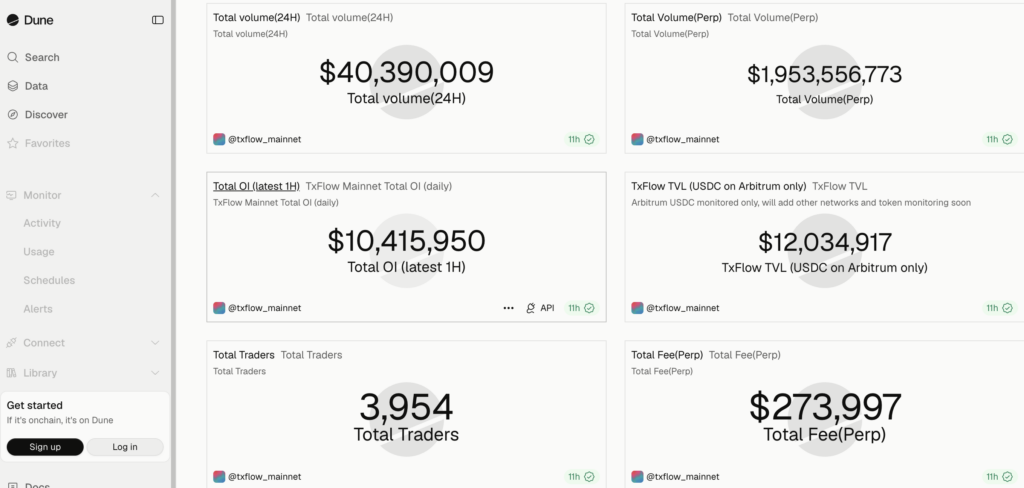
The platform advertises more than 250,000 transactions per second, block latency below 50 milliseconds and deterministic finality. These are reported protocol capabilities rather than independently verified trading benchmarks.
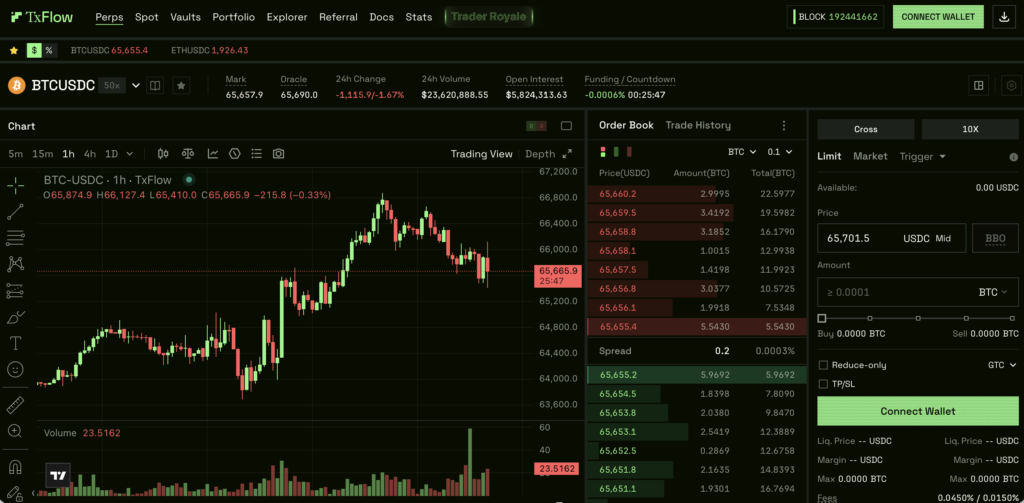
TxFlow’s standard perpetual fees begin at 1.5 basis points for makers and 4.5 basis points for takers. High-volume users can reach zero maker fees and a 2.4-basis-point taker fee.
The platform also provides cross and isolated margin, hedge mode, trigger orders, TWAP, Protocol and User Vaults, referral discounts, Fee Credits, mobile access and developer APIs.
Flagship verdict: TxFlow is among the most differentiated market-structure projects of 2026. Its long-term success will depend less on theoretical throughput and more on liquidity depth, validator decentralisation, oracle integrity, API reliability and whether independent builders adopt its Channel model.
Trade on TxFlow through Decentralised News
Referral code: TXHEATH
TxFlow at a Glance
Category | TxFlow |
Platform type | Purpose-built financial Layer 1 and decentralised exchange |
Flagship product | Fully onchain perpetual-futures CLOB |
Execution model | Deterministic onchain matching engine |
Consensus | Tx-BFT DAG-based Byzantine Fault Tolerance |
Published throughput | More than 250,000 TPS |
Published block latency | Less than 50 ms |
Published finality | Approximately 200 ms |
Platform-reported uptime | 99.99% |
Main collateral | USDC |
External deposit network | Arbitrum |
Current public-app focus | Cryptocurrency and TradFi perpetuals |
TradFi perpetuals documented | 13 |
Margin modes | Cross and isolated |
Position modes | One-way and hedge |
VIP0 perpetual maker fee | 0.015% |
VIP0 perpetual taker fee | 0.045% |
Lowest published maker fee | 0% |
Lowest published perpetual taker fee | 0.024% |
Funding cycle | One hour by default |
Order types | Market, limit, trigger and TWAP |
Time in force | GTC, IOC, ALO and GTD |
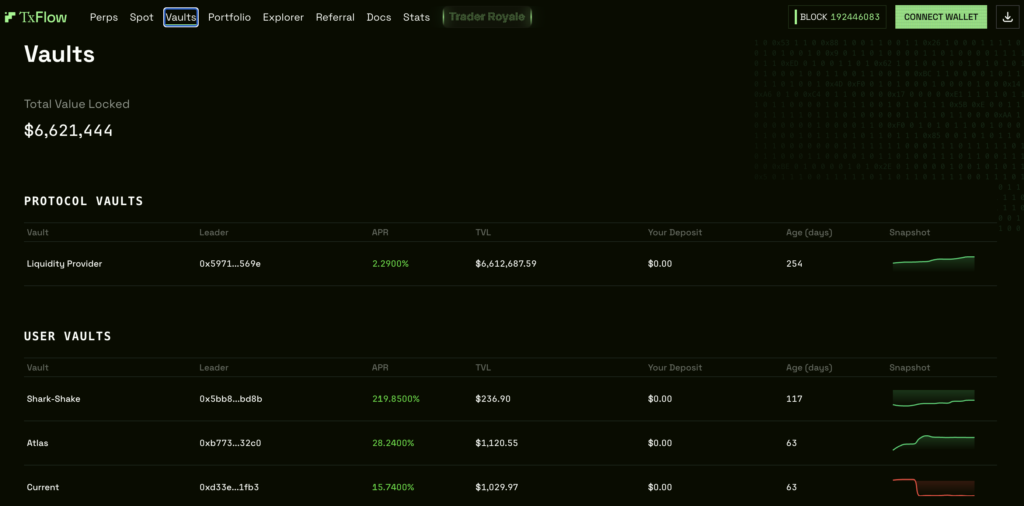
Vault products | Protocol Vault and User Vaults |
User Vault leader profit share | 10% |
Referral benefit | Referred user billed at 95% of standard rate, subject to cap |
Referrer reward | 10% of net fees on first $1 billion of invitee volume |
Mainnet access | Early whitelist phase at review time |
Bug-bounty maximum | 150,000 USDC |
Operator named in privacy policy | TxFlow Labs Ltd |
Governing law | England and Wales |
Arbitration seat | Hong Kong |
Restricted major markets | U.S., China, Singapore, Canada and U.K. |
The network, fee, trading and legal information above comes from TxFlow’s current official website, documentation and terms.
Decentralised News Rating
Category | DN Score |
Architectural innovation | 9.5/10 |
Onchain transparency | 9.3/10 |
Perpetual fee competitiveness | 8.8/10 |
Order functionality | 8.8/10 |
TradFi market potential | 8.5/10 |
API and developer readiness | 8.3/10 |
Margin and risk controls | 8.4/10 |
Current liquidity maturity | 6.8/10 |
Validator transparency | 6.7/10 |
Security disclosure | 7.0/10 |
Legal accessibility | 5.8/10 |
Beginner suitability | 6.0/10 |
Overall | 8.1/10 |
These are Decentralised News editorial scores. They are not investment ratings or guarantees of safety.
The TxFlow Investment Thesis
TxFlow is built around one central observation:
Liquidity becomes less useful when every financial application isolates it behind a separate chain, bridge, margin system or settlement process.
A perpetual exchange may have one pool of collateral.
A stock-futures application may have another.
A prediction market may create its own balances and orderbook.
A market maker must then divide capital across each venue.
TxFlow’s TIP framework allows each application to operate as a Channel while sharing:
- Consensus
- Block ordering
- Account infrastructure
- Clearing and settlement
- Margin calculations
- Liquidation logic
- Insurance-fund rules
- Market-data infrastructure
A Channel still controls its instruments, fee recipient, authorised deployers, oracle feeders and referral configuration.
This separates product identity from infrastructure.
A company can create a specialised financial venue without operating another blockchain.
TxFlow Architecture
Layer | Function |
TxFlow Layer 1 | Consensus, transaction ordering and deterministic state |
Tx-BFT | DAG-based validator agreement and finality |
Transaction batcher | Groups up to 1,000 transactions and flushes at short intervals |
Matching engine | Maintains price-time-priority orderbooks |
Clearing module | Converts fills into balances, positions and realised PnL |
Margin system | Calculates initial and maintenance requirements |
Risk engine | Manages liquidation, insurance and ADL |
Oracle layer | Publishes mark price, index price and funding |
TIP standards | Define financial instrument behaviour |
Channels | Application and governance boundaries |
Frontend | Wallet, email and mobile user interface |
Explorer | Public trading and state visibility |
The official architecture describes consensus finality after more than two-thirds of voting power confirms a batch. Matching, clearing, funding, margin and liquidation are applied deterministically so every node replaying the chain should reach the same state.
TxFlow vs Other Exchange Models
Model | Order Matching | Settlement | Custody | Main Advantage | Main Limitation |
Centralised exchange | Private server | Internal ledger | Exchange | Liquidity and speed | Counterparty risk |
Hybrid perpetual DEX | Offchain engine | Onchain or rollup | Wallet or smart account | Fast Web3 execution | Private matcher |
AMM perpetual DEX | Pool or oracle model | Onchain | Smart contract | Composability | No conventional CLOB |
Keeper-based DEX | Smart-contract requests | Onchain after keeper execution | Smart contract | Transparent rules | Variable execution delay |
TxFlow | Onchain deterministic CLOB | Same-block onchain clearing | Non-custodial | Verifiability and shared infrastructure | New Layer 1 risk |
TxFlow’s architecture is closest to a conventional exchange from the trader’s perspective, but the orderbook state and settlement logic are intended to remain publicly reproducible.
What Does Fully Onchain Mean on TxFlow?
TxFlow describes every order, cancellation, fill and liquidation as an onchain transaction.
The matching engine uses strict price-time priority:
- The best price receives priority.
- Orders at the same price are ranked by arrival.
- Self-trades are prevented.
- Fills move directly into clearing.
- Balances and positions are updated within the same block.
There is no later reconciliation between a private matcher and an external settlement contract.
Why This Matters
Benefit | Implication |
Reproducible matching | Nodes can verify the same fills |
Atomic clearing | No partial trade and margin state |
Public liquidations | Risk events can be reconstructed |
Shared accounts | Capital can support several Channels |
Deterministic timestamps | Funding, expiry and TWAP use one network clock |
Composable financial modules | Builders inherit common infrastructure |
What It Does Not Guarantee
- Deep liquidity
- Fair token listings
- Accurate oracle data
- Validator decentralisation
- Uninterrupted uptime
- Smart-contract safety
- Regulatory permission
- Profitable vault performance
Throughput and Latency
Metric | TxFlow’s Published Figure |
Throughput | More than 250,000 TPS |
Block latency | Less than 50 ms |
Transaction batch size | Up to 1,000 |
Batch flush interval | Approximately 50 ms |
Finality | Approximately 200 ms |
Finality type | Non-reversible after quorum |
Platform-reported uptime | 99.99% |
The Difference Between Chain Speed and Trading Speed
A fast blockchain does not automatically give every trader a 50-millisecond fill.
Actual order performance depends on:
- Internet latency
- Wallet signing
- API processing
- Orderbook liquidity
- Network inclusion
- Validator conditions
- Order type
- Slippage limits
- Market volatility
The most credible latency assessment is a production benchmark measuring median and tail-order acknowledgement, cancellation and fill times.
TIP Liquidity Standards and Channels
Feature | Shared Across TxFlow | Configured by Each Channel |
Consensus | Yes | No |
Deterministic execution | Yes | No |
Clearing | Yes | No |
Margin engine | Yes | No |
Liquidation and ADL | Yes | No |
Account model | Yes | No |
Instruments | No | Yes |
Fee address | No | Yes |
Deployers | No | Yes |
Oracle feeders | No | Yes |
Fee tiers | No | Yes |
Referral configuration | No | Yes |
Channels are organisational and governance boundaries, not separate chains.
A user can maintain one TxFlow account while interacting with markets deployed by different Channels.
Strategic Importance
The Channel model could let:
- Brokers create branded orderbook interfaces
- Asset issuers launch tokenised markets
- Prediction platforms deploy outcome contracts
- Trading communities operate specialised venues
- Institutions maintain their own fee and oracle controls
- New applications access existing market data and settlement
The model will succeed only if independent Channels attract real users and market makers.
Product Availability
Product or Feature | Status at Review |
Crypto perpetual futures | Live |
TradFi perpetual futures | Live |
Fully onchain CLOB | Live |
Protocol Vault | Live in platform ecosystem |
User Vaults | Documented |
Referral programme | Live |
Fee Credits | Live |
Mobile applications | Available |
Explorer | Available |
Spot protocol support | Documented |
Outcome-market standard | Documented |
Public app emphasis | Perpetual trading |
Mainnet access | Early whitelist |
Permissionless Channel adoption | Developing ecosystem |
The public application continues to identify itself as a perpetual exchange, even though the protocol architecture supports a wider range of instruments.
TxFlow TradFi Perpetuals
Official documentation refers to 13 traditional-finance perpetual markets.
The platform has indexed contracts linked to international equities, including a Samsung perpetual market.
Trading Hours
U.S. Market Schedule | Open | Close |
Standard time | 14:30 UTC | 21:00 UTC |
Daylight-saving time | 13:30 UTC | 20:00 UTC |
Stock Perpetual vs Direct Share Ownership
TxFlow Stock Perpetual | Direct Share |
Derivative price exposure | Legal security ownership |
Can trade long or short | Shorting requires separate facility |
May use leverage | Brokerage margin rules |
Subject to funding | No perpetual funding |
Liquidation possible | Fully paid share not liquidated solely for price decline |
No standard voting rights | Shareholder voting may apply |
No conventional dividend claim | Dividend rights may apply |
Oracle and market-hours risk | Exchange and broker risk |
Stock perpetuals can be useful for tactical exposure, but they should not be marketed as tokenised ownership of the underlying company.
Complete TxFlow Fee Schedule
TxFlow measures spot and perpetual volume separately using a rolling 14-day period.
VIP Tier | 14-Day Volume | Perp Maker | Perp Taker | Spot Maker | Spot Taker |
VIP 0 | Below $5 million | 0.0150% | 0.0450% | 0.0400% | 0.0700% |
VIP 1 | $5 million or more | 0.0120% | 0.0400% | 0.0300% | 0.0600% |
VIP 2 | $25 million or more | 0.0080% | 0.0350% | 0.0200% | 0.0500% |
VIP 3 | $100 million or more | 0.0040% | 0.0300% | 0.0100% | 0.0400% |
VIP 4 | $500 million or more | 0% | 0.0280% | 0% | 0.0350% |
VIP 5 | $1 billion or more | 0% | 0.0260% | 0% | 0.0300% |
VIP 6 | $2 billion or more | 0% | 0.0240% | 0% | 0.0250% |
Perpetual Fee Examples at VIP0
Executed Notional | Maker Fee | Taker Fee |
$1,000 | $0.15 | $0.45 |
$10,000 | $1.50 | $4.50 |
$100,000 | $15 | $45 |
$1 million | $150 | $450 |
Referral Economics
Referral Feature | Current Documentation |
Referred-user billing | 95% of standard fee |
Discount cap | Protocol-defined per-address volume cap |
Referrer reward | 10% of net invitee fees |
Eligible invitee volume | First $1 billion |
Code: TXHEATH
Fee Credits and Current Campaigns
Feature | Current Description |
Fee Credit value | 1 credit reimburses $1 of eligible trading fees |
Application | Automatically applied to perpetual trades |
Settlement | Reimbursement through platform reward process |
Deposit campaign | Promotional cashback for qualifying deposits |
Campaign status | Time-sensitive and subject to change |
Fee Credits reduce direct cost only when the user would have traded anyway.
Trading purely to use credits can create greater spread, funding and liquidation losses than the credits reimburse.
Margin System
Feature | Cross Margin | Isolated Margin |
Collateral | Shared perpetual-account USDC | Position-specific |
Portfolio offset | Yes | No |
Contagion | Account-wide | Limited |
Funding impact | Account equity | Position margin |
Liquidation | Cross-account assessment | Individual position |
Best suited to | Hedged portfolios | Defined-risk trades |
TxFlow also supports:
Position Mode | Function |
One-way | One net exposure per market |
Hedge | Separate long and short exposure |
Core Margin Formulas
Calculation | Formula |
Notional | Size × mark price |
Initial margin | Notional ÷ leverage |
Maintenance margin | Notional × MMR |
Margin ratio | Equity ÷ maintenance margin plus fee reserve |
Liquidation condition | Margin ratio below 1.0 |
Maximum leverage and MMR change according to market-specific position-size tiers.
A trader increasing position size can move into a higher maintenance tier even without changing the leverage setting.
Worked Leverage Example
Assume a trader opens a 0.1 BTC long at a $64,000 mark price.
Variable | Value |
Position notional | $6,400 |
Leverage | 10x |
Initial isolated margin | $640 |
Example MMR | 0.5% |
Maintenance margin | $32 |
Approximate bankruptcy price | $57,600 |
Approximate liquidation price | $57,920 |
This example follows the protocol documentation’s simplified isolated-margin calculation. Actual market tiers and fees must be read from the live application.
Mark, Index and Last Price
Price | Purpose |
Last price | Latest TxFlow execution |
Mark price | Unrealised PnL, margin and liquidation |
Index price | External-market reference and funding anchor |
The mark price is smoothed to reduce the effect of short-lived orderbook wicks.
Validators publish pricing and funding data onchain. These updates execute before other trading and risk operations within the block.
Oracle Dependencies
- Quality of external source data
- Authorised feeder integrity
- Timely validator publication
- Correct smoothing methodology
- Protection from stale prices
- Response to traditional-market closures
- Handling of extreme gaps
Onchain publication makes the oracle event visible. It does not make the underlying market data infallible.
Funding
Feature | TxFlow |
Default settlement cycle | One hour |
Positive rate | Longs pay shorts |
Negative rate | Shorts pay longs |
Isolated position | Funding adjusts position margin |
Cross position | Funding adjusts account equity |
Basis | Position notional and published funding rate |
Example
Variable | Value |
Position | Long 0.1 BTC |
Mark price | $64,000 |
Notional | $6,400 |
Funding rate | Positive 0.01% |
Funding payment | $0.64 paid by long |
Funding can become more significant than trading fees for positions held over many cycles.
Order and Execution Controls
Order Control | Function |
Market | Immediate execution |
Limit | Price-controlled resting order |
GTC | Active until filled or cancelled |
IOC | Fill available quantity and cancel remainder |
ALO | Post-only, rejected if marketable |
GTD | Expires at defined consensus time |
Reduce only | Cannot increase exposure |
Trigger | Activates after mark-price condition |
Take profit | Closes after favourable trigger |
Stop loss | Closes after adverse trigger |
TWAP | Slices orders over time |
Self-trade prevention | Skips the user’s opposing resting orders |
TxFlow’s consensus timestamp controls time-dependent instructions, reducing differences between nodes caused by local computer clocks.
Liquidation Waterfall
Stage | TxFlow Action |
1 | Detect margin ratio below 1.0 |
2 | Determine partial or full liquidation |
3 | Cancel open orders in affected market |
4 | Take over position at bankruptcy price |
5 | Attempt IOC disposal against support liquidity |
6 | Retry with wider slippage if needed |
7 | Activate ADL if exposure remains |
Every stage emits an onchain event.
Insurance and ADL
Outcome | Treatment |
Liquidation surplus | Credited to insurance resources |
Liquidation shortfall | Covered by insurance fund where possible |
Fund and book insufficient | ADL activated |
ADL ranking | Leverage-PnL ratio |
Highest priority | Profitable, highly leveraged opposing positions |
The protocol documentation refers to a protection mechanism when the insurance fund draws down beyond a default 10% threshold.
Protocol Vault vs User Vault
Feature | Protocol Vault | User Vault |
Ownership model | Community liquidity pool | Community-created strategy |
Main function | Market making and liquidation backstop | Managed trading strategy |
Deposits | USDC-based | USDC-based |
Returns | Trading and market-making results | Vault strategy results |
Manager | Protocol system | Community vault leader |
Leader profit share | Not applicable | 10% |
Primary risk | Inventory and liquidation losses | Strategy and leader risk |
Vault Risks
- Negative trading performance
- Leverage
- Illiquid positions
- Adverse selection
- Liquidation deficits
- Smart-contract failure
- Withdrawal limitations
- Performance-fee drag
- Unproven leader track record
A high historical APY should not be assessed without maximum drawdown and realised profit data.
API and Developer Infrastructure
Capability | Availability |
Exchange API | Yes |
Information API | Yes |
WebSocket API | Yes |
SDKs | Documented |
EIP-712 signing | Yes |
Agent keys | Yes |
Testnet | Yes |
Market metadata | Yes |
Funding data | Yes |
Open-order data | Yes |
Position data | Yes |
TWAP operations | Supported in protocol documentation |
Liquidation calculators | Available through information queries |
Full-node replay | Architectural goal and documentation path |
TxFlow’s testnet documentation publishes:
Environment | Endpoint |
Testnet HTTP | https://rpc.txflow-testnet.xyz |
Testnet WebSocket | wss://testnet-api.txflow-testnet.xyz/api-ws |
Testnet chain ID | 2511 |
Automation Terms
The legal terms prohibit bots and automated access that are not supplied or expressly permitted by TxFlow.
Production teams should use documented APIs, respect limits and obtain authorisation where required.
Onboarding and Capital Movement
Feature | Current Documentation |
Access | Early whitelist phase |
Login | Email or compatible EVM wallet |
Main deposit asset | Native USDC |
Deposit network | Arbitrum |
Minimum deposit | 5 USDC |
Deposit fee | None |
Minimum withdrawal | 2 USDC |
Maximum withdrawal | 5,000 USDC per transaction |
Withdrawal fee | 1 USDC |
Smaller withdrawal estimate | Approximately one minute |
Maximum-size estimate | Approximately ten minutes |
Custody Nuance
Access Method | Key Question |
EVM wallet | User controls familiar external wallet keys |
Email account | Platform creates address tied to email |
Trading enablement | Gasless signed transaction |
Deposits | Arbitrum USDC route |
Terms | Interface described as non-custodial |
Users choosing email access should investigate the signing and recovery architecture before depositing significant capital.
Security Assessment
Positive Controls
Control | Intended Benefit |
Fully onchain orderbook | Public execution history |
Deterministic state | Reproducible balances and fills |
BFT finality | Prevents simple chain reorganisation |
EIP-712 signing | Authorised account instructions |
Agent keys | Separable automation permissions |
Self-trade prevention | Prevents accidental internal matching |
Mark-price liquidation | Reduces wick-driven liquidations |
Insurance fund | Covers qualifying deficits |
ADL indicator | Shows relative deleveraging risk |
Testnet | Safer integration development |
Explorer | Public transaction visibility |
Bug bounty | Incentivises responsible reporting |
Bug-Bounty Schedule
Severity | Maximum Reward |
Critical | 150,000 USDC |
High | 30,000 USDC |
Medium | 10,000 USDC |
Security Gaps to Monitor
- Public third-party audit reports
- Deployed-code verification
- Validator distribution
- Governance-key structure
- Oracle-feeder concentration
- Emergency controls
- Upgrade procedures
- Insurance-fund size
- Vault loss allocation
- Historical uptime evidence
- Mainnet incident disclosures
Privacy and Legal Structure
Area | Current Position |
Interface entity named in privacy policy | TxFlow Labs Ltd |
Age requirement | At least 18 or local age of majority |
Governing law | England and Wales |
Arbitration administrator | HKIAC |
Arbitration seat | Hong Kong |
Class-action rights | Waived where enforceable |
Interface suspension | Permitted by terms |
VPN circumvention | Prohibited |
Automated scraping | Prohibited |
Protocol access | Interface described as non-exclusive |
Restricted Territories
Restricted Major Jurisdiction | Current Terms |
United States | Prohibited |
China | Prohibited |
Singapore | Prohibited |
Canada | Prohibited |
United Kingdom | Prohibited |
Sanctioned territories | Prohibited |
Sanctioned persons | Prohibited |
The restriction of the United Kingdom is notable because the agreement itself is governed by the laws of England and Wales. This is not necessarily contradictory, but it should be understood by users evaluating legal recourse.
TxFlow Risk Matrix
Risk | Potential Impact | Practical Mitigation |
New Layer 1 | Unproven production resilience | Begin with limited capital |
Validator concentration | Censorship or governance risk | Monitor validator distribution |
Consensus bug | Network or state failure | Follow incident disclosures |
Matching-engine bug | Incorrect fills | Review audits and explorer data |
Oracle failure | Incorrect valuation or liquidation | Maintain margin buffers |
Cross-margin contagion | Account-wide liquidation | Use isolated margin |
ADL | Profitable position closed | Reduce leverage and monitor indicator |
Thin liquidity | Slippage and poor liquidation fills | Check depth before entry |
Stock-market closure | Gaps and unavailable execution | Reduce overnight exposure |
Vault losses | Depositor capital declines | Review realised drawdown |
Email-wallet issue | Loss of access | Understand recovery model |
Arbitrum deposit error | Funds delayed or lost | Use native USDC and test amount |
API failure | Automated trading losses | Implement kill switches |
Legal restriction | Interface access removed | Confirm eligibility |
Audit gap | Unknown unresolved vulnerabilities | Limit exposure |
TxFlow Pros and Cons
Advantages | Disadvantages |
Purpose-built financial L1 | Newer network |
Fully onchain price-time-priority CLOB | Liquidity remains developing |
Atomic matching and clearing | Validator-set dependence |
Publicly reproducible execution | State-machine risk |
Claimed 250,000 TPS | Performance claims need independent testing |
Crypto and TradFi perpetuals | TradFi trading-hour constraints |
Competitive maker fees | VIP taker fees still matter |
Referral discount | Discount cap can apply |
Cross and isolated margin | Liquidation risk |
Hedge mode | More complex account management |
Professional order controls | Stops cannot guarantee exact fills |
Protocol and User Vaults | Vault strategies can lose money |
API, SDK and testnet | Unauthorised bots prohibited |
Mobile applications | Mobile security risk |
Fee Credits | Campaigns are temporary |
Public explorer | Explorer visibility does not prevent bugs |
150,000 USDC bounty | Full audit library not prominent |
No stated VC allocations | Token and governance economics need continued disclosure |
Best TxFlow Alternatives for 2027
Onchain Orderbook Platforms
Platform | Best Compared For | Affiliate Access |
Lighter | Verifiable Ethereum-settled matching | Join Lighter |
edgeX | Professional emerging perpetual CLOB | |
Paradex | APIs, subaccounts and portfolio margin | |
Aster | Binance-style APIs and broad perpetuals | Join Aster |
Aevo | Perpetuals, options and pre-launch markets | |
ApeX Omni | Multi-chain orderbook trading |
Alternative Onchain Execution Models
Platform | Main Model | Affiliate Access |
MYX | Matching-pool perpetuals | |
GMX | Oracle and liquidity-pool execution | |
gTrade | Synthetic crypto and macro markets | |
Helix | Injective-based orderbook markets | Join Helix |
Ondo Perps | Equity, index and commodity perpetuals | |
Ostium | Onchain macro and RWA exposure | Trade on Ostium |
Centralised Futures Alternatives
Platform | Best Compared For | Affiliate Access |
Bybit | Broad derivatives and bots | |
MEXC | Altcoin perpetual selection | |
Bitget | Futures and copy trading | |
BingX | Social and copy trading | |
BloFin | Futures-focused professional interface | |
Bitunix | Streamlined perpetual access | |
KCEX | Fee-focused futures trading | |
Deribit | Institutional options and derivatives |
Which Platform Fits Each Trader?
Priority | Platform to Research |
Purpose-built financial Layer 1 | TxFlow |
Fully onchain CLOB | TxFlow or Lighter |
Advanced API trading | Paradex or Aster |
Emerging professional DEX | edgeX |
Perpetuals and options | Aevo |
Pool-based oracle execution | GMX |
Crypto, forex and commodities | gTrade |
TradFi perpetual specialisation | TxFlow or Ondo Perps |
Onchain macro markets | Ostium |
Centralised liquidity | Bybit |
Altcoin futures | MEXC |
Crypto options | Deribit |
Copy trading | Bitget or BingX |
How to Use TxFlow More Carefully
- Confirm that your jurisdiction is supported.
- Enter through the verified referral link.
- Check whether a whitelist access code is still required.
- Use a dedicated trading wallet.
- Secure the connected email account.
- Deposit only native Arbitrum USDC.
- Start with a small test transfer.
- Complete a withdrawal test.
- Check live market and margin tiers.
- Use materially less than maximum leverage.
- Prefer isolated margin for experimental trades.
- Monitor the mark price and funding rate.
- Use post-only orders when seeking maker treatment.
- Use reduce-only exits.
- Review stock-futures trading hours.
- Monitor the ADL indicator.
- Treat vault returns as variable.
- Use official APIs only.
- Restrict and revoke agent keys when no longer needed.
- Keep long-term holdings outside active trading infrastructure.
Final TxFlow Review Verdict
TxFlow’s most important innovation is not simply that it offers perpetual futures on another blockchain.
It is the decision to make the exchange itself part of the blockchain’s core state machine.
This creates a credible answer to several persistent DeFi problems:
- Private offchain matching
- Fragmented settlement
- Isolated application liquidity
- Inconsistent margin systems
- Dependence on bridges between financial products
Its TIP and Channel model could allow multiple markets to develop on common infrastructure while retaining their own branding, instruments, fees and governance permissions.
The architecture is coherent.
The question is whether market adoption will validate it.
Liquidity is a social and economic network effect. It cannot be created by throughput alone. TxFlow must attract recurring traders, professional market makers, independent builders and credible asset issuers.
It must also demonstrate that its validator set, oracle network, APIs and risk engine remain reliable during genuine market stress.
TxFlow has several encouraging foundations:
- A fully onchain CLOB
- Competitive fees
- Cryptocurrency and TradFi markets
- Vault infrastructure
- Testnet and developer tools
- A substantial bug bounty
- A clear shared-liquidity thesis
The platform remains early enough that prudence is necessary.
Mainnet access is gated, audit visibility can improve, liquidity should be measured per market and email-based custody assumptions should be understood before substantial deposits.
Our 2027 conclusion: TxFlow has the potential to become an important shared execution network for onchain finance, but it has not yet accumulated enough operating history to be treated as mature market infrastructure.
Experienced traders and developers should evaluate it.
Beginners should use conservative leverage, isolated margin and limited capital.
Referral code: TXHEATH
TxFlow Review FAQs
Is TxFlow legitimate?
TxFlow is an operating Layer 1 and decentralised trading application with official documentation, terms, mobile applications, testnet infrastructure and a public bug-bounty programme. These factors do not eliminate network, protocol, liquidity or legal risks.
Who operates the TxFlow interface?
The privacy policy identifies TxFlow Labs Ltd.
Is TxFlow a blockchain?
Yes. TxFlow is a Layer 1 designed specifically for financial applications.
Is TxFlow an exchange?
Yes. Its first major application is a decentralised perpetual-futures exchange.
Is TxFlow fully onchain?
TxFlow says matching, clearing, margin, funding, liquidation and settlement are processed in its deterministic state machine.
Does TxFlow use an offchain matcher?
The protocol documentation describes the central limit orderbook as onchain rather than a hybrid offchain matching system.
What are TIP Liquidity Standards?
They are TxFlow’s shared standards for deploying financial instruments and application Channels on common network infrastructure.
What is a TxFlow Channel?
A Channel is an application and governance boundary controlling markets, fees, deployers and oracle feeders while sharing TxFlow’s consensus, clearing and risk engine.
What is the TxFlow referral code?
The Decentralised News referral code is TXHEATH.
How much is the referral discount?
Protocol documentation describes referred-user fees as 95% of the standard rate, subject to a volume cap.
Is the referral code also an access code?
Not necessarily. TxFlow’s current onboarding guide separately refers to a mainnet whitelist access code.
What are TxFlow’s perpetual fees?
VIP0 fees are currently 0.015% for makers and 0.045% for takers.
Does TxFlow offer zero maker fees?
Yes, its higher published volume tiers list a 0% maker fee.
What is TxFlow’s lowest taker fee?
The VIP6 perpetual taker fee is currently listed as 0.024%.
Does TxFlow have stock futures?
Yes. Its documentation currently identifies 13 TradFi perpetual markets.
When do TxFlow stock futures trade?
The documented session aligns with U.S. market hours, changing between standard time and daylight-saving time.
Are TxFlow stock futures real stocks?
No. They are derivatives and do not provide ordinary shareholder rights.
Does TxFlow support spot trading?
Spot-market infrastructure and fees are documented, although the current public application remains primarily focused on perpetual trading.
Does TxFlow have prediction markets?
The protocol includes an outcome-market standard. Live product availability should be confirmed in the current interface.
Does TxFlow support cross margin?
Yes.
Does TxFlow support isolated margin?
Yes.
Does TxFlow support hedge mode?
Yes.
How often is funding paid?
The default documented settlement cycle is one hour.
Does TxFlow use mark-price liquidation?
Yes.
What triggers liquidation?
A margin ratio below 1.0 can trigger liquidation.
Does TxFlow use an insurance fund?
Yes.
Does TxFlow use ADL?
Yes, as a final solvency backstop.
What are TxFlow User Vaults?
They are community-created managed trading strategies into which users can deposit USDC.
What fee does the vault leader receive?
The published leader profit share is 10%.
Does TxFlow have an API?
Yes. Exchange, information and WebSocket APIs are documented.
Can traders run bots?
Traders should use official APIs and obtain any required permission. The terms prohibit unauthorised bots, scraping and automated access.
Does TxFlow have a testnet?
Yes.
How do deposits work?
Current onboarding uses native USDC on Arbitrum.
What is the minimum TxFlow deposit?
The current documentation lists 5 USDC.
What is the withdrawal fee?
The current guide lists 1 USDC per withdrawal transaction.
Is TxFlow available in the United States?
No.
Is TxFlow available in Canada?
No under the current terms.
Is TxFlow available in the United Kingdom?
No under the current terms.
Does TxFlow collect user data?
Its privacy policy describes collection of wallet, IP, geolocation, transaction, device and usage information.
Is TxFlow audited?
A complete public audit library for the current full stack was not located in the materials reviewed. TxFlow has a bug bounty with critical rewards of up to 150,000 USDC.
What are the best TxFlow alternatives?
Leading alternatives include Lighter, edgeX, Paradex, Aster, Aevo, MYX, GMX, gTrade, Helix, Ondo Perps, Bybit, MEXC and Deribit.
Affiliate Disclosure
The TxFlow referral link and selected alternative-platform links are affiliate or referral links. Decentralised News may receive compensation, trading-fee revenue or protocol rewards when eligible users register or transact through them.
Commercial relationships do not determine our ratings, technical analysis, risk findings or final verdict.
Educational Disclaimer
This article is for educational and informational purposes only. It is not financial, investment, legal, trading or tax advice.
Cryptocurrency, stock-linked perpetuals, trading vaults and leveraged derivatives carry substantial risks. Users can lose their complete collateral balance. Positions can be liquidated or auto-deleveraged, while validators, blockchains, APIs, wallets, orderbooks, vaults, price feeds and deposit routes can fail or be compromised.
Fees, markets, leverage, campaigns, vault performance and regional availability can change. Verify all live information before depositing or trading. Never use funds you cannot afford to lose. For adults aged 18 and over.
About the Author